ESG & Sustainability

ESG+ Newsletter – 14 May 2026
In this week’s newsletter, we analyse the impact of AI data centres and their strain on US electricity grids. We also explore the European Commission’s continued simplification of ESG reporting rules under revised ESRS standards, which significantly reduce disclosure requirements while retaining the EU’s core “double materiality” approach. Elsewhere, we look at how European companies are shifting sustainability from compliance to a driver of commercial growth linked to customer demand. Finally, we assess the continued inclusion of defence stocks in ESG portfolios, as Article 8 funds expand exposure amid evolving interpretations of sustainability.

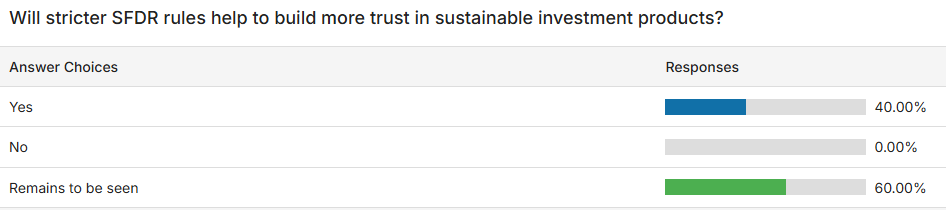
This week’s poll

Last week’s poll

AI data centres and grid costs

The growing demand from AI data centres is increasing pressure on United States-based electric grids while simultaneously accelerating investment in new power infrastructure. To keep up with expanding power needs from AI and data centres, US policymakers are progressively allowing utilities to charge customers upfront for grid infrastructure projects through Construction Work in Progress (CWIP) incentives. Critics believe the policy shifts financial risk from utilities to ratepayers, increasing near-term household electricity bills for projects that may take years to deliver benefits. Reuters found at least 40 US states allow some form of CWIP financing, roughly double the number from a decade ago, reflecting growing urgency around grid reliability and power demand growth. Georgia’s Vogtle nuclear project has become a cautionary example of CWIP-related backlash, as the state’s regulatory filings reveal that households in the state paid around $1,000 each in CWIP expenses since 2009 as power rates moved sharply higher. Major cost overruns and delays contributed to rising household power bills, ultimately resulting in growing consumer frustration surrounding energy affordability, including state voters unseating two Georgia public service commissioners following an anti-CWIP referendum. Grid cost concerns highlight rising sustainability and infrastructure apprehensions tied to AI expansion, including energy demand growth, grid reliability, and consumer affordability.

European Commission releases draft ESRS revisions

Sustainability must drive growth, not just protect value and comply

The corporate sustainability agenda in Europe is shifting from value preservation to value creation, Sustainable Views reports. While traditional approaches such as values-based responsibility, operational efficiency, and disclosure remain valid, they primarily protect existing value rather than generating new growth. The next phase requires commercialising sustainability as a strategic discipline. In EU business-to-business markets, sustainability creates value by helping customers reduce costs, meet procurement standards, and manage resource risks. However, success demands three critical shifts: starting with customer demand rather than disclosure, embedding sustainability in core business functions like product development and sales, and measuring commercial outcomes as rigorously as cost savings.

Companies must identify which customer segments actively seek lower-carbon, traceable, or durable solutions, then develop offerings around those needs. Tracking revenue from sustainable products, win rates in sustainability-focused tenders, and customer impact metrics also support the shift from value protection to creation. Compliance maintains market access and efficiency defends margins, but competitiveness depends on building products that customers actively choose. Sustainability will remain strategically relevant only when it drives commercial performance.

Defence stocks gain greater inclusion in ESG portfolios in 2025

ICYMI

  • S&P Global has released a research report providing a detailed overview of where the world stands on ISSB adoption, finding that 28 jurisdictions have adopted the standards, with a further 12 planning to do so in the future.

The views expressed in this article are those of the author(s) and not necessarily the views of FTI Consulting, its management, its subsidiaries, its affiliates, or its other professionals.

©2026 FTI Consulting, Inc. All rights reserved. www.fticonsulting.com


Related Articles

4th Annual Shareholder Activism State of the Market

September 8, 2025—4th Annual Shareholder Activism State of the Market Request Report The 4th Annual Shareholder Activism State of the Mark...

Use It or Lose It: U.S. Hydrogen Industry Must Act To Maintain Momentum

July 12, 2025—Key takeaway: Following the passage of the “One Big Beautiful Bill Act”, time is of the essence for hydrogen produce...

Quick Analysis: ‘One Big Beautiful Bill’ Drives More Gas and Batteries, Less Renewables

July 3, 2025—With the recent passage of the “One Big Beautiful Bill” (“OBBB” or the “Legislation”),[1] FTI Consulting’s...

FTI Consulting News Bytes – 10 July 2026

July 10, 2026—FTI Consulting News Bytes We begin this week’s News Bytes with the growing scrutiny of AI, as Meta faces criticism...

Global Public Affairs Newswire – 10 July 2026

July 9, 2026—Welcome to the latest instalment of FTI Consulting’s fortnightly Global Public Affairs Newswire. This week, we bring y...

Colombia: Electoral Risk as a Structural Corporate Variable

July 9, 2026—The Electoral Cycle as a Core Factor in Corporate Operations The PA Insights 2026 — Second Edition study, conducted by...