Global Public Affairs Newswire

Global Public Affairs Newswire – 10 July 2026

Market updates

NATO convenes, court decides, senate election in flux
  • Trump in Turkey: President Trump used this week’s NATO summit in Ankara to positively reaffirm America’s commitment to the alliance while simultaneously unsettling allies with comments on defense spending and U.S. foreign policy. During the summit’s opening day, Trump praised the unity of the alliance, threatened to halt trade with Spain, suggested the fragile peace agreement with Iran was effectively over, endorsed more aggressive Ukrainian military tactics against Russia, and renewed his interest in a U.S. acquisition of Greenland.
  • Supreme Court ends session: The Supreme Court concluded its term with two consequential decisions. In Trump v. Barbara, the Court rejected the administration’s attempt to narrow birthright citizenship, holding that children born in the United States to parents who are undocumented remain citizens under the Fourteenth Amendment. In NRSC v. FEC, the Court struck down limits on political parties’ expenditures coordinated with candidates, giving national party committees substantially greater freedom to direct resources toward competitive races and potentially strengthening the parties relative to independent super PACs.
  • Maine Senate election: The Democratic race in Maine has been thrown into uncertainty after nominee and populist progressive Graham Platner withdrew following allegations of sexual assault, which have been denied. The loss of key endorsements accelerated pressure for withdrawal, leaving the state Democratic Party to select a replacement candidate. This disruption could weaken Democratic prospects in what had been considered a prime opportunity to unseat Republican Senator Susan Collins.
"This week’s meeting showed NATO’s continuing dependence on American leadership as well as its vulnerability to Trump’s willingness to connect collective security with individual trade and unrelated bilateral disputes.”

Jackson Dunn
Head of Public Affairs, Americas

For more information about FTI’s Public Affairs services in the Americas, please contact [email protected].

Nigel Farage resigns from Parliament, triggering a by-election on his political future
  • Nigel Farage, leader of the populist right-wing party Reform UK, this week resigned his parliamentary seat of Clacton amid escalating scrutiny of his personal finances. Farage was already under investigation by the Parliamentary Commissioner for Standards — the watchdog that polices MPs’ conduct — over an undeclared £5 million gift from Christopher Harborne, a Thailand-based cryptocurrency billionaire, received before the 2024 general election. The pressure intensified sharply last weekend when a Sunday Times investigation revealed that Farage had also received undeclared benefits — including security, drivers, staff and the use of a Georgian townhouse near Buckingham Palace — from George Cottrell, a sometime aide jailed in the United States in 2017 for his role in a money laundering conspiracy. Parliamentary rules require MPs to declare any benefit over £300 connected to their political activities.
  • Farage’s response was characteristically combative. In an angry statement from Reform UK headquarters, he denounced the investigation and the media’s reporting on his finances as an establishment “witch hunt”, announced his resignation from Parliament, and declared that the voters of Clacton, not Westminster, would decide his fate at the resulting by-election, in which he plans to stand. The move was a bid to convert a standards problem into a popular mandate a high-profile contest fought on Farage’s favoured terrain of the people versus the establishment.
  • The gambit, however, has backfired. Rather than take the bait, all of the major parties are boycotting the contest, declining to field candidates and dismissing the by-election as a taxpayer-funded publicity stunt. Farage now finds himself campaigning not against Labour or the Conservatives but against the satirical candidate Count Binface, portrayed by comedian Jon Harvey. While Farage remains overwhelmingly likely to win, a walkover against a novelty candidate denies him the confrontation and the vindication that his resignation appeared designed to engineer.
  • Crucially, victory would not end Farage’s troubles. The standards investigation is merely paused while he is out of Parliament and resumes if he returns. Should it recommend a suspension of ten sitting days or more, UK law allows constituents to trigger a recall petition, and if 10% sign, a second by-election follows. The major parties have made clear they would contest a second Clacton by-election, meaning Farage could yet face the fight he wanted, months later and on far worse terms.
“The spectacle of a tussle between Nigel Farage and a bin will offer some picturesque moments over the summer. But it also marks a potentially critical inflection point for Reform UK, around whether Farage is an electoral asset or an electoral liability. Nobody expects Farage to lose, but equally it is difficult to see how he emerges with his reputation enhanced.”

Adrian Pascu-Tulbure
Senior Director, United Kingdom
For more information about FTI’s Public Affairs services in the United Kingdom, please contact [email protected].

China-EU economic relationship gains structure
  • On June 29, Chinese Commerce Minister Wang Wentao and EU Trade and Economic Security Commissioner Maroš Šefčovič held the first meeting of the China-EU Trade and Investment Consultation mechanism in Brussels, formally establishing the mechanism with four workstreams covering trade and investment balance, export controls, intellectual property, and WTO reform.
  • The launch comes amid mounting pressure in China-EU economic relations, including concerns over trade imbalances, export controls, industrial policy, cybersecurity rules, and procurement-related restrictions. Both sides exchanged market access lists and agreed to establish a joint monitoring mechanism to track trade flows, improve transparency, and manage frictions through more sustained technical engagement.
  • Beyond creating a new structure, the meeting also reinforced a policy framing of China and the EU as key trading partners seeking a more stable and balanced relationship. In parallel, China has kept member-state channels open, including through Wang’s meeting with German Federal Minister for Economic Affairs and Energy Katherina Reiche and Foreign Minister Wang Yi’s visit to the Nordic countries.
“The first meeting of the China-EU Trade and Investment Consultation mechanism is an attempt to give structure to a more contested economic relationship. It also reflects an effort to frame China-EU economic ties as economically significant and strategically relevant, but increasingly exposed to questions of balance, transparency, and friction management. For Beijing, the mechanism provides a venue to push back against EU economic-security tools while keeping market access, export controls, and supply-chain issues within a negotiable framework. For businesses, the signal is that China-EU economic ties remain important, but are becoming more institutionalized, conditional, and increasingly shaped by economic-security priorities.” 

Xu Zheng
Director, China

For more information about FTI’s Public Affairs services in China, please contact [email protected]

Ankara NATO Summit 2026
  • Ankara shifts NATO from targets to delivery – including on Ukraine. Allies used the Summit to show that last year’s commitment to invest 5% of GDP annually on defence by 2035 is beginning to translate into contracts, production capacity and priority capabilities. Leaders also pledged €70bn in military equipment, assistance and training for Ukraine and affirmed their sovereign commitments to sustain at least equivalent levels in 2027. The message to Washington was clear: Europe and Canada are taking on more responsibility, but within a “stronger Europe in a stronger NATO” that keeps the U.S. central to Allied deterrence. However, Iranian attacks on commercial shipping and renewed U.S. remarks on Greenland injected political and security tensions that risked overshadowing constructive Allied discussions.
  • NATO is building a more structured interface with industry. Allies made clear that transatlantic defence industrial cooperation is a critical part of NATO’s deterrence and defence. The new Strategy for Industry-NATO Cooperation, and the initiatives launched during the Summit such as the NATO Front Door for Industry, consolidated demand signals, the multinational Defence Critical Raw Materials initiative and the NATO Engine point to a more active NATO role in shaping demand, aggregating requirements and helping companies scale production. For industry, Ankara signals a clearer path to engage NATO beyond traditional procurement portals, especially in air and missile defence, deep strike, drones, counter-drone systems, ammunition, ISR, space, cyber, AI and critical supply chains.
  • Innovation, financing and Ukraine’s battlefield experience are becoming core Alliance business. The new Innovation Scale-Up Package links rapid adoption, private capital mobilisation and manufacturing capacity, while Ukraine is being positioned both as a recipient of urgent air defence support and as a source of battlefield-tested innovation for NATO. At the same time, initiatives such as the Defence, Security and Resilience Bank and the Multilateral Defence Mechanism show that Allies are looking beyond national budgets to unlock capital for defence production.
“This year’s NATO Summit was fundamentally about industry. Ankara showed that the Alliance’s new defence investment commitments are no longer just political targets, but are increasingly being translated into production capacity, procurement pipelines and capability delivery. It also gave the EU a more visible role inside the NATO framework; not as an alternative to the Alliance, but as the actor best placed to organise, finance and industrialise Europe’s contribution to NATO’s defence posture. The key question is still whether Allies can mobilise capital, aggregate demand and scale production fast enough to match the level of ambition they have set.” 

Dr. Beatriz Cózar Murillo
Senior Director, Brussels

For more information about FTI’s Public Affairs services in the EU, please contact [email protected]

Protests slow ethanol ramp-up
  • India will be adopting a more measured approach toward ethanol-blended petrol (EBP) beyond the current 20% (E20) due to the consumer and political backlash around automotive readiness and consumer acceptance. Car users, experts, and influencers report fuel efficiency drops with E20, as well as damage to rubber hoses, O-rings, seals, and gaskets, leading to fuel leaks.
  • After India’s rapid nationwide rollout of E20, which was achieved five years ahead of its original target, the government is now aiming for E85 and flex-fuel (FFVs). With more than 80% of vehicles on Indian roads predating the April 2023 E20 compliance standards, concerns over fuel efficiency, compatibility and maintenance costs have fueled public debate. The lack of lower-blend fuel alternatives at retail outlets has further amplified consumer concerns, while broader questions around the impact of ethanol production on crop choices and food security continue to shape the policy discussion.
  • For global automakers, component manufacturers and energy companies, the government’s phased approach provides lead time to recalibrate engines, adapt manufacturing processes and strengthen supply chains. The transition is also creating opportunities for aftermarket suppliers of retrofit components, fuel-system materials, and specialized lubricants for India’s large legacy vehicle fleet. However, deep consumer anxiety is delaying new vehicle purchases and is getting more consumers to consider electric vehicles (EVs), for both commercial and personal use, a possible unexpected tailwind from the crisis.
“India's accelerated rollout of E20 highlights the complexities of balancing long-term energy security and sustainability objectives with consumer readiness and industry adaptation. It also underscores the evolving landscape for automakers, who are simultaneously navigating tighter efficiency standards, higher ethanol blending requirements and the transition toward electric mobility. The silver lining: the E20 crisis may become a tailwind for increased EV adoption and charging infrastructure.”  

Kerban Rajdeo
Director, India

For more information about FTI’s Public Affairs services in India, please contact [email protected].

Le Pen cleared to run for French Presidency after appeals court reduces ban
  • A French appeals court on Monday reduced Marine Le Pen’s sentence in the EU funds embezzlement case, lifting the immediate ban on holding public office that had threatened her 2027 presidential run. The far-right National Rally (RN) leader confirmed hours later that she would stand in the election.
  • The court upheld Le Pen’s conviction but cut the public office ban to 15 months, which she has already served. She faces a three-year prison sentence, with two years suspended and one under house arrest with an electronic tag, alongside a €100,000 fine.
  • Le Pen announced that party president Jordan Bardella, 30, previously her designated replacement, would serve as prime minister should the RN win. She also confirmed she would challenge the ruling before the Cour de Cassation, France’s supreme court, a move which she argues allows her to begin campaigning without wearing the electronic tag.
“Le Pen’s presidential run reshapes the dynamics of the 2027 race. Many had anticipated that Bardella would step in as the RN’s candidate, and he had spent recent months positioning the party closer to the mainstream right on economic policy to broaden its appeal among conservative voters. Le Pen brings considerable experience from three presidential campaigns, but her interventionist economic views could make it harder for the RN to attract the conservative voters Bardella had been courting and could give both the centre-right and mainstream conservatives an opening to reclaim that ground. Her conviction also makes her an easier target for her opponents, although voter fatigue and protest votes against the establishment will play in her favour.”

Gregory Grellet
Senior Director, Paris
For more information about FTI’s Public Affairs support in Paris, please contact [email protected].

Government set to align 2026 policy address with the city’s first five-year plan
  • The Hong Kong government has launched a public consultation for the 2026 Policy Address alongside the consultation for the city’s first Five-Year Plan, deviating slightly from the annual policymaking routine. The consultations will run in parallel, with the government considering feedback from both exercises simultaneously.
  • Although much attention is currently focused on the city’s inaugural Five-Year Plan, it is the annual Policy Address that will introduce the specific policy measures, funding initiatives, and legislative priorities with the most immediate implications for businesses, while leveraging the Five-Year Plan as the overarching strategic framework. The government has said that Principal Officials will conduct extensive consultation with businesses, professional groups, district organizations, political parties, and members of the public before finalizing both documents later this year.
  • The closer integration between the two policy processes also reflects the government’s efforts to embed longer-term planning into Hong Kong’s governance framework. Recent discussions between the Chief Executive and university leaders highlighted the proposed university town within the Northern Metropolis as an example of this approach, bringing together higher education, research, industry, and technology development under a single strategic vision.
““The concurrent consultation on the Policy Address and Hong Kong's first Five-Year Plan signals the introduction of a more structured medium-term planning framework that is likely to provide businesses with greater visibility over policy priorities and implementation over multiple years. For companies operating in Hong Kong, particularly those in financial services, technology and infrastructure, this creates an opportunity to engage earlier in the policy development process as the government seeks to align annual initiatives with longer-term economic and industrial objectives. Understanding how the two documents interact will become increasingly important for corporate planning and stakeholder engagement.”

Seulah Han
Managing Director, Hong Kong and South Korea

For more information about FTI Consulting’s Public Affairs services in Hong Kong, please contact [email protected].

Presidential handover collapses as De la Espriella suspends transition
  • On July 7, President-elect Abelardo De la Espriella ordered his transition team, led by Vice President-elect José Manuel Restrepo, to suspend the handover with the outgoing government of Gustavo Petro, ending the working process that had been running since late June under 22 sectoral commissions ahead of the August 7 inauguration. De la Espriella framed the move as an institutional obligation rather than a political choice, saying he could not “legitimize” a government he described as the most corrupt in the country’s history, and accused Petro and 2026 runner-up Iván Cepeda of advancing a plan to remain in power. Petro rejected the characterization, said his government would not be insulted, and declared that the handover would continue “with the people” regardless of the suspension, while repeating unproven claims of fraud in the June election.
  • The rupture followed several days of rising rhetoric rather than a single trigger: Petro’s continued refusal to recognize the election result, his description of Cepeda as the legitimate winner, a call for demonstrations on July 20, and a lawsuit, filed by a former government official and backed by Petro’s supporters, asking the Consejo de Estado for precautionary measures that could delay De la Espriella’s inauguration. Legal analysts cited in Colombian media have characterized the suit’s prospects as narrow given the Consejo Nacional Electoral’s earlier rejection of a related challenge, but its mere existence, combined with Petro’s public statements, has hardened the incoming administration’s position that the outgoing government is acting in bad faith.
  • The practical effect is that the technical work of the handover — the fiscal, health, and security assessments the incoming government had said would document “hundreds of irregularities,” and which were being conducted with the Contraloría General as observer and IDB financing — is now paused, with government-side commission head Germán Ávila and Restrepo trading public statements about who bears responsibility. Colombian legal commentary published notes the handover is a legal obligation under transition law regardless of political friction, meaning a resumption — potentially under more adversarial and less coordinated conditions — remains the likelier near-term path unless the dispute over the election’s legitimacy itself escalates further before August 7.
“The suspension of the handover moves Colombia's transition from a contested-but-functioning process to an open institutional standoff, with both sides now making public accusations — coup on one side, illegitimate election on the other — that neither has yet substantiated through formal channels. For companies and financial institutions, the near-term priority shifts from monitoring the content of fiscal, health, and security findings to monitoring whether the handover resumes at all before August 7, and through what mechanism — court order, negotiated restart, or continued impasse. Investors should treat the coming weeks as a period of elevated event risk around institutional continuity, distinct from the underlying policy questions the handover was designed to clarify, and should watch the Consejo de Estado's handling of the pending lawsuit as the most concrete near-term signal of how this resolves.”

Jorge Del Castillo
Managing Director and Head of Strategic Communications, Colombia

For more information about FTI Consulting’s Public Affairs services in Colombia, please contact [email protected].

South Africa positions itself as Africa’s digital hub as global technology investment accelerates
  • South Africa is strengthening its position as a leading digital investment destination, with President Cyril Ramaphosa highlighting growing confidence from global technology companies, including Google, Amazon Web Services and Microsoft, in the country’s digital economy. Speaking at the Google Cloud Summit, President Ramaphosa noted that major technology firms are expanding their presence in South Africa as the country seeks to build a secure, inclusive and innovation-driven digital future. These investments form part of the government’s broader agenda to accelerate digital transformation, expand digital infrastructure, improve connectivity, and harness technology as a driver of economic growth, job creation, and social development.
  • The announcements land on a foundation of genuine scale: South Africa hosts approximately 70 percent of Africa’s hyperscale data centre capacity and is the continent’s largest cloud market, with Amazon Web Services and Microsoft also operating local cloud regions. Notably, the President’s framing signals the government’s evolving posture toward hyperscalers. He linked the summit directly to Operation Vulindlela and the creation of digital public infrastructure and called on Google and other cloud providers to help South Africa develop sovereign digital and AI capabilities, referencing the state’s Sebowa Cloud platform hosted at the CSIR (Council for Scientific and Industrial Research). He also stressed that digital growth must be accompanied by “guardrails” protecting privacy, cybersecurity and national control over critical data and technology systems — an indication of the regulatory direction of travel on data sovereignty and AI governance.
  • The continued expansion of global technology firms in South Africa signals confidence in the country’s potential to anchor Africa’s digital transformation. If supported by ongoing investments in skills development, energy reliability, connectivity, and enabling regulation, the growth of the digital economy could strengthen competitiveness, create new employment opportunities, improve government efficiency, and expand access to digital services. The developments reinforce South Africa’s ambition to become a regional technology hub while ensuring that digital transformation translates into broader economic participation and inclusive growth.
“The inaugural Google Cloud Summit confirms that South Africa is no longer simply courting digital investment. It is competing for it on the strength of real assets, including the continent’s largest cloud market and roughly 70 percent of its hyperscale capacity. What has changed is the terms of engagement. Government is now pairing its welcome with clear expectations on digital sovereignty, skills and inclusion, which will shape the regulatory environment hyperscalers operate in. The companies that succeed will be those that engage policymakers early and treat sovereignty and skills commitments as central to their licence to operate, rather than as corporate social investment.”

Lelo Skosana
Head of Public Affairs, South Africa

For more information about FTI’s Public Affairs services in South Africa, please contact [email protected].

Suite of new reforms commence as FY 2026-27 kicks off
  • The Australian government rolled out new legislative and regulatory measures that commenced in line with the new financial year on 1 July. New policies including family-focused reforms such as the extension of paid parental leave to six months and the introduction of Payday Super, requiring employers to pay superannuation (Australia’s mandatory pension scheme) at the same time regular wages are paid..
  • Healthcare changes include mandating that pathology and imaging results are uploaded to the online government-run platform. Two new agencies started in line with the new financial year: the National Environmental Protection Agency and a Veteran Wellbeing Agency.
  • 1 July is a key moment in the phased implementation of Australia’s Scams Prevention Framework, with the Australian Financial Complaints Authority’s role as the single external dispute resolution scheme for scam complaints under the Framework, effective from this date.
  • For Australian businesses, the permanent $20,000 instant asset write-off, and forthcoming National EPA signal a shift toward greater compliance and regulatory centralisation. The incoming Food and Grocery Code, that aims at preventing very large retailers from engaging in excessive pricing of grocery products for retail sale also commences. This is a significant development given the sustained public and political scrutiny of Australia’s supermarket pricing practices.
  • These reforms align with the Albanese government’s pro worker and consumer stance, and should be viewed as a continuation, rather than the last step in the government’s reformist agenda.
“In addition to the administration that comes with the new financial year, 1 July 2026 signals the commencement of a diverse array of reforms impacting Australia’s economy. Everything from an extension of Australia’s parental leave scheme, to the ban on supermarket price gouging to the establishment of the national EPA commence, amongst many others with the new financial year. It is imperative that business and stakeholders with an Australian presence are fully aware of the impact of any of these reforms on their operations, are prepared from a compliance perspective and fully understand their new obligations.”

Miriam Phillips
Senior Director, Australia

Lobito corridor strengthens Africa’s trade connectivity as critical minerals competition intensifies
  • The US$753 million Lobito Corridor Railway Project has reached financial close, marking a major milestone for one of Africa’s most strategically significant transport and trade infrastructure initiatives. The project will rehabilitate and extend the Lobito Corridor, linking the Port of Lobito in Angola to critical mining regions in the Democratic Republic of the Congo and Zambia. For Angola, the railway is central to its ambition of transforming into a regional logistics and trade hub, strengthening the country’s role in facilitating exports, diversifying its economy beyond oil, and improving connectivity across Southern and Central Africa.
  • Beyond its transport significance, the Lobito Corridor has emerged as a strategically important geopolitical and economic asset. Backed by the United States, the project aligns with Washington’s efforts to deepen engagement with Africa’s critical minerals sector and reduce reliance on China-dominated supply chains as global demand for transition minerals continues to grow. By improving the movement of copper, cobalt and other strategic minerals from Angola, the Democratic Republic of the Congo and Zambia to international markets, the corridor is expected to strengthen regional value chains, enhance supply chain resilience, facilitate greater intra-African trade, and reinforce Angola’s role as a strategic gateway in the global critical minerals economy.
  • This signals growing international confidence in large-scale African infrastructure as a driver of long-term economic transformation. For Angola, the corridor presents an opportunity to strengthen its position as a regional gateway for trade and investment, creating new economic activity around logistics, manufacturing and mineral processing. More broadly, the project is expected to enhance regional connectivity, reduce transport costs, facilitate cross-border trade, and unlock new opportunities for industrial development. It also illustrates how strategic infrastructure is increasingly becoming a focal point of global competition for critical minerals and influence, placing Angola at the centre of an evolving geopolitical and economic landscape.
“The Lobito Corridor is significant because it brings together two of the most important forces shaping Africa's economic future: the push for deeper regional trade connectivity and the global race to secure critical mineral supply chains. For Angola, it strengthens the country's position as a strategic gateway linking Southern and Central Africa to international markets. For global partners, particularly the United States, it provides a credible alternative route into Africa's copper, cobalt and transition mineral economy at a time when supply chain diversification has become a geopolitical priority. The corridor is therefore more than transport infrastructure; it is a platform for trade, industrial development and strategic influence. The test now is whether Angola and its neighbours can convert that strategic position into processing, industrial capacity and jobs, rather than remaining a transit route for other economies' value chains.”

Lelo Skosana
Head of Public Affairs, South Africa

U.S. Tariffs, Bolsonaro family rift, and 2026 electoral dynamics in Brazil
  • The United States has proposed a 25% tariff on Brazilian goods under Section 301, with a final USTR decision expected by 15 July; Senator Flávio Bolsonaro traveled to Washington to argue against the measure, warning that imposing broad tariffs at this moment would harm Brazil’s economy and could backfire politically by strengthening President Lula’s reelection bid. While Flávio advocated for a more targeted approach – framed in his statements as opposition to blanket tariffs and openness to narrow, case-by-case measures – Brazil’s federal government stressed that he was the only major Brazilian participant in the hearing who did not explicitly condemn the proposal, instead asking for postponement until after the October vote to avoid electoral distortion. Despite his intent to decouple the bolsonarist movement from the tariff narrative, Flávio’s intervention failed to ease concerns in Brazil’s political and economic spheres, leaving the association between bolsonarismo and U.S. trade pressure effectively intact and reinforcing narratives that the Bolsonaro family is aligned with Washington’s coercive trade agenda.
  • A public dispute between Michelle Bolsonaro and Flávio Bolsonaro has exposed deeper tensions within the right-wing movement over leadership, influence, and succession. Michelle accused Flávio of disrespecting her and disregarding her political support after disagreements over party alliances in Ceará and the role of the PL women’s wing, describing a humiliating phone call and subsequently resigning from her position as head of the party’s women division. The clash highlights contrasting strategies: Michelle has built symbolic leadership and grassroots mobilization among religious and conservative voters, while Flávio pursues a more institutional, party- organization-based approach focused on electoral machinery; the episode underscores the challenges movements built around a dominant leader face when political power must be redistributed among successors without a single central coordinator. 
  • Current polling scenarios for the 2026 presidential election show Lula leading in the first round and either slightly ahead or statistically tied with Flávio in a potential runoff, depending on the survey and timing; the race remains highly competitive and within a narrow margin, with alternative right-wing and opposition candidates remaining in the low single digits and not disrupting the Lula–Flávio binary. For Flávio Bolsonaro, the main challenges include overcoming high rejection levels, consolidating support amid internal tensions within Bolsonarism over succession and leadership, and expanding beyond his core base to reach undecided voters; recent controversies, including the family rift and scandals involving alleged ties to a disgraced banker, have produced limited shifts in overall voter preferences, suggesting that many voters remain strongly aligned with their existing political positions as the 2026 election approaches.
“Brazilian diplomacy is becoming increasingly exposed to public scrutiny in a scale unprecedented in the country’s recent history, as foreign policy has become one of the central themes of the 2026 electoral campaign. The volatility surrounding these debates directly affects strategic decision-making, with partisan and ideological politics increasingly shaping state policy, especially in trade and geopolitical alignment. At the same time, internal disputes within the right-wing camp highlight a broader challenge in Brazilian politics: the difficulty of producing viable political successors. In recent years, the left has struggled to articulate a successor project independent of Lula, who remains the most viable electoral option. On the right, despite greater internal fragmentation, the viability of potential candidates remains closely tied to Jair Bolsonaro’s approval and political endorsement. Currently, this support is divided between his son, Senator Flávio Bolsonaro, and his wife, former first lady Michelle Bolsonaro, whose public dispute has further exposed the challenges of succession within the movement.” 

Raquel Rocha
Senior Director, Brazil

For more information about FTI’s Public Affairs services in Brazil, please contact [email protected].

Spain - Budget Defeat Could Mark the Start of Spain’s Pre-Electoral Cycle
  • On 7 July, the Council of Ministers approved the non-financial spending ceiling and the 2027 budgetary stability targets, referring both to Parliament. The proposed fiscal path sets the general government deficit at 1.8% of GDP, with targets of 1.5% for the central State, 0.2% for Social Security and 0.1% for the autonomous communities.
  • The proposal reproduces, without modification, the same deficit targets tabled by the Government in December 2025, which Congress rejected at the time. The fiscal path therefore returns to Parliament under the same terms as in the previous vote.
  • Parliamentary approval of the stability targets is a necessary step before the Government can move forward with the 2027 General State Budget. A vote is expected at the extraordinary plenary on 14 July, with a second sitting reserved for 23 July in the event of an initial rejection.
"The politically salient dimension lies beyond the vote itself. Rejection is the probable outcome, and the Government is expected to frame it accordingly: an Executive that sought to deliver a budget, obstructed by an opposition bloc of PP and Vox acting alongside Junts. The more consequential reading is that the defeat could serve as a deliberate point of departure. Deprived of the procedural gateway to a 2027 Budget, and with general elections in any case constitutionally due next year, the Government may judge the political value of the defeat to exceed that of a narrow win, using it to open the electoral sequence and prepare the ground for a potential early call. Prime Minister Sánchez has publicly ruled out an anticipated election, so this remains a scenario to monitor rather than a base case; nonetheless, the incentive structure is aligned, and the coming weeks warrant close attention."

Gonzalo Conde
Director, Spain
For more information about FTI’s Public Affairs services in Brazil, please contact [email protected].

Expert Analysis

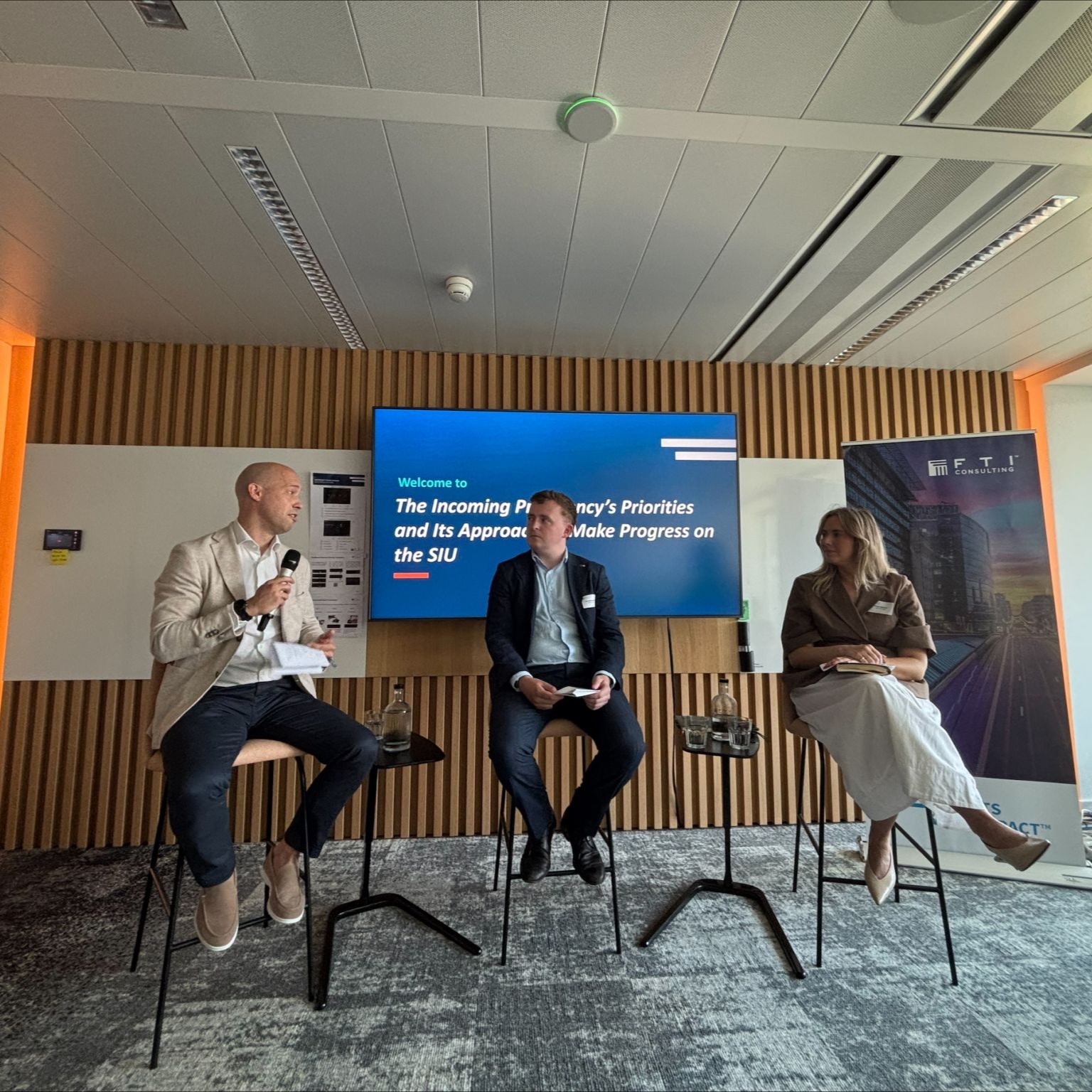
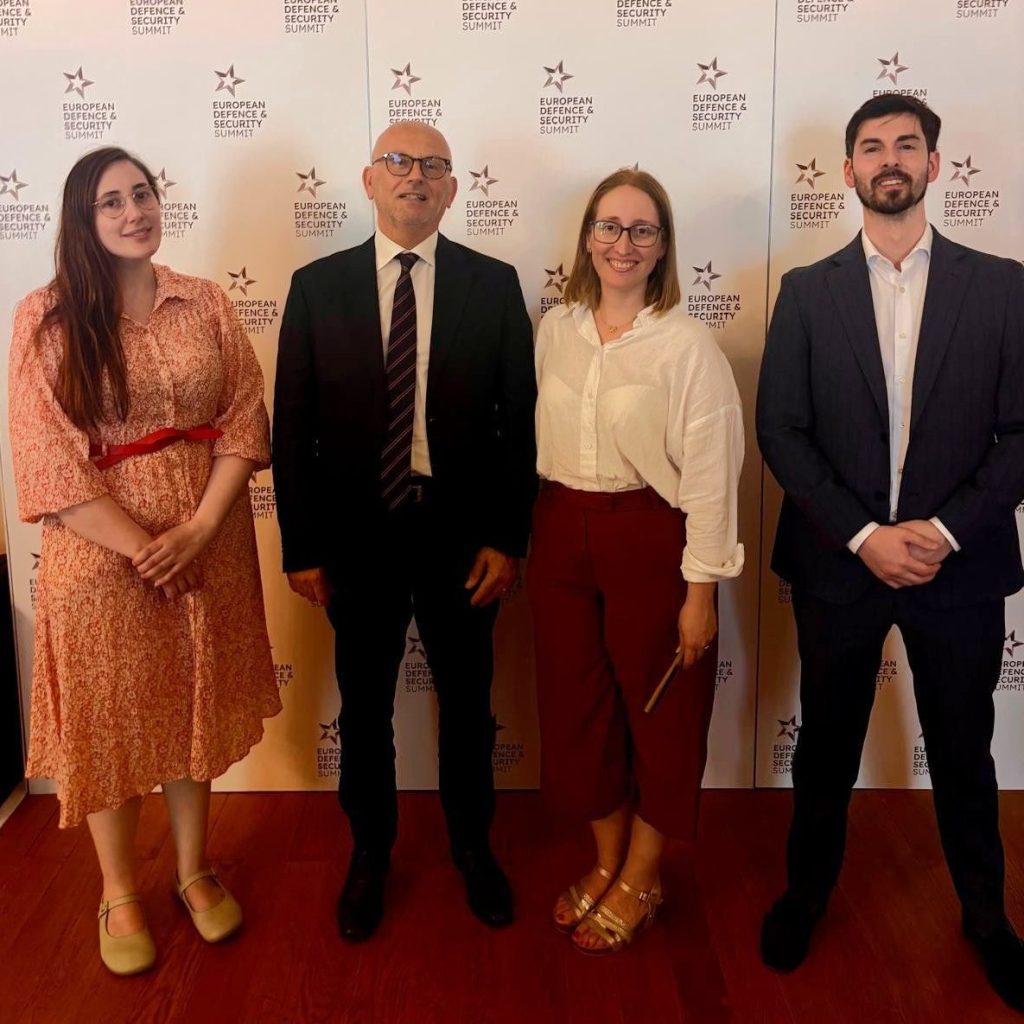
European Defence and Security Summit

Our Defence & Aerospace experts in Brussels attended the European Defence and Security Summit last week, engaging with senior stakeholders from EU institutions, national governments, industry leaders and the broader defence community to discuss the future of European defence and security.

As one of Europe’s key forums for defence policy and industrial strategy, the Summit provided an important opportunity to discuss the priorities shaping the sector – from capability development and procurement reform to industrial cooperation and the evolving European defence architecture.

View here >>

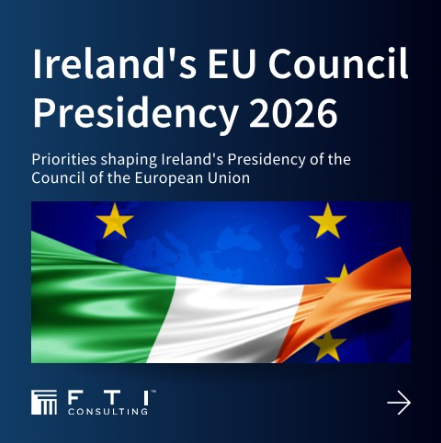
Ireland’s EU Presidency: Key Priorities

On Wednesday 1st July, Ireland assumed the Presidency of the Council of the European Union, marking an important milestone for both Ireland and the EU. This Presidency will be one to watch. With a strong focus on implementation and reform, it presents a meaningful opportunity to shape Europe’s competitiveness, resilience, and cohesion at a pivotal moment for the Union.

FTI Consulting’s Public Affairs experts in Dublin have outlined the top priorities shaping Ireland’s Presidency of the Council of the European Union and what they mean for policymakers, businesses, and stakeholders across Europe.

View here >>

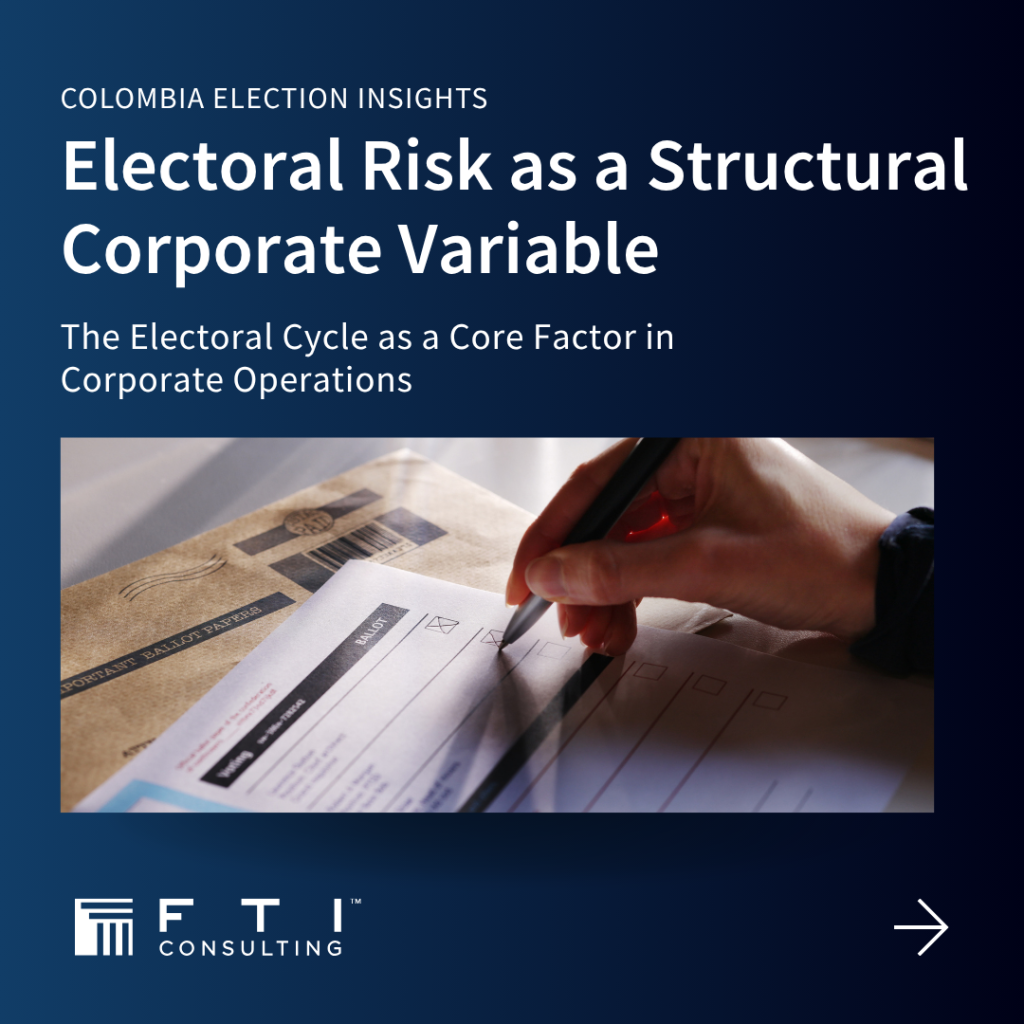
Colombia Election Insights

In Colombia, electoral risk is no longer a challenge that emerges during every election cycle, it has become a permanent factor influencing regulation, business operations, and corporate legitimacy.

In the second edition of our Colombia PA Insights, our experts examine why awareness alone isn’t enough and how organizations can strengthen their stakeholder engagement and institutional resilience to successfully navigate Colombia’s 2026 electoral cycle.

View here >>

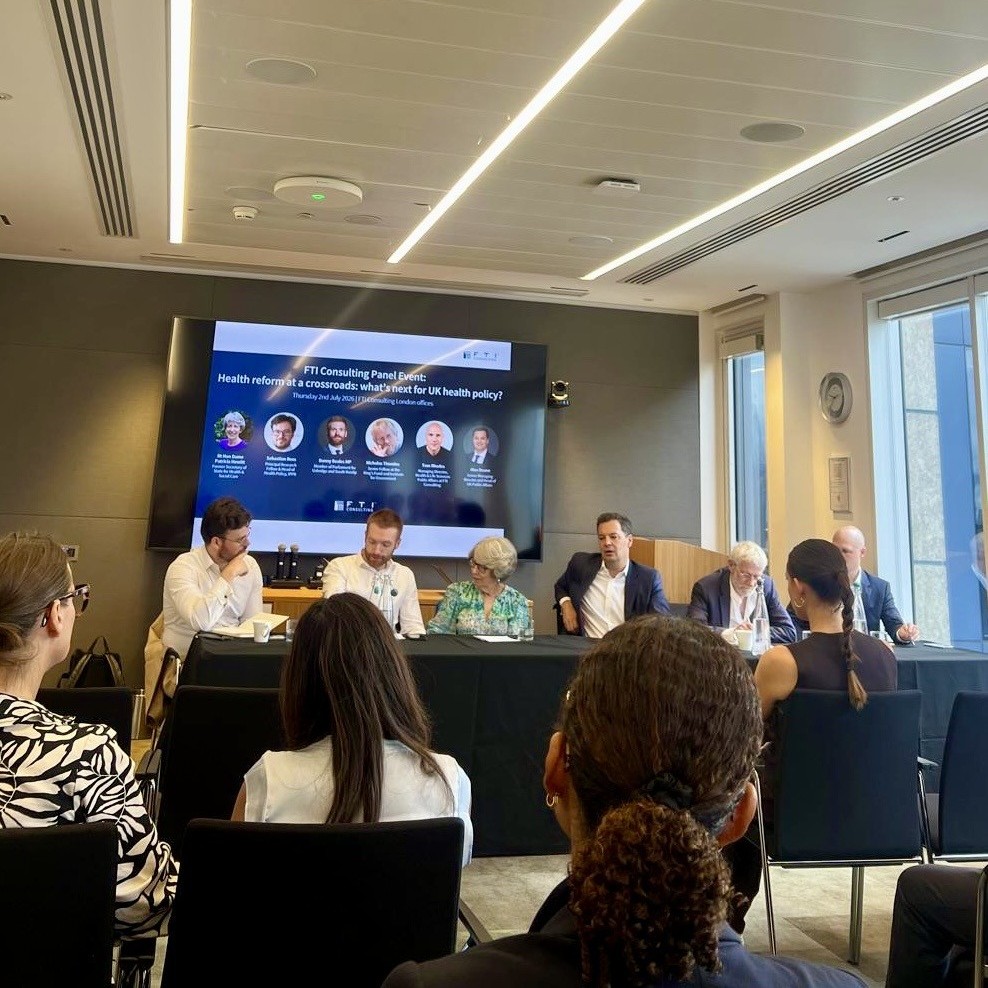
UK Health Reform Panel Event

A new chapter in NHS reform is underway. The NHS Modernisation Bill aims to transform care and deliver the 10 Year Health Plan. 

Against this backdrop, we were thrilled to host a health policy panel event at our London offices last week to explore the opportunities, challenges and priorities shaping the next phase of NHS reform, and what these changes mean for the health and life sciences industry. 

Sign up to our Public Affairs list here >>

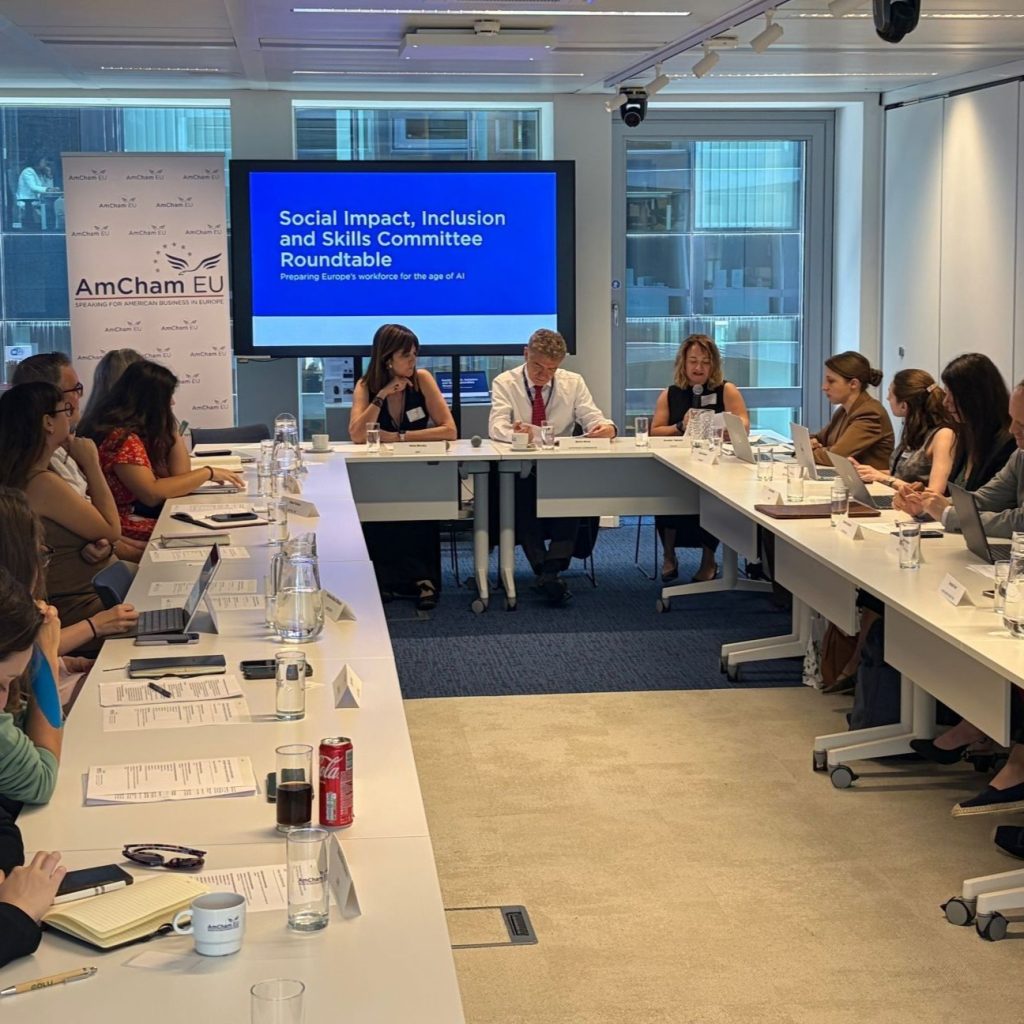
American Chamber of Commerce to the European Union Roundtable

Brussels-based Director Monica Adami recently spoke at American Chamber of Commerce to the European Union (AmCham EU)’s roundtable on ‘Preparing Europe’s Workforce for the Age of AI,’ joined by Director-General Mario Nava and MEP Idoia Mendia.

Monica shared her insights on Europe’s AI gap being human, not technical. Only ~20% of EU businesses used AI in 2025, the SME gap is widening, and adoption ranges from 35-42% in the Nordics to just 5-9% in parts of Eastern and Southern Europe. Closing it means building AI literacy, giving SMEs hands-on support, and making the case sector by sector, not with generic advice.

View here >>

Ireland’s EU Presidency: Financial Services in Focus

We were delighted to host leading industry representatives alongside the incoming Irish Presidency for an insightful discussion on its priorities and its objectives concerning the Savings and Investments Union with Emma Moyles, FCCA and Ben Cunningham, Attachés at the Irish Permanent Representation to the EU.

The conversation offered a timely opportunity to reflect on what this Presidency might mean, not just for Ireland, but for Europe more broadly, from the financial services perspective. 


View here >>

Upcoming Elections

  • 28 June: Provincial elections (New Caledonia) 
  • 2 July: Parliamentary elections (Algeria) 
  • 19 July: Presidential Election (São Tomé and Príncipe) 
  • 13 August: General Election (Zambia) 

To be added to the distribution list for the Global PA Newswire, or for further information on the dedicated Public Affairs team at FTI, please contact [email protected].

The views expressed in this article are those of the author(s) and not necessarily the views of FTI Consulting, its management, its subsidiaries, its affiliates, or its other professionals.

©2026 FTI Consulting, Inc. All rights reserved. www.fticonsulting.com

Related Articles

4th Annual Shareholder Activism State of the Market

September 8, 2025—4th Annual Shareholder Activism State of the Market Request Report The 4th Annual Shareholder Activism State of the Mark...

Use It or Lose It: U.S. Hydrogen Industry Must Act To Maintain Momentum

July 12, 2025—Key takeaway: Following the passage of the “One Big Beautiful Bill Act”, time is of the essence for hydrogen produce...

Quick Analysis: ‘One Big Beautiful Bill’ Drives More Gas and Batteries, Less Renewables

July 3, 2025—With the recent passage of the “One Big Beautiful Bill” (“OBBB” or the “Legislation”),[1] FTI Consulting’s...

FTI Consulting News Bytes – 10 July 2026

July 10, 2026—FTI Consulting News Bytes We begin this week’s News Bytes with the growing scrutiny of AI, as Meta faces criticism...

Colombia: Electoral Risk as a Structural Corporate Variable

July 9, 2026—The Electoral Cycle as a Core Factor in Corporate Operations The PA Insights 2026 — Second Edition study, conducted by...

ESG+ Newsletter – 09 July 2026

July 9, 2026—This week’s poll With sustainability under political pressure and growing calls for change, what’s the right...