The Street’s View of the Hottest New Activist Investor: The Trump Administration
Street Supportive of Government Investment, Looking for Follow-On Opportunities.
From taking stakes in MP Materials and Intel to its recent investment in L3Harris Technologies, the Trump administration has embraced a more active role in investing in public companies to advance national priorities. Against this backdrop, FTI Consulting conducted a survey to better understand how investors are interpreting increased governmental involvement and what they expect from public company leadership in response. The findings are intended to help Boards anticipate market reactions and navigate the evolving intersection of government investment and corporate strategy.
View From the Street
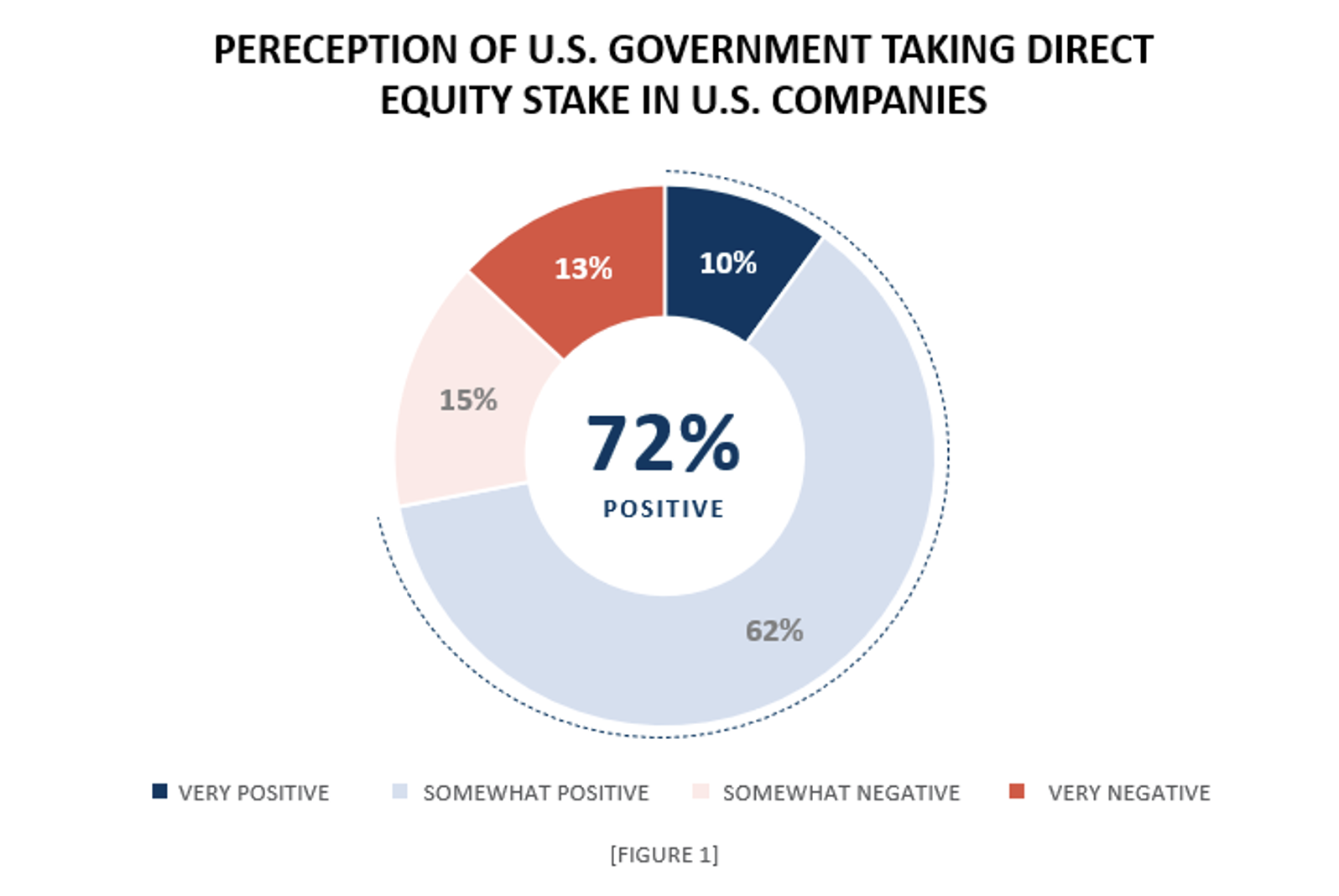
The survey found that investors view government investment in publicly-traded companies as overwhelmingly positive. [See Figure 1] This may be explained by several factors, such as increased demand for the stock, heightened visibility, and reduced risk of negative consequences from turning down the investment. However, policymakers in Washington are uneasy about its broader implications. “If the definition of socialism is political control over the means of production, welcome to the great socialist country of the United States of America,” Connecticut Representative Jim Himes said in comments on the floor of the U.S. House of Representatives in November.1
Source FTI Consulting
The tension between market enthusiasm and policy skepticism is mirrored in academic circles as well. A recent survey of top finance economists by the Kent A. Clark Center for Global Markets at the University of Chicago Booth School of Business found that more than 40% believe government ownership of equity stakes is measurably detrimental to both corporate performance and corporate governance. Notably, several respondents cautioned that the impact of government ownership remains difficult to isolate and quantify.
Investors appear inclined to follow the Trump administration’s lead and invest in the same companies, viewing federal involvement as a source of added stability and conviction. Respondents to our survey noted that government backing “signals stability and lowers company investment risk,” while public-sector capital “enhances credibility for investors evaluating a company.” Several also pointed to the clarity that these investments can offer, noting that the specific companies that the government invests in make national priorities “more evident.”
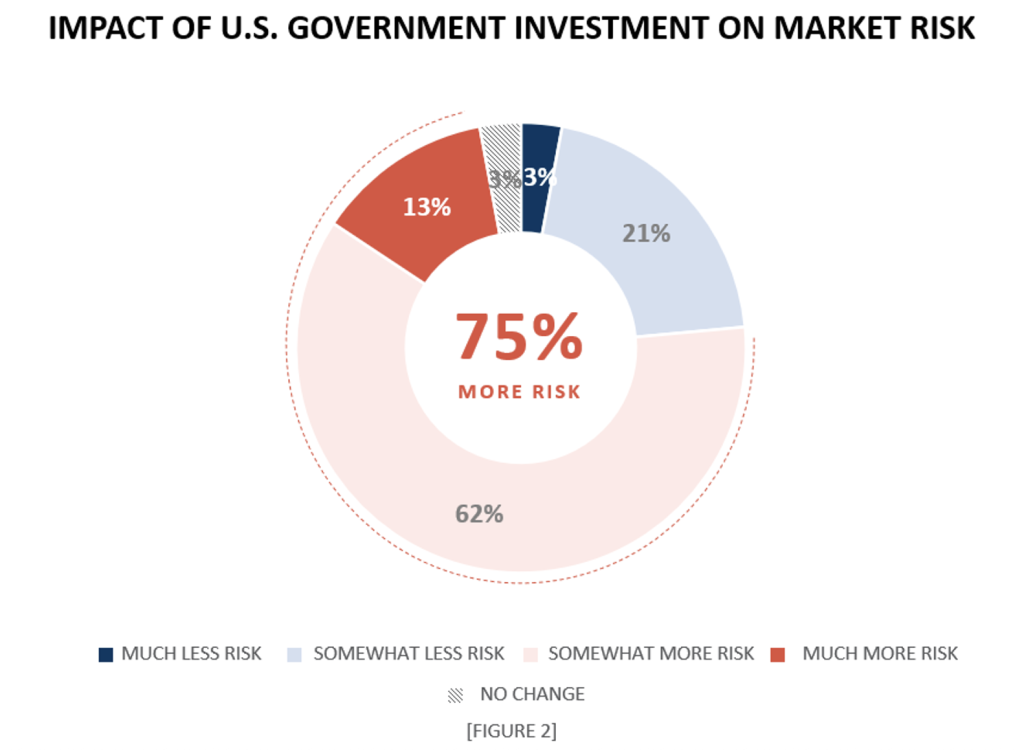
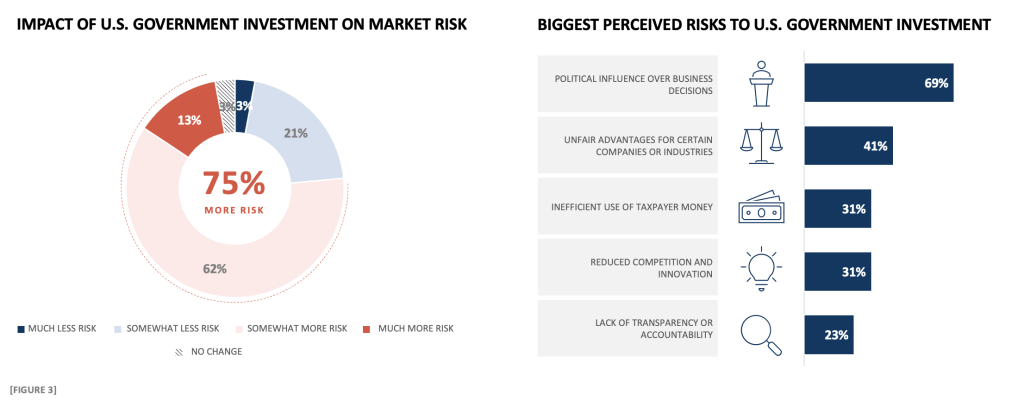
Still, investor optimism is tempered by an awareness of trade-offs. Even as investors view government backing as a stabilizing force, many also believe that it creates incremental risk with likely political influence over business decisions. [See Figure 2] As one respondent noted, “government involvement may reduce company decision-making flexibility,” while another cautioned that “bureaucratic influence can make companies slower to adapt.” Investors found investment priorities and research and innovation agendas as the areas most likely to be affected [See Figure 3], with one warning that “oversight pressures could limit innovation and risk-taking abilities.”
Source FTI Consulting
Source FTI Consulting
National Security Sectors Viewed as Best Fit for Government Investment
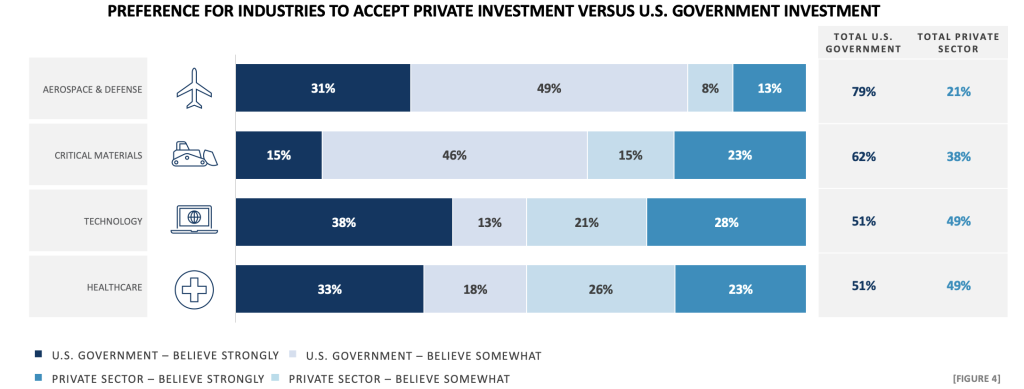
The Trump administration took a notable step earlier this year when it announced it would invest $1 billion in L3Harris Technologies’ growing rocket motor business. U.S. Commerce Secretary Howard Lutnick foreshadowed the approach in August when he said the Trump administration was weighing equity stakes in major defense contractors.2 Investors appear aligned with this strategy. In our survey, aerospace and defense emerged as particularly well suited to government investment, with 79% of respondents favoring public capital over private funding in the sector. [See Figure 4]
Investor support for government investment also extends to critical minerals, where more than 60% of respondents believe critical minerals firms should accept government investment over private sector investment. [See Figure 4] 3
Investors would also encourage companies across both industries to proactively pursue government investment as a source of capital. According to the survey, they are broadly optimistic about the outlook for both the aerospace and defense and critical minerals industries.
Source FTI Consulting
Technology Industry Seen as Prime Investment Target Despite Skepticism
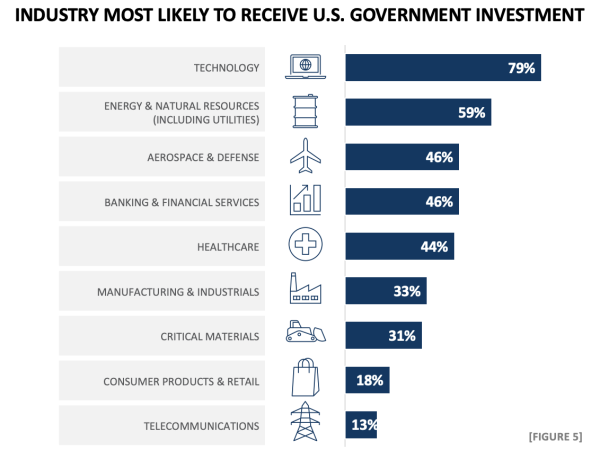
One of the Trump administration’s most prominent investments to date has been Intel, where it took a 10% stake as part of its broader strategy to strengthen domestic chip manufacturing.4 The administration’s focus on the technology industry is reflected in investor expectations: survey respondents overwhelmingly point to technology as the most likely recipient of government investment over the next 12 months (79%), well ahead of energy (59%), aerospace and defense (46%), and banking (46%). [See Figure 5] Investors are broadly optimistic about the future of the technology industry and expect it to benefit most from government investment.
Source FTI Consulting
However, investors are largely split on whether they would prefer technology companies take private sector (49%) or government (51%) capital, with a majority believing these companies should not actively solicit government investment. [See Figure 4]
Guidance for Responding to a Trump Administration Investment
- Frame it as a strategic opportunity: Position the investment as a deliberate choice your company is making, rather than an external intervention imposed upon it. By anchoring the narrative in proactive decision-making, the company reinforces its credibility and avoids the perception that the Board lacked vision and resources to create shareholder value.
- Clearly explain the benefits: Articulate how the investment translates into tangible, long-term shareholder value rather than near-term optics. Detailing the specific ways that the government investment strengthens the business helps anchor the narrative in fundamentals.
- Highlight alignment with long-term priorities: Demonstrate how the investment supports your company’s strategic goals and growth plans. Management should link the capital to priorities already articulated to investors, underscoring that the government investment is additive to, not a departure from, the company’s long-term vision.
Adhering to this framework will help ensure that potential government investment delivers maximum value to all shareholders. Ultimately, despite concerns, investors signaled in the survey a clear willingness to follow government money.
Methodology: FTI Consulting conducted a survey between November 21 and December 9, 2025 among n=39 institutional investors and analysts who were either current, prospective, or prior shareholders in at least one of the following industries: technology, healthcare, critical materials, and aerospace & defense.
Related Expertise
| The views expressed in this article are those of the author(s) and not necessarily the views of FTI Consulting, its management, its subsidiaries, its affiliates, or its other professionals. ©2026 FTI Consulting, Inc. All rights reserved. www.fticonsulting.com |
References
[2] Kevin Breuninger. “Trump Pentagon weighing equity stakes in defense contractors like Lockheed, says Lutnick,” CNBC (8/26/25). https://www.cnbc.com/2025/08/26/trump-pentagon-equity-stakes-in-defense-contractors.html.
[3] Spencer Kimball, “The Trump administration equity portfolio is growing. These are the investments so far,” CNBC (2/7/26), https://www.cnbc.com/2026/02/07/trump-administration-equity-portfolio-grows-these-are-investments-so-far.html.
[4] Dan Primack. “Trump: Intel agreed to sell 10% stake to U.S. government,” Axios (8/22/25), https://www.axios.com/2025/08/22/trump-intel-stake-government.