The Autonomy Perception Gap: How Americans’ Perception of Autonomous Technology Creates a Strategic Opportunity for Industry Leaders
The American public isn’t opposed to autonomous technology, but many Americans either don’t know enough, haven’t heard enough, or haven’t heard the right arguments for why they should embrace it. In a survey conducted by FTI Consulting of 1,001 nationally representative sample of U.S. adults (18+) on Americans’ perception of self-operating systems, the results showed that:1
- Comfort levels with autonomous technology vary dramatically by use case, creating an opportunity for drone delivery and more trusted forms of autonomous technology to pave the road for more ambitious use cases.
- Americans are concerned about the safety of autonomous technology and how humans are remaining in the loop to oversee autonomous systems. The growing body of research that shows the clear safety benefits of autonomous technology isn’t resonating with most Americans.
- However, Americans are starting to become more comfortable with autonomous technology in workplace settings and, in certain cases, are ready to embrace this technology if it benefits their households’ bottom lines. But a significant gap remains to building broad-based support for widespread adoption.
Would use drone delivery if faster and cheaper
Source: FTI Consulting survey
Cite safety risks as a top concern
Uncomfortable riding in a self-driving vehicle
The Use Case Spectrum
Source: FTI Consulting survey
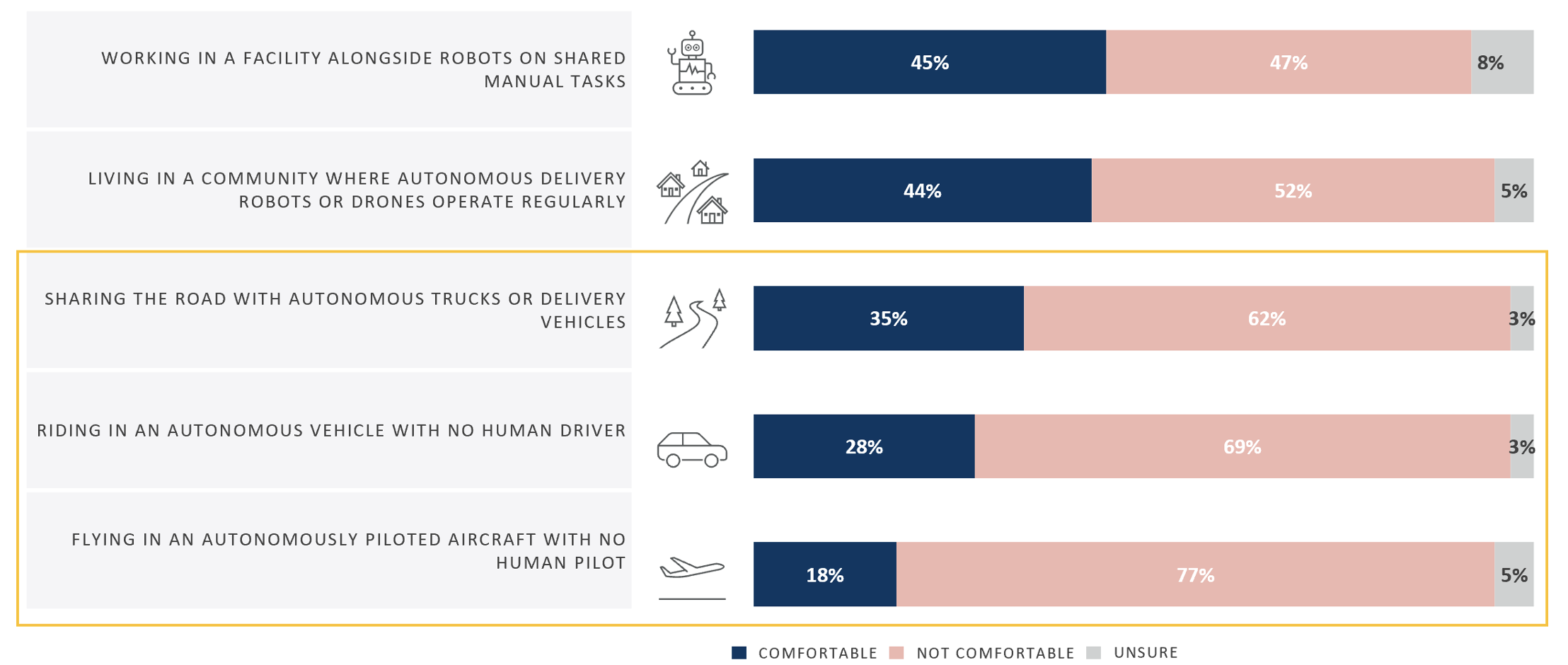
The country is split on working alongside robots in a shared facility: 45% comfortable versus 47% uncomfortable, indicating that the workforce automation debate is unresolved in the public’s mind. Companies operating in this space have a solid opportunity to shape opinion through direct experience and transparent engagement.
The numbers shift when personal safety is more directly at stake. Only 28% of respondents said they are comfortable riding in a self-driving vehicle, while 69% are uncomfortable. For autonomous aircraft with no human pilot, discomfort rises to 77%.
The lack of comfort with autonomous flight seems counterintuitive given commercial aviation already operates with extensive automation—most modern aircraft fly themselves for most of a flight—yet the idea of removing the pilot entirely triggers deep resistance. This suggests the barrier is psychological and emotional, not purely technical, and will require a fundamentally different communications approach than other autonomy categories.
Companies operating in lower-perceived-risk categories—last-mile delivery, warehouse automation—have a window right now to build public familiarity and confidence. That foundation becomes essential as the same companies, or their peers, scale into higher-stakes applications.
KEY TAKEAWAY
Public comfort with autonomous technology tracks directly to perceived personal risk. Companies should sequence their public engagement accordingly—building trust through lower-stakes applications before asking the public to accept higher-stakes ones.
What Drives Comfort—and What Drives Concern
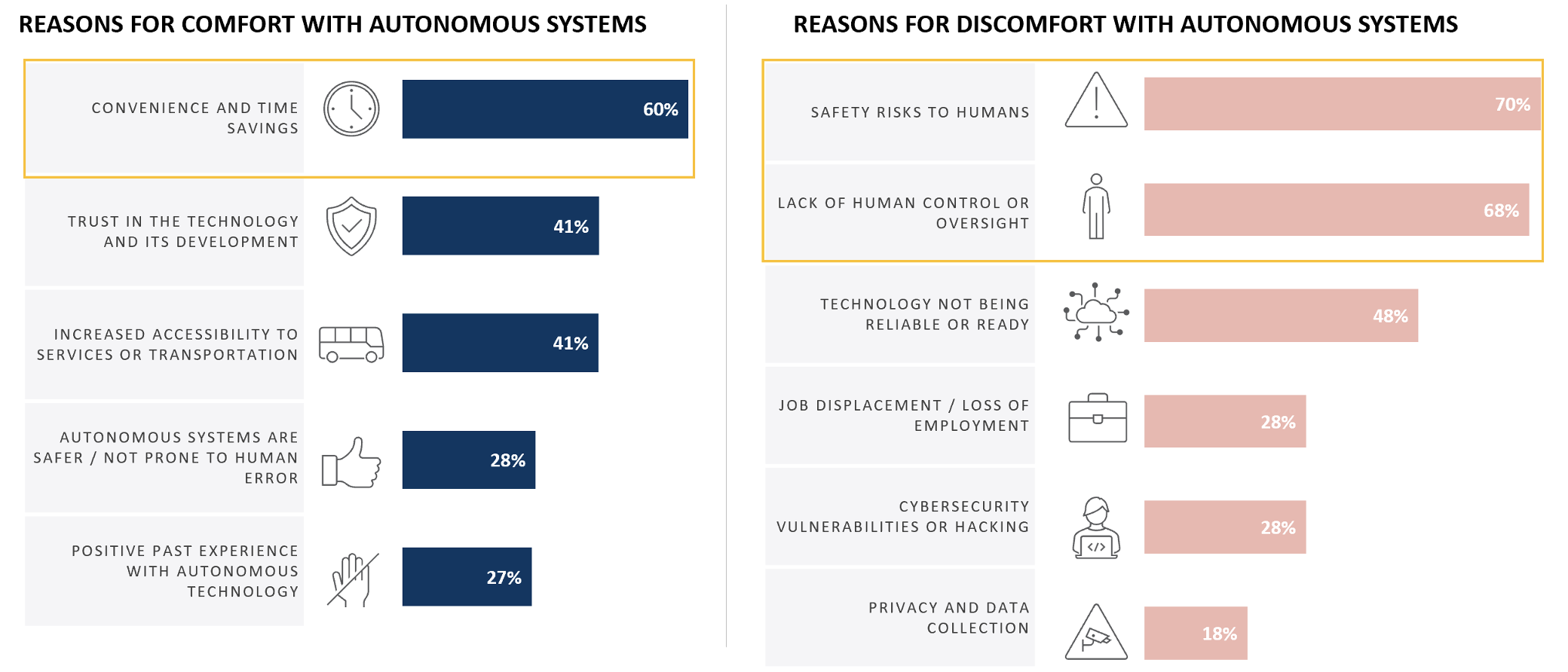
Seven in 10 respondents who were uncomfortable with one or more autonomous systems selected safety risks to humans as a top concern, and nearly seven in 10 selected lack of human control or oversight. Doubts about the reliability and readiness of autonomous technology followed at 48%.
Source: FTI Consulting survey
Privacy and data collection ranked last among predefined options at just 18%. The autonomy sector has invested heavily in privacy frameworks and data governance, but the public’s center of gravity is elsewhere. They want to know whether these systems will hurt someone and what happens when no human is in the loop.
Among those who expressed comfort, the top driver was practical: 60% cited convenience and time savings. Trust in the technology (41%) and increased accessibility to services or transportation (41%) followed. Only 28% pointed to autonomous systems being safer than humans.
Convenience is what draws people in. Safety arguments alone are not driving adoption—but safety concerns are the primary barrier to adoption. Effective communications strategies need to address both simultaneously by leading with the practical value of the technology while directly and consistently addressing the safety questions that keep people skeptical.
When forced to choose a single biggest concern, 39% selected safety risks and 17% selected accountability when something goes wrong. Together, those two responses account for more than half of all respondents. Job displacement, at 15%, was lower than might be expected. This doesn’t mean workforce concerns are irrelevant—they are real and deeply emotional, and labor advocates will use them to paint companies as indifferent to workers. But the data indicates that safety and accountability are the primary barriers to public acceptance.
KEY TAKEAWAY
Safety and accountability—not privacy, not job loss—are the dominant public concerns about autonomous technology. Companies that establish clear accountability frameworks and communicate them in plain language will differentiate themselves from competitors still speaking in engineering terms.
The Safety Perception Opportunity
Only 21% of respondents believe self-driving vehicles currently on the road are safer than human drivers. Nearly half—47%—believe they are less safe. And 15% said they don’t know enough to have an opinion.
Those numbers get worse in challenging conditions. In poor weather, the share believing AVs are less safe rises to 50%, with only 19% saying they’re safer. Across all conditions, 15–17% of respondents said they lack enough information to form a view—a population that represents both the persuadable middle and the clearest indicator of where industry communications efforts need to focus.
Independent safety data increasingly shows that autonomous vehicles outperform human drivers on key safety metrics. If the industry’s safety record is as strong as the data suggests, the gap between that reality and public perception represents one of the largest communications opportunities in the sector. Closing it requires moving safety narratives out of technical reports and into the communities where these systems operate—through local demonstration programs, third-party validation, and partnerships with trusted community voices.
KEY TAKEAWAY
The gap between AV safety data and public perception is wide—and that gap is an opportunity. The 15–17% who say they don’t know enough to form an opinion are reachable through local engagement, third-party validation, and consistent, human-scale storytelling.
Drone Delivery: Speed and Cost Are Winning the Argument
When asked whether they would use a drone delivery service if it were faster and cheaper than ground delivery, 61% said yes. Only 28% said no, and 11% were unsure.
Speed of service and lower cost are attracting broad public interest in a way that few other autonomous applications can match. When autonomy is presented as a practical upgrade to something people already do—receive packages—rather than a replacement for something that involves personal risk, acceptance rises significantly.
This openness should be treated as a strategic asset. It is also fragile. Early missteps—safety incidents, persistent noise complaints, heavy-handed regulation—could erode it quickly. Companies in this space should protect their current public favorability with the same rigor they apply to operational scaling: invest in community relations, proactively address noise and privacy concerns, and demonstrate responsiveness to local feedback before problems become public.
The Workforce Question
Forty percent of respondents believe autonomy and robotics will mostly replace jobs and reduce wages. Only 18% believe they will mostly change jobs and improve safety and working conditions. A third said both equally.
The “job replacement” narrative has taken hold with the public, even as economic research on the actual impact of automation remains mixed. Jobs and layoffs are deeply emotional, and even if employment statistics don’t ultimately reflect a dramatic shift, labor advocates and elected officials will use an emotional appeal to pressure companies that appear indifferent to their workforce.
Companies that get ahead of this need to do more than announce retraining programs. They need to demonstrate, specifically and publicly, what workforce transition looks like in practice: how many workers are being retrained, into what roles, at what cost, and with what outcomes. Vague commitments to “upskilling” aren’t enough. Companies that show concrete results will protect both their reputation and their stakeholder relationships. Those that don’t risk becoming a political target—and eroding the trust of employees, investors, and communities that is essential to long-term growth.
The Window Is Open—but Not Moving
More than half of respondents (52%) said their opinion of autonomous technology has not changed in the past year. Among those whose views did shift, 27% became more positive and 21% became more negative—a modest net positive.
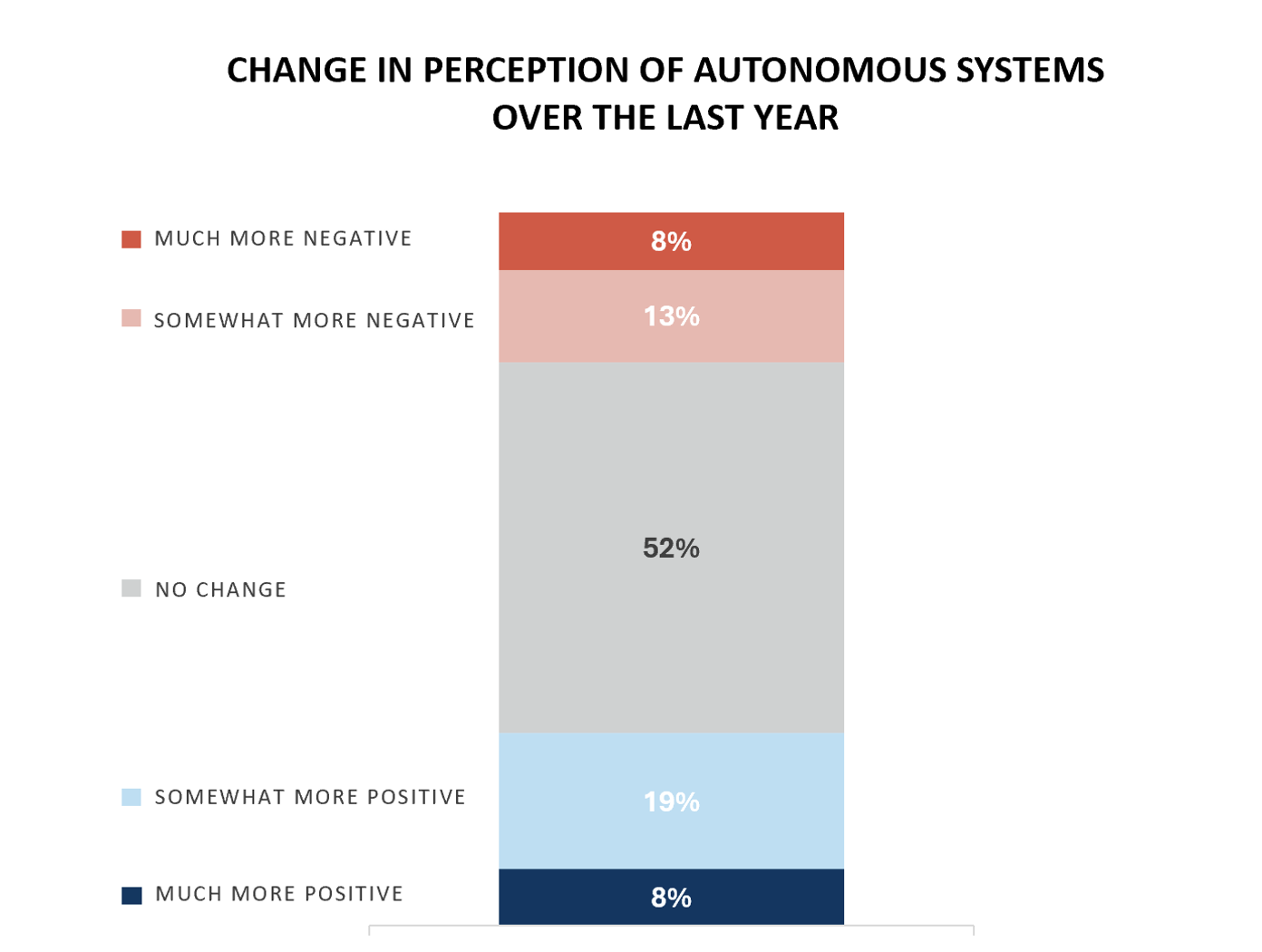
The dominant story here is stasis. Despite billions in R&D investment to advance the technology and substantial media coverage of that progress, the public’s views have not meaningfully moved. The persuadable middle remains large but reaching it requires a different approach—one built on local engagement, third-party validation, and practical demonstrations of value rather than incremental corporate announcements.
The lack of change in public opinion indicates perception toward the industry isn’t hardening, creating an opportunity for the industry to shape that conversation. But that window will not stay open indefinitely, particularly as autonomous systems become more visible in daily life and inevitably face the public scrutiny that comes with scale.
What This Means and What Autonomous Industry Leader Can Do About It
This survey points to five areas where companies deploying autonomous technology can take concrete action:
Build accountability frameworks before you need them
Safety (39%) and accountability (17%) together account for more than half of respondents’ single biggest concern about autonomous systems. Establish a clear, public accountability framework that answers the question every consumer is asking: when something goes wrong, who is responsible and what happens next? Publish it. Communicate it in community meetings, not just in regulatory filings. Companies like Waymo have begun publishing safety reports—the sector needs more of this, and from independent sources that the public trusts.
Go local
The 15–17% of respondents who said they don’t know enough about AV safety to form an opinion are unlikely to be reached through national media campaigns. They require community-level engagement in the specific markets where deployment is planned or underway: town halls with local officials, ride-along demonstrations, partnerships with local universities and community organizations, and dedicated local spokespeople who become familiar faces. Local credibility drives faster approvals, stronger stakeholder support, and more durable social license.
Sequence public engagement by perceived risk
The comfort gradient in this data—45% comfortable with warehouse robots, 28% with self-driving cars, 18% with autonomous aircraft—should directly inform communications strategy. Build public familiarity and trust through lower-perceived-risk applications first. Use the credibility earned in delivery and logistics to support the case for passenger vehicles and, eventually, aviation. Even within specific industry applications, sub-industry applications that have low-risk to human safety can help create the permission structure for more ambitious rollouts. Each application needs its own earned trust; it doesn’t transfer automatically.
Show, don’t announce, workforce transition
With 40% of the public already believing autonomy will primarily replace jobs, industry leaders are playing defense. General commitments to retraining are not sufficient. Publish specific data: how many employees are being transitioned, into which roles, with what investment, and at what retention rate. Partner with community colleges and trade programs and publicize those partnerships. The companies that demonstrate concrete workforce outcomes will earn the regulatory and community goodwill that protects long-term growth—and avoid becoming a case study in public backlash.
Protect the drone delivery advantage
Sixty-one percent willingness to use drone delivery is the strongest positive signal in this survey. Treat that favorability as a strategic asset: invest in community relations programs in early-deployment markets, proactively address noise and visual-impact concerns, and establish rapid-response protocols for the inevitable incidents that will test public patience. Companies that get community engagement right in drone delivery will set the template for how the broader autonomy sector earns public trust.
The Bottom Line
This survey data doesn’t describe a public hostile to autonomous technology. It describes a cautious one—one that evaluates autonomous technology with nuance, and one that remains open to persuasion on practical terms.
The companies that communicate as though they are earning a social license—through local presence, clear accountability, demonstrated workforce investment, and consistent engagement at the community level—will be the ones that scale. Public trust has to be treated as a strategic priority, not a downstream consequence of good engineering.
METHODOLOGY
This survey was conducted by FTI Consulting among a nationally representative sample of 1,001 U.S. adults (18+) across all 50 states. The sample was balanced by age, gender, and geography. The margin of error is approximately ±3.1 percentage points at the 95% confidence level. Respondents were asked about their comfort with various autonomous systems, concerns about autonomous technology, perceptions of self-driving vehicle safety, willingness to use drone delivery, views on employment impacts, and changes in opinion over time.
Contact Us

MARK RANNEBERGER
Senior Director
[email protected]

JAMES CONDON
Managing Director
[email protected]

JOHN WHITCOMB
Senior Managing Director
[email protected]
References
[1] Methodology: This survey was conducted by FTI Consulting among a nationally representative sample of 1,001 U.S. adults (18+) across all 50 states. The sample was balanced by age, gender, and geography. The margin of error is approximately ±3.1 percentage points at the 95% confidence level. Respondents were asked about their comfort with various autonomous systems, concerns about autonomous technology, perceptions of self-driving vehicle safety, willingness to use drone delivery, views on employment impacts, and changes in opinion over time.