Quick Analysis: ‘One Big Beautiful Bill’ Drives More Gas and Batteries, Less Renewables
Senior Managing Director, Energy & Natural Resources, Srategic Communications
[email protected]
With the recent passage of the “One Big Beautiful Bill” (“OBBB” or the “Legislation”),[1] FTI Consulting’s Power Market Advisory team modeled the impact of the latest bill text on U.S. power markets over the next 10 years. Specifically, the analysis forecasted market outcomes across the Eastern Interconnection, the largest of the three major power grids in the United States. The team simulated a scenario with the OBBB enacted (“OBBB Case”) and compared the results to the most recent quarterly update of FTI Consulting’s Power Market Outlook (“Reference Case”). [2]
Overall, the Legislation would prove a big winner for natural gas and battery storage, while the buildout of additional renewable technologies like wind and solar would be significantly curtailed.
Here are five key takeaways from the analysis:
Electricity Demand Surges - Driven by AI
U.S. electricity demand has been largely flat since 2007, but it is now projected to surge, primarily driven by artificial intelligence (AI) and data centers. The U.S. Department of Energy estimates that data centers consumed approximately 4% of total U.S. electricity consumed in 2023, with demand expected to double or even triple by 2028.[3]
Natural Gas Is a Big Winner
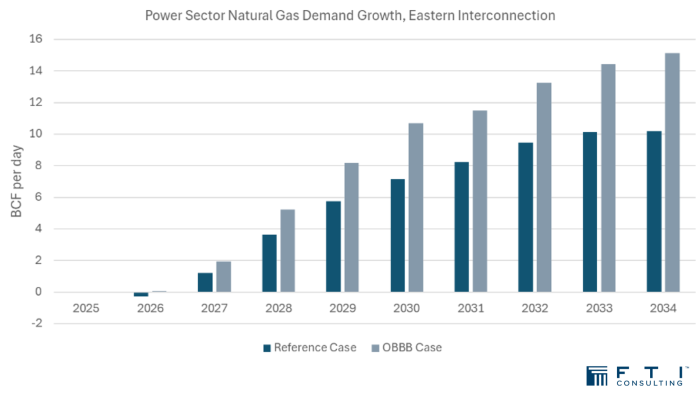
Total natural gas capacity is 53 GW higher in the OBBB Case by 2034, increasing natural gas fuel use in the power sector by more than 9,000 billion cubic feet (BCF) over the next 10 years, nearly 8% higher than Reference Case projections. This is equal to an average annual increase of 2.5 BCF/day in natural gas demand relative to the Reference Case.
Battery Storage Is Also a Big Winner
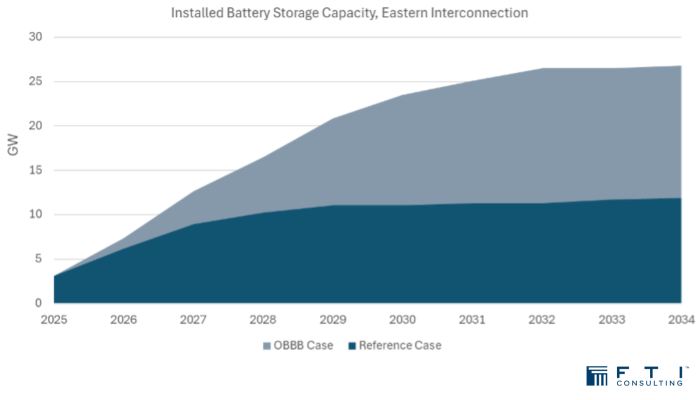
Total battery storage capacity is 15 GW higher in the OBBB Case, with a marked shift toward longer duration storage (4-6 hours). For comparison, total utility-scale battery storage capacity in the United States was over 26 GW in 2024, according to the U.S. Energy Information Administration, with less than 3 GW sited in the Eastern Interconnection footprint.[4]
Major Hit to Wind and Solar
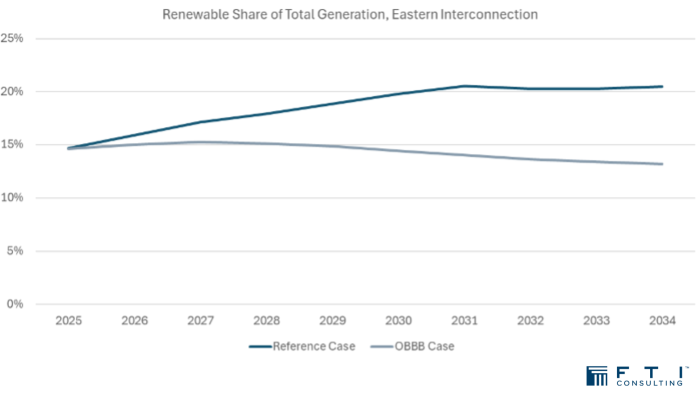
Total wind capacity is 26 GW lower in the OBBB Case by 2034, with no new wind built over the next decade that isn’t already in the development stage. For solar, the impact is even bigger. Total solar capacity is 118 GW lower in the OBBB case and by 2029, growth is practically non-existent. In the 2030’s, renewables’ share of total generation begins to steadily decrease.
Advanced Nuclear Expands
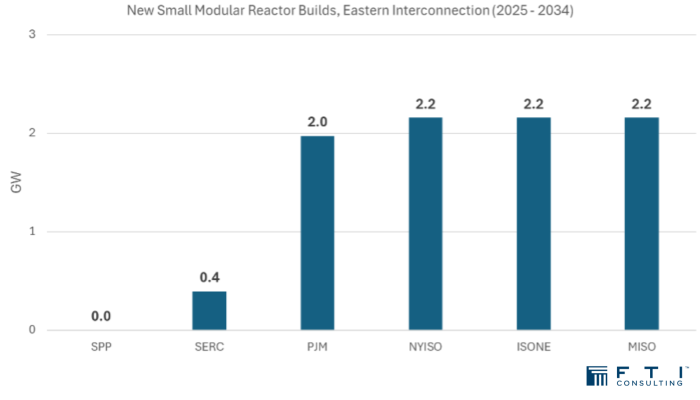
Total nuclear capacity is 9 GW higher in the OBBB Case by 2034, compared to no new builds, outside of announced re-powerings at Palisades and Three Mile Island, in the Reference Case. All incremental capacity comes in the form of advanced nuclear (i.e. small modular reactors, or SMRs), with the majority sited along the east coast in NYISO, ISONE, and PJM, according to the analysis. Supply chain constraints on new natural gas construction and/or pipeline constraints on fuel supply could induce additional nuclear growth over this period.
Related Expertise
References
[1] “H.R.1 – One Big Beautiful Bill Act,” 119th Congress (2025-2026), https://www.congress.gov/bill/119th-congress/house-bill/1/text.
[2] Robert Kaineg, Mitchell DeRubis, Dan Goodwin, “U.S. Power Market Outlook Service Sheet,” FTI Consulting (March 28, 2024), https://fticommunications.com/wp-content/uploads/2024/03/FTI-Consultings-U.S.-Power-Market-Outlook.pdf
[3] Arman Shehabi, Alex Newkirk, Sarah J. Smith, Alex Hubbard, Nuoa Lei, Md Abu Bakar Siddik, Billie Holecek, Jonathan Koomey, Eric Masanet, Dale Sartor, “2024 United States Data Center Energy Usage Report,” Lawrence Berkeley National Laboratory (December 20, 2024), https://escholarship.org/uc/item/32d6m0d1.
[4] “U.S. battery capacity increased 66% in 2024,” U.S. Energy Information Administration (March 12, 2025), https://www.eia.gov/todayinenergy/detail.php?id=64705.
The views expressed herein are those of the author(s) and not necessarily the views of FTI Consulting, Inc., its management, its subsidiaries, its affiliates or its other professionals.
FTI Consulting, Inc., including its subsidiaries and affiliates, is a consulting firm and is not a certified public accounting firm or a law firm.
FTI Consulting is an independent global business advisory firm dedicated to helping organizations manage change, mitigate risk and resolve disputes: financial, legal, operational, political and regulatory, reputational and transactional. FTI Consulting professionals, located in all major business centers throughout the world, work closely with clients to anticipate, illuminate and overcome complex business challenges and opportunities. ©2025 FTI Consulting, Inc.
All rights reserved. fticonsulting.com