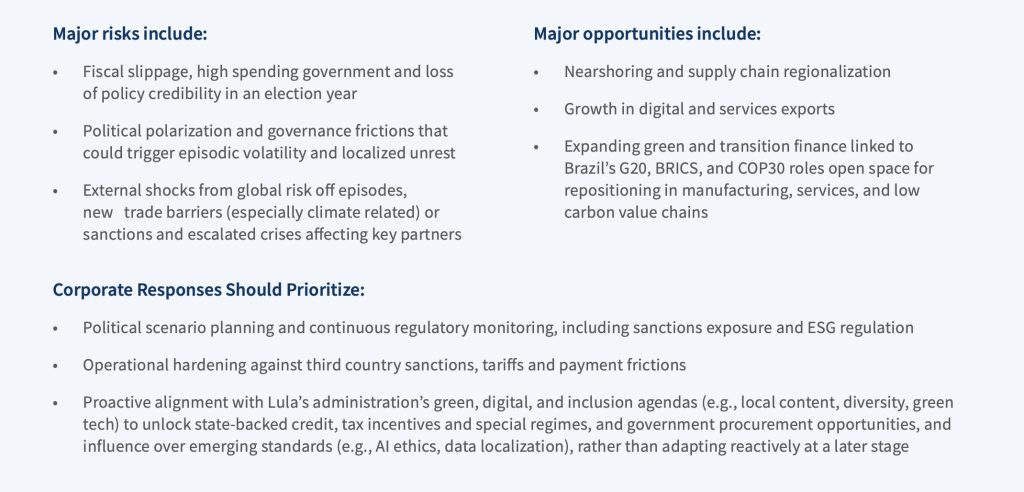
Brazil enters 2026 as a relatively resilient, opportunity‑rich middle power in a more volatile global system, combined with modest growth, persistent fiscal and political risks, in an election year that sharpens both down and upside scenarios for investors.
Get our 2026 Latin America Insights in your inbox – Subscribe Now
Geopolitics and Alignments
2026 begins amid intensified competition reshaping trade, technology, conflicts, and finance. Regional occurrences such as Venezuela’s generate spillovers in migration, increased informal cross‑border trade through Roraima, and risk perception that often lead investors to treat Latin America as a correlated risk block despite heterogeneous fundamentals. Brazil’s “multi‑alignment” posture – balancing US security ties, Chinese infrastructure finance, European green standards, BRICS diplomacy and navigating EU-Mercosur delays driven by EU sectorial objections – may be used by investors as a hedge against alignment shocks such as sanctions, secondary tariffs, and tech bans.
This maturity, forged through decades of economic and diplomatic heft, UN reform advocacy, and crisis mediation, turns Brazil into a bridge, rejecting bloc discipline while securing market access across poles amid transactional US-China rivalry and Russia’s energy weaponization. Investors should see Brazil as a hub for regional supply chains and as an entry point to the wider Latin American market, particularly for investors in manufacturing, logistics, agribusiness, energy, and digital services. And it preserves diversified revenue streams even as global securitization fragments supply chains and payment systems.
Moreover, this “multi-alignment” creates ambiguous signals to investors such as how to navigate supply-chain ambiguity around dual-use tech, critical minerals export controls, and diversification hedge and ESG compliance. Multinationals benefit from Brazil’s “both/and” posture – accessing Chinese capital and tech while maintaining Western compliance pathways – but must navigate resulting policy crosses (e.g., selective GSI endorsement, sanction resistance). This is an attractive market for investors with a high appetite threshold and willingness to monitor policy developments closely. Effective public affairs strategies, regulatory engagement, and reputation management are therefore essential to maintain operational stability, manage political risk, and support sustainable long-term growth.
Domestic Policy and 2026 Elections
Tax reform moves from design to implementation in 2026, testing the new consumption‑tax system, credits, exemptions, and transition rules while advancing a green‑industrial agenda focused on digitalization, energy transition chains, and logistics improvements.[1] For companies, this means a gradual easing of some “Brazil cost” factors but a denser regulatory environment with stronger ESG, climate, and technology requirements that reward well‑capitalized, compliance‑savvy players. Democratic institutions such as the Superior Electoral Court (TSE), Supreme Court, and Congress remain functional but highly politicized being stress‑tested by polarization and contestation of electoral results, anchoring basic legal certainty but also driving regulatory activism and judicialization. Often, a multi‑veto dynamics is applied increasing policy unpredictability in tax and environmental matters.
The 2026 electoral cycle will pressure even more public spending and test the new fiscal framework, driving likely volatility in the second half of the year and reinforcing the importance of active currency and financing risk management.[2] Also, the fiscal challenge intensifies in an election year with public debt projected to reach 84.2% of GDP by 2028.[3] Political instruments are politicized and used as a means to discredit opponents. The new fiscal framework – straining under the approved 2026 budget – bans tax hikes during elections, forcing reliance on spending restraint or creative accounting, which risks slippage, higher rates, and investor flight. This dynamic heightens volatility, underscoring needs for scenario planning around post-election austerity or continuity.
Current President Lula enters the pre‑electoral period with improved approval rating but still faces high rejection, combined with a fragmented opposition creates a relative advantage to the current President but no certainty.[4], [5] Economic shocks, corruption narratives, or security crises could still reconfigure preferences in a short time frame, especially among centrist and under-informed voters. Continuity scenarios imply sustained social and environmental investment with active regulation or a market‑friendly shift would bring privatization, deregulation and fiscal tightening. The direct impact on business, however, will be from congressional composition, as all “federal deputies”/congresspeople, two‑thirds of senators and over a thousand state legislators face renewal, shaping governability after 2026.
“Brazil Cost”
To enter Brazil, investors must comprehend how the country’s political economy, regulatory trajectory, and geopolitical positioning shape risk-adjusted returns over the next electoral cycle. Local market combines structural scale advantages – a large domestic market, export capacity in commodities and manufactured goods, a relatively clean energy matrix, and a sophisticated financial system – with persistent frictions linked to the “Brazil cost,” fiscal constraints, and regulatory complexity.[6] This translates into upfront costs, compliance requirements, and policy navigation higher than in peer markets, but where long-term optionality and strategic relevance remain substantial.
A defining feature of the current landscape is regulatory densification. Across energy, climate, data, industrial policy, and ESG-related domains, Brazil is moving toward clearer, more formalized rules that increasingly align with global standards – mainly EU, while still reflecting domestic priorities around sovereignty, redistribution, and development.
This raises initial compliance costs – stricter licensing, disclosure, traceability, and social consultation – but also reduces long-term legal, reputational, and policy volatility. This shift favors investors capable of internalizing regulatory complexity early in exchange for more durable operating conditions and privileged access to global growth themes such as decarbonization, digitalization, and sustainable supply chains.
Geopolitics can no longer be ignored. Brazil’s greater exposure to trade frictions, carbon border measures, extraterritorial sanctions, and technology controls alongside rising defense spending amid global tensions creates both opportunity and risk. While increased government investment and export-oriented policies can crowd in private capital and FDI, fiscal pressure and election-cycle politics add uncertainty to the local scenario.
The Year Ahead
The electoral race will be the key variable determining whether current reforms, regulatory tightening, and industrial policy consolidate into a more predictable environment or slide into fiscal slippage, polarization, and renewed uncertainty. Ultimately, Brazil rewards a strategic rather than tactical investment mindset through solid long-term relationship building that may translate into tangible wins. The country is less attractive for short-horizon, low-friction capital and more compelling for investors who can price regulatory evolution, geopolitical exposure, and institutional complexity into their models. Those able to do so gain access to scale, diversification, and long-term growth drivers that few emerging markets can match.
Adriana Prado leads FTI Consulting’s Strategic Communications team in Brazil and the Cybersecurity and Data Privacy Communications practice in Latin America. She frequently speaks about cyber incident preparedness and response at top-tier events in Latin America and is a guest professor at Brazilian business school Insper.
Natalia Mejia is a Director in the Strategic Communications segment at FTI in Brazil, providing expertise in public affairs, reputation management, risk assessment, and crisis communications. In this role, she has worked with different industries across the globe, providing support with regulatory and policy monitoring, political context analysis and advocacy strategies to help address specific client issues.
FTI Consulting advises companies doing business across Latin America to navigate the stakeholder dynamics around special situations and high profile corporate events, from transactions and market entry to crisis, disputes and litigation. We help clients anticipate critical political, policy and reputational risks and effectively overcome them, unlocking long term opportunity. Our Latin America practice works in a coordinated manner through our offices in Mexico City, Bogotá, and São Paulo, as well as with our teams in Washington D.C., Brussels, Madrid, Houston, Miami, and other important hubs. Through our vast network of strategic partners, we have coverage on all Latin American countries.
Washington D.C. | Houston | Mexico City | Bogotá | São Paulo
The views expressed in this article are those of the author(s) and not necessarily the views of FTI Consulting, its management, its subsidiaries, its affiliates, or its other professionals.
We use cookies on our website to give you the most relevant experience by remembering your preferences and repeat visits. By clicking “Accept All”, you consent to the use of ALL the cookies. However, you may visit "Cookie Settings" to provide a controlled consent.
This website uses cookies to improve your experience while you navigate through the website. Out of these cookies, the cookies that are categorized as necessary are stored on your browser as they are essential for the working of basic functionalities of the website. We also use third-party cookies that help us analyze and understand how you use this website. These cookies will be stored in your browser only with your consent. You also have the option to opt-out of these cookies. But opting out of some of these cookies may have an effect on your browsing experience.
Necessary cookies are absolutely essential for the website to function properly. These cookies ensure basic functionalities and security features of the website, anonymously.
Cookie
Duration
Description
cookielawinfo-checkbox-analytics
11 months
This cookie is set by GDPR Cookie Consent plugin. The cookie is used to store the user consent for the cookies in the category "Analytics".
cookielawinfo-checkbox-functional
11 months
The cookie is set by GDPR cookie consent to record the user consent for the cookies in the category "Functional".
cookielawinfo-checkbox-necessary
11 months
This cookie is set by GDPR Cookie Consent plugin. The cookies is used to store the user consent for the cookies in the category "Necessary".
cookielawinfo-checkbox-others
11 months
This cookie is set by GDPR Cookie Consent plugin. The cookie is used to store the user consent for the cookies in the category "Other.
cookielawinfo-checkbox-performance
11 months
This cookie is set by GDPR Cookie Consent plugin. The cookie is used to store the user consent for the cookies in the category "Performance".
viewed_cookie_policy
11 months
The cookie is set by the GDPR Cookie Consent plugin and is used to store whether or not user has consented to the use of cookies. It does not store any personal data.
Functional cookies help to perform certain functionalities like sharing the content of the website on social media platforms, collect feedbacks, and other third-party features.
Performance cookies are used to understand and analyze the key performance indexes of the website which helps in delivering a better user experience for the visitors.
Analytical cookies are used to understand how visitors interact with the website. These cookies help provide information on metrics the number of visitors, bounce rate, traffic source, etc.
Advertisement cookies are used to provide visitors with relevant ads and marketing campaigns. These cookies track visitors across websites and collect information to provide customized ads.