Artificial Intelligence

AI Search revisited: Reputational risk in a fractured landscape

Download a PDF of this article
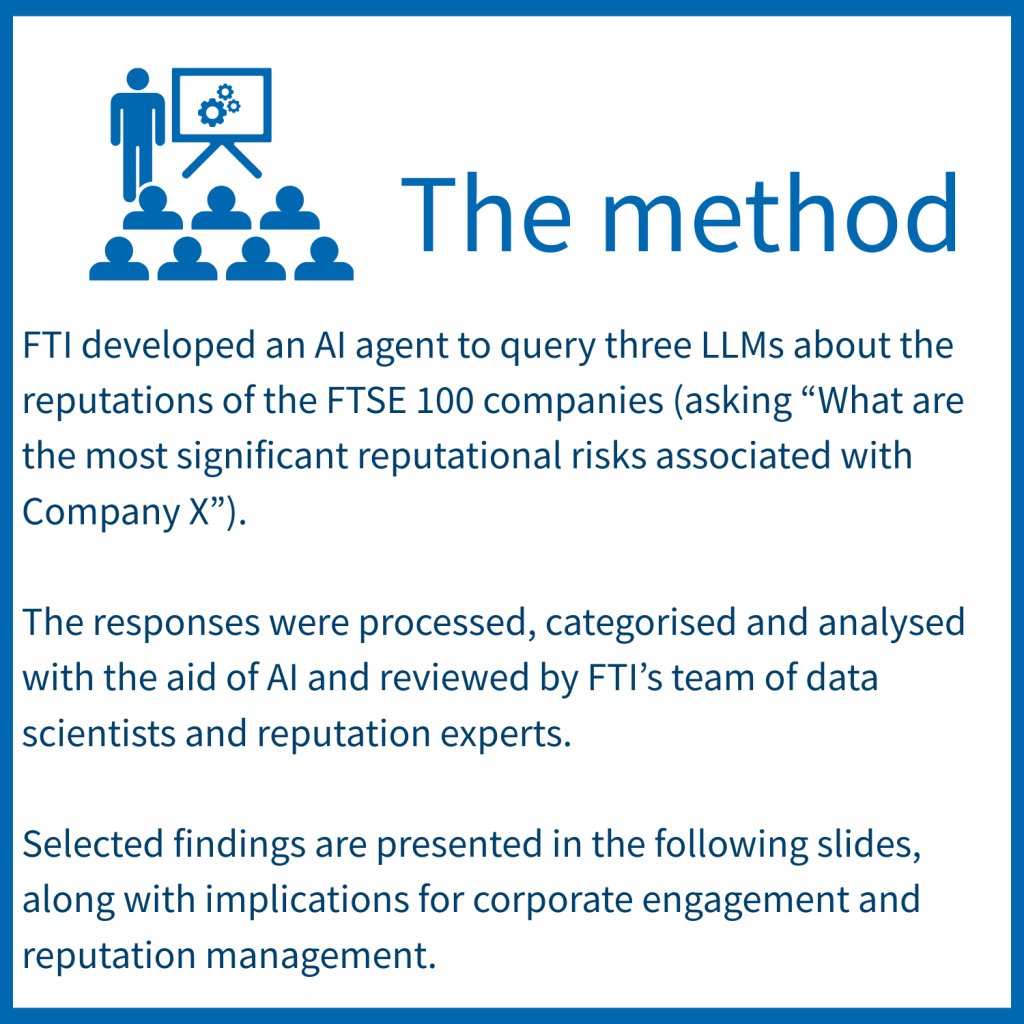
Last spring, FTI’s Digital & Insights team undertook an initial piece of research analysing FTSE 100 corporate reputations on ChatGPT. This research highlighted that reputational risks were present in 79% of ChatGPT responses when prompted around corporate reputation.

After establishing the existence of reputational risk within LLM responses, our team has broadened and deepened our analysis in 2026. We examined the three most frequently used LLMs over the past six months: ChatGPT (78% of visits), Gemini (Google AI Mode) (64.5%) and Copilot (47.5%)*. We also sought to more deeply understand the types of risks – historical or emerging– that most often cut through in responses across these models.

What have we learned? Each LLM draws on different data sources, publisher relationships and weighting mechanisms, resulting in materially different reputational profiles. For corporates, this fragmentation means reputational risk can no longer be assessed or managed through a single-model lens, requiring a more holistic and adaptive approach. Critically, legacy risk signals pervade – meaning that issues corporates thought were in the past still live in LLM ‘memory’.

Key takeaways

Legacy risk signals persist in LLM outputs

and organisations must continuously identify and manage historical issues that may appear without their responses or context.

Focusing on only one LLM to inform communications strategies creates blind spots

as fragmented models and publisher relationships can surface risk elsewhere.

User-generated content platforms including Reddit, Glassdoor and Wikipedia must increasingly be considered as critical reputational battlegrounds

and systematic monitoring is necessary to anticipate how they influence LLM outputs.

Managing LLM reputational risk requires attention to a broader – not narrower – set of channels and platforms

with offline engagement complementing a targeted strategy across earned, owned and shared content.

Which sources matter?

A broader set of media outlets is driving LLM visibility

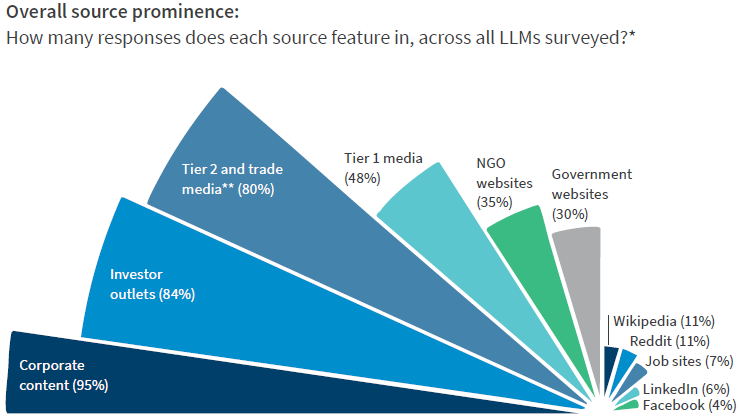
  • Corporate content dominates LLM citations, indicating that organisations can materially influence their LLM profile through their own content and disclosures.
  • LLMs draw on a wide media mix, with investor, trade and Tier 1 outlets all prominent. Tier 1 media is less often referenced by Copilot, bringing it down in the ranking.
  • NGO and government sources feature strongly, underscoring the indirect but important role of offline stakeholder engagement and public affairs in shaping LLM outputs.
  • User-generated sources outweigh traditional social media, with Wikipedia and especially Reddit emerging as influential – and under-managed – reputational inputs.

How is this different across LLMs?

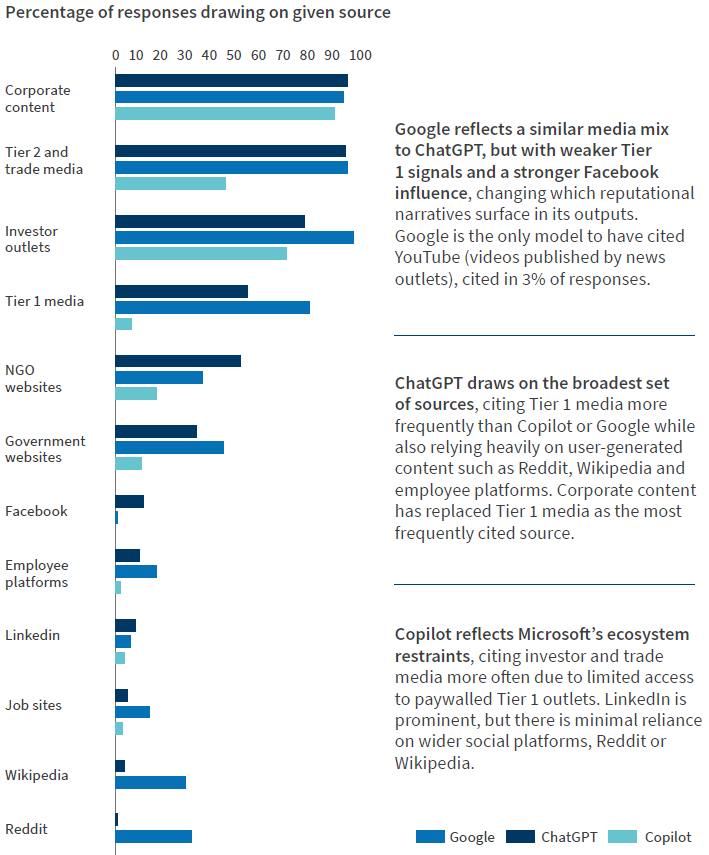
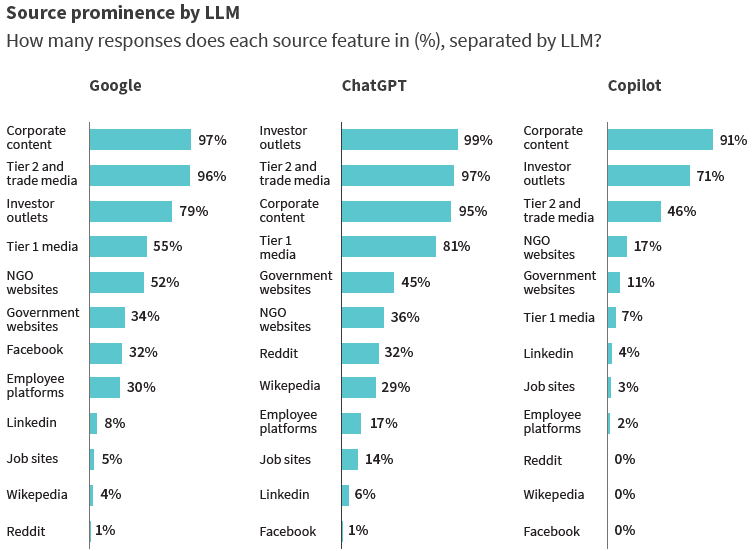
Reputational risk is shaped by fragmented and model-specific source ecosystems

Prominence of source categories across different LLMs

Where is the corporate voice missing?

LLMs amplify historical risk while underrepresenting corporate responses

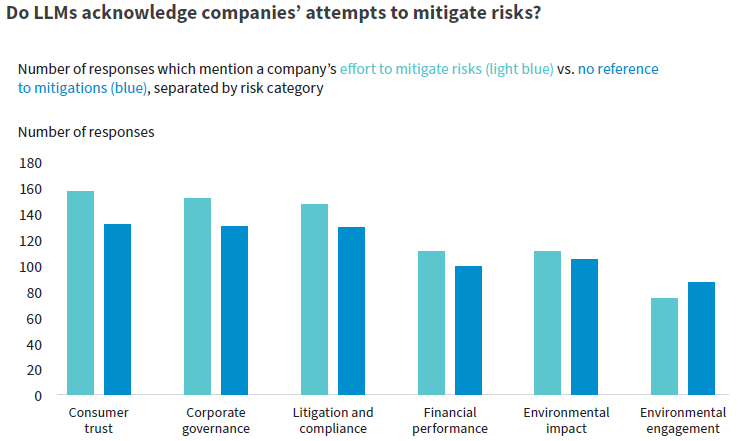
When detailing reputational risks in their responses, corporate responses are often absent. LLMs frequently surface reputational risks without referencing how companies are addressing them, particularly for Consumer Trust, Corporate Governance and Litigation and Compliance – the top three risks in LLM outputs.

Legacy risk signals dominate LLM outputs: every response surfaces at least one historical issue, and 60% of all risks identified across FTSE 100 sectors are those which companies have often already addressed but that persist in LLM ‘memory’.

Which platforms drive reputational risk (and opportunity)?

Reddit must increasingly be considered as a critical reputational battleground

Reddit is increasingly influential. It appears in over 10% of LLM responses overall and in more than one-third of ChatGPT outputs, making it a critical platform for reputational influence.

Employee platforms like Glassdoor feature prominently across all three LLMs, especially for Consumer, Retail and Real Estate. Corporates should actively monitor and engage on these channels to manage reputational risk.

Social media platform influence varies by LLM. LinkedIn and Facebook are less cited on ChatGPT but appear prominently on Copilot (LinkedIn) and Google (Facebook), highlighting the need for organisations to align social engagement with both audience and model usage.

Questions for corporate affairs in 2026

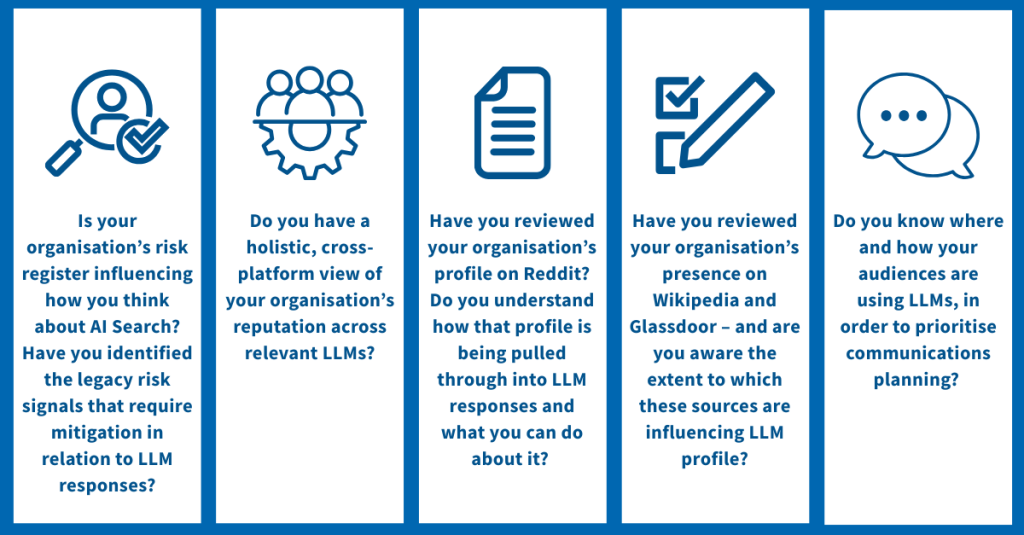
How can your organisation de-risk its AI presence and enhance its reputation supply chain?

Get in touch

For tailored insights, please email [email protected].

The views expressed in this article are those of the author(s) and not necessarily the views of FTI Consulting, its management, its subsidiaries, its affiliates, or its other professionals.

©2026 FTI Consulting, Inc. All rights reserved. www.fticonsulting.com

Related Articles

4th Annual Shareholder Activism State of the Market

September 8, 2025—4th Annual Shareholder Activism State of the Market Request Report The 4th Annual Shareholder Activism State of the Mark...

Use It or Lose It: U.S. Hydrogen Industry Must Act To Maintain Momentum

July 12, 2025—Key takeaway: Following the passage of the “One Big Beautiful Bill Act”, time is of the essence for hydrogen produce...

Quick Analysis: ‘One Big Beautiful Bill’ Drives More Gas and Batteries, Less Renewables

July 3, 2025—With the recent passage of the “One Big Beautiful Bill” (“OBBB” or the “Legislation”),[1] FTI Consulting’s...

FTI Consulting News Bytes – 12 June 2026

June 12, 2026—FTI Consulting News Bytes From drones to chatbots to humanoid robotics and more, it has been a busy week as business and...

Global Public Affairs Newswire – 12 June 2026

June 12, 2026—Welcome to the latest instalment of FTI Consulting’s fortnightly Global Public Affairs Newswire. This week, we bring y...

ESG+ Newsletter – 11 June 2026

June 11, 2026—In this week’s ESG+ Newsletter, we first dive into updates within the sustainable reporting landscape, as Norges B...