2025 Q1 2025 Payer-Provider Dispute Update
Slow Start – Fewer Disputes in 2025 Between Payers and Providers
The first quarter of 2025 saw a wave of decision-making and changing healthcare priorities from the Trump administration and the 119th Congress. From potential funding cuts to the Medicaid program, to a renewed interest in the site-neutral payment model, and significant increases to Medicare Advantage (MA) reimbursements, Republican lawmakers are laser-focused on changing the healthcare landscape to align priorities with the “Make America Healthy Again” (“MAHA”) agenda, being led by Department of Health and Human Services (“HHS”) Secretary Robert F. Kennedy, Jr.
As such, payers and providers have had to adapt quickly to changing demands and opportunities presented by new federal and state leadership, while battling with existing challenges, evolving patient demands, financial hardships, inflationary pressures and staffing issues. At times, these levers force patients and providers to renegotiate reimbursement rates, often leading to contentious contract disputes that, if left unresolved, can leave thousands of patients without care.
For three years, FTI Consulting’s Healthcare Strategic Communications team has been closely monitoring these disputes through publicly reported news coverage and paid and earned media. Increasingly, both parties are facing greater challenges in reaching agreements related to important contract terms, including reimbursement rates, utilization management, care coordination and disease management, quality improvement and performance metrics, and other contractual terms that impact coverage for tens of millions of individuals and families across the United States. These disputes have historically drawn attention from third-party players, including state and federal lawmakers, regulators and local government officials, with evolving levels of attention from traditional and social media outlets and the public.
What we found: Q1 2025 saw a smaller number of disputes between payers and providers reported in traditional media outlets than the last two quarters of 2024.
Q1 2025 Healthcare Quarter in Review
- In Q1 2025, there were a total of 26 disputes reported in traditional media outlets, seven of which were left unresolved.
- 58% (15 out of 26) of total disputes involved MA plans. Five of these disputes were exclusively disputes with MA plans, four of which were unresolved by the end of the first quarter of 2025.
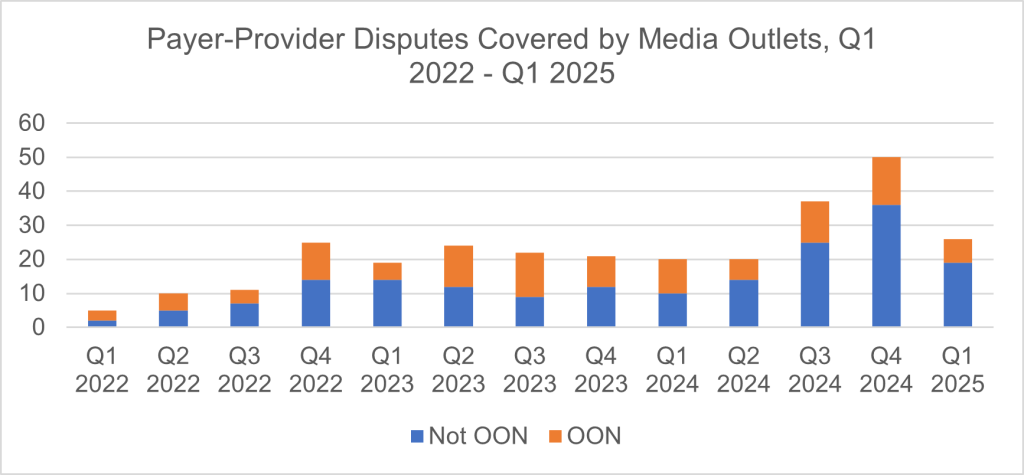
OON = Out of Network
Healthcare reporting has been dominated by the rapidly changing actions and decision-making at the federal level, which could explain the dip in coverage of disputes between payers and providers. As federal and state actions on healthcare policy normalize, we expect to see a rise in the number of disputes being covered by regional and local media outlets. Additionally, we expect to continue seeing a rising number of disputes between payers and providers this year.
Looking Ahead
Proposals by the Trump administration, especially the Centers for Medicare and Medicaid Services (“CMS”) proposed MA payment model, will likely influence the reimbursement landscape for healthcare players. In April 2025, CMS announced a 5.06% average payment increase for MA plans.1 This could ease some tensions in reimbursement disagreements by providing payers with more favorable fiscal outlooks.
However, CMS’s completion of the phase-in for removing medical education costs from fee-for-service calculations may lead to friction, as providers associated with teaching hospitals could experience added financial pressure, prompting intensified negotiations with payers over reimbursement. Additionally, the finalized adjustments to the MA risk-adjustment model may create additional disputes, as payers might find it strategic to pass on any potential revenue impacts to providers. CMS’s proposal will necessitate careful negotiation and collaboration between payers and providers.
Beyond reforms to MA payments, other federal legislative, regulatory, and administrative actions, like the potential introduction of site-neutral payments as suggested by President Trump’s Executive Orders[2] or reactions to integration in the healthcare industry,[3] will change payer and provider needs, and could force them into contentious contract negotiations as they attempt to protect both their bottom lines and patients’ access to care.
Research Methodology:
FTI Consulting searched multiple news databases for articles regarding negotiations over reimbursement rates between provider organizations and insurance companies. Those negotiations, which were publicly reported by a news outlet on July 1 or later, were counted for the quarter in which they were publicly reported. Negotiations that were resolved or failed to reach an agreement in one quarter but were first reported in another quarter were counted for the quarter in which they became public. Where providers no longer accept any Medicare Advantage plans, FTI Consulting has counted that decision as a single dispute.
Related Practices
[1] “CMS Finalizes 2026 Payment Policy Updates for Medicare Advantage and Part D Programs,” CMS.gov (April 7, 2025), https://www.cms.gov/newsroom/press-releases/cms-finalizes-2026-payment-policy-updates-medicare-advantage-and-part-d-programs.
[2] “Lowering Drug Prices by Once Again Putting Americans First,” The White House (April 25, 2025), https://www.whitehouse.gov/presidential-actions/2025/04/lowering-drug-prices-by-once-again-putting-americans-first/.
[3] N. Adam Brown, “The Danger of Trump’s Deregulation Play,” MedPage Today (February 22, 2025), https://www.medpagetoday.com/opinion/prescriptionsforabrokensystem/114326.
The views expressed herein are those of the author(s) and not necessarily the views of FTI Consulting, Inc., its management, its subsidiaries, its affiliates, or its other professionals.
FTI Consulting, Inc., including its subsidiaries and affiliates, is a consulting firm and is not a certified public accounting firm or a law firm.
FTI Consulting is an independent global business advisory firm dedicated to helping organizations manage change, mitigate risk and resolve disputes: financial, legal, operational, political and regulatory, reputational and transactional. FTI Consulting professionals, located in all major business centers throughout the world, work closely with clients to anticipate, illuminate and overcome complex business challenges and opportunities. ©2025 FTI Consulting, Inc.
All rights reserved. fticonsulting.com