The UK’s deregulation overtures to attract investment: Don’t look back in anger

The Labour Government has sent a mixed message to the business community since coming to power. Ahead of the Spring Statement 2025, much of the mood music from the Chancellor has been on balancing the books during troubled time and investing in our economic future. Critics, however, will point to National Insurance tax increases and employment law changes as evidence that the Prime Minister’s Growth Mission can’t survive contact with the left-wing-instincts of his Cabinet.
Realising that the Government’s challenging fiscal position will limit its ability to subsidise or tax-cut its way to growth, the Chancellor has set her eyes on another path for the growth mission: deregulation.
In her Mansion House speech on 14th November the Chancellor sent a very clear message to the UK’s regulatory bodies: you ignore the Government’s “Growth Mission” at your peril. Regulators duly scrambled to comply – or at least to be seen to comply – with the clear expectation that they will not get in the way of the growth mission. The public pronouncements were followed up in December with joint correspondence from the Prime Minister, Chancellor and Business Secretary requiring regulators to come up with ideas for self-improvement that would support growth.
Some regulators recognised the writing on the wall and showed themselves nimble in response. The Financial Conduct Authority – never much beloved by the sectors it regulates – was, nonetheless, able to offer up sufficient changes to avert any immediate government ire. Declaring growth to be a “cornerstone of our strategy to 2030” the financial regulator offered up a savvy mix of already planned reporting reductions with new commitments to scale down the burdens associated with the Consumer Duty. This fleetfooted response stands in stark contrast to the Competition and Markets Authority’s (CMA) commitments. The institution which had won plaudits for its intervention into the Oasis concert ticketing snafu was sure they’d heard it all before and never really had a doubt about the security of its position. Where the Government wanted to see a commitment to cutting red-tape and showing the welcome mat to international investment, the CMA took the opportunity to rededicate itself to ever more zealous pursuit of its duties through access to new tools and technologies. Evidence of just how badly the CMA had misread the room swiftly followed. The body’s Chair, Marcus Bokkerink, shown the door by the Government so he could be replaced by someone more in line with the Government’s new strategic direction.
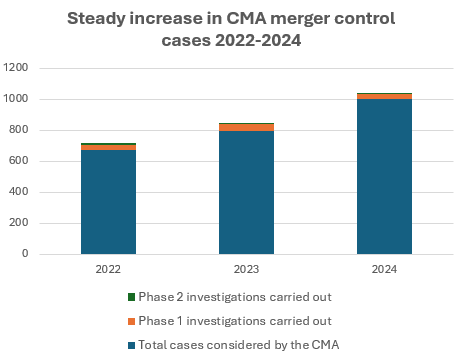
It should come as no surprise that the CMA has been singled out. The organisation’s view, as set out in its 2024 State of UK Competition Report is that, while the UK is doing better than other advanced economies, competition metrics are going in the wrong direction. The report suggests that greater vigilance and more active enforcement is required. It also argues that UK has been spared even worse competition outcomes by the CMA’s refusal to countenance the kind of large-scale mergers and acquisitions that have been more common in the US. This rigid approach to its role is reflected in the statistics with a remarkable 45% increase in merger control investigations over the past three years.
Forcing the departure of Bokkerink’s seemed to have the effect the Chancellor and Business Secretary were looking for as the CMA publicly expressed its commitment to the Government’s Growth Mission. The CMA’s interim Chair, Doug Gurr, declared encouraging business investment to be the organisation’s “north star” and acknowledged that the Authority’s actions “costs businesses when they have to deal with lengthy and uncertain investigations”.
Change had come to the CMA faster than a cannonball. The Government was determined to push ahead with regulatory reform and regulators who failed to move far or fast enough would be caught beneath the landslide.
As illustrated here, the volume of CMA merger control investigations (including cases reviewed by the CMA’s Mergers Intelligence Committee and cases voluntarily notified) saw a consistent yet staggering 45% increase over the past three years. Each instance no doubt occupied significant headspace and boardroom attention for the companies involved, knowing of the high profile instances where a strategic investment or acquisition was blocked or stalled through a lengthy Phase 2 investigation.
Source: The State of the UK Competition Report 2024, Published by the CMA on 24 October 2024
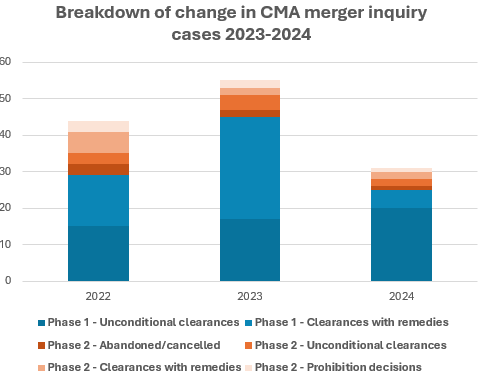
However, when we drill into the numbers, we observe:
- A decrease in the number of Phase 2 investigations year-to-year,
- A decrease in the proportion of Phase 2 investigations,
- A growing number of remedies applied to clear investigations at Phase 1 stage,
- A reduction in probation decisions with only one blocked transaction in 2024.
Source: The State of the UK Competition Report 2024, Published by the CMA on 24 October 2024
This suggests that the CMA has a perception problem. It is no wonder therefore that shortly after being appointed interim Chair of the CMA earlier this year, Doug Gurr wrote in the Financial Times about the need to demonstrate expertise on the sectors under investigations and engage directly with businesses. Gurr also emphasised the need to make CMA investigations and processes as simple and rapid as possible, aligning with Pace objective in the CMA’s 4Ps framework (alongside predictability, proportionality and process).
Data from the past three years indicates that progress is being made, with the number of cases addressed in the far shorter Phase 1 timeframe of approximately 10 weeks. But CMA chief executive Sarah Cardell has conceded that the regulator has a perception problem on this front, stating “I have heard clearly from businesses and investors (both domestic and international) that 4 aspects of how the CMA carries out our work also really matter to perceptions of the UK as a great place to do business.”
Having made an example of the CMA and succeeded in getting regulators to pay homage to the growth mission, the Government followed up with the publication of the Regulatory Action Plan last week (17 March). After paying obligatory lip service to the value of well-designed regulation, the plan set out the Government’s grim view of a regulatory system that “too often holds back growth and inhibits private sector investment”.
The assessment of the status quo reads like a 1 star review of business complaints, with poor design, unpredictability, duplication and unnecessary complexity listed among the many regulatory barriers faced by the nation’s wealth creators. The document paints the picture of a regulatory system that has been allowed to grow without due regard to the cumulative weight of the burden placed on businesses and where risk aversion has been the guiding incentive for the country’s 36,000 full time equivalent regulator employees.
The plan sets out to reduce complexity, regulatory burden and uncertainty while addressing what ministers see as excessive risk aversion. As well as being subject to the general vision – which includes a commitment to reduce the cost of regulatory compliance by 25% this Parliament – the plan sets out the next steps in the programme to change the CMA. The organisation will soon be in receipt of a “Growth Focused Strategic Steer” from the Government which will be informed by a business consultation. Ministers are also promising consultation on likely legislation to enshrine the 4Ps framework – proportionality, predictability, process and pace – conceived by the CMA late last year to bring greater certainty to the investigations process.
The Government has made plain that it sees the UK’s regulators as barriers to its growth agenda. With limited growth leavers to pull, regulatory reform is a sensible but challenging mechanism to improve the UK’s economic fortunes. The CMA has been too slow to realise the scale of its perception problem and how serious the Government is about removing barriers to investment.
The views expressed in this article are those of the author(s) and not necessarily the views of FTI Consulting, its management, its subsidiaries, its affiliates, or its other professionals.
©2025 FTI Consulting, Inc. All rights reserved. www.fticonsulting.com