Telecom, Media & Technology

The Race Is On To Define Data Centers and AI Infrastructure for Americans
Data centers may be a hot topic in the news, but the American public doesn’t understand them yet. That’s an opportunity and a risk.

Concerns are growing in the data center industry that the November 2025 elections will be a harbinger for the 2026 midterm elections, because candidates who had spent the months in the runup to Election Day attacking the industry won their highly contentious races.

But election outcomes shouldn’t be an indicator of public sentiment. A recent FTI Consulting survey data shows Americans are largely unfamiliar with data centers. To the extent they have some knowledge about them, American voters do support their construction, including those that are planned for sites in the communities where they live and work. The elections, then, should be viewed as an inflection point for the industry, because the race is on to define data centers for Americans and show how they will impact their communities, lives, and professions.

Research Background and Methodology

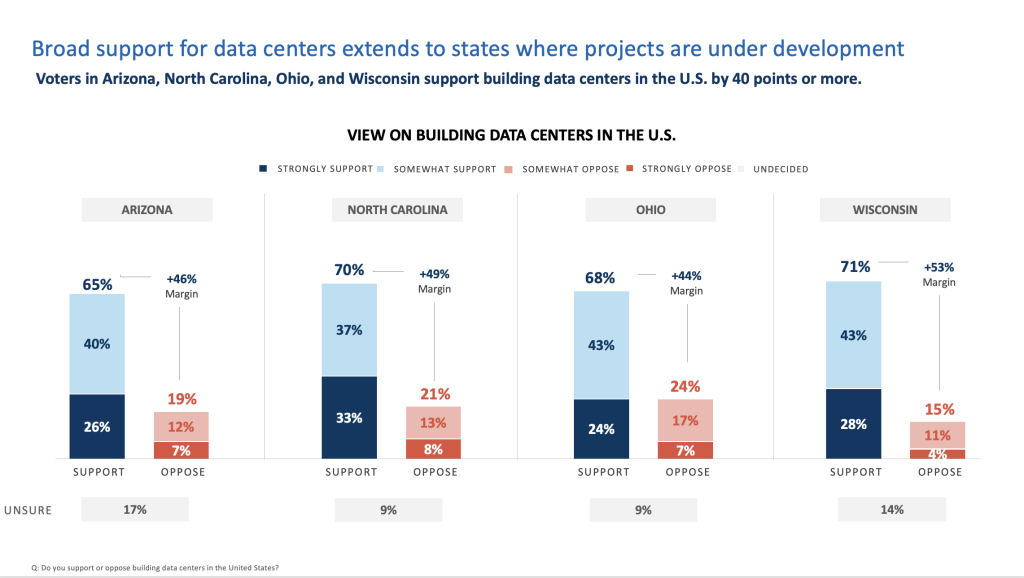
FTI Consulting conducted a nationwide survey of 1,912 registered voters in fall of 2025, including oversamples of 200 voters each in the critical midterm battleground states of Arizona, Ohio, North Carolina and Wisconsin. The margin of error was +/- 3%.

Americans Still Lack Awareness of and Knowledge About Data Centers

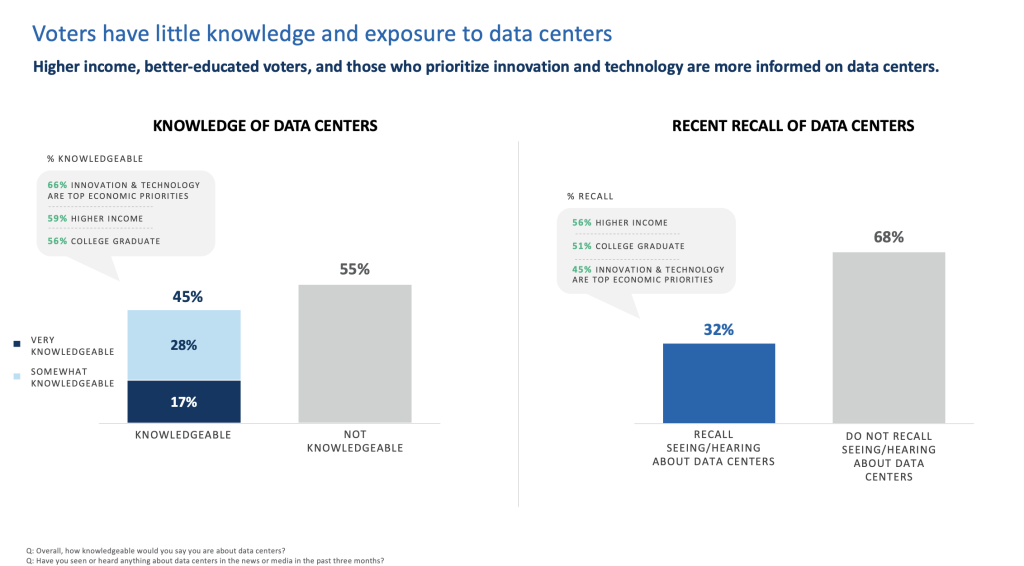
Despite a deluge of news coverage about planned data centers, construction, and the accelerating need for compute to power AI, only 32% of voters said they have heard anything recently about data centers from the media.

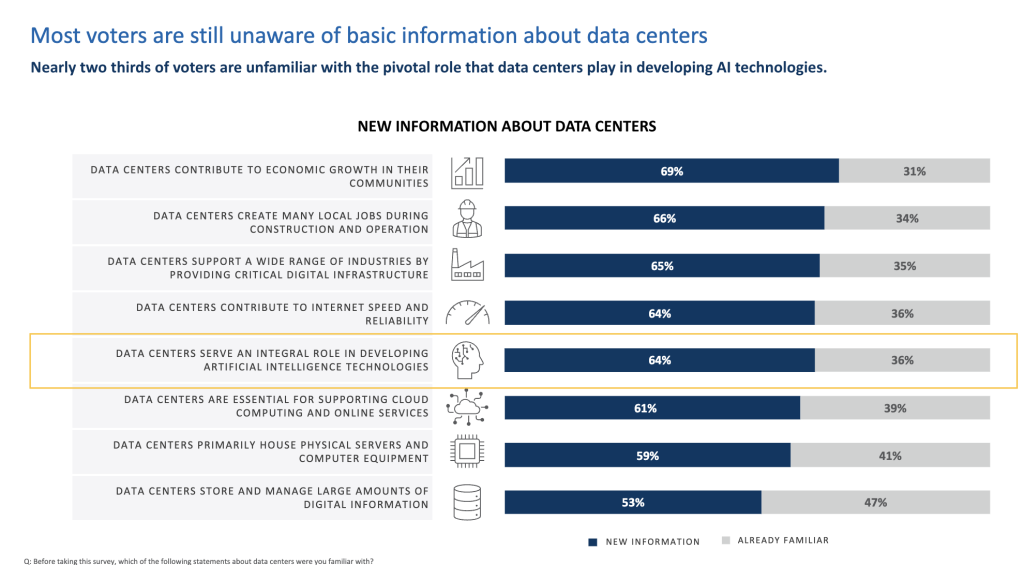
In fact, about half of those surveyed said they are familiar with what data centers do, which is storing large amounts of digital information essential for developing AI technologies; 53% said that this basic definition is essentially new to them. This suggests that the connection of data centers to AI, as well as AI-powered products and applications, lags even further in the public consciousness.

A Bipartisan Issue, and a Potential Economic Winner

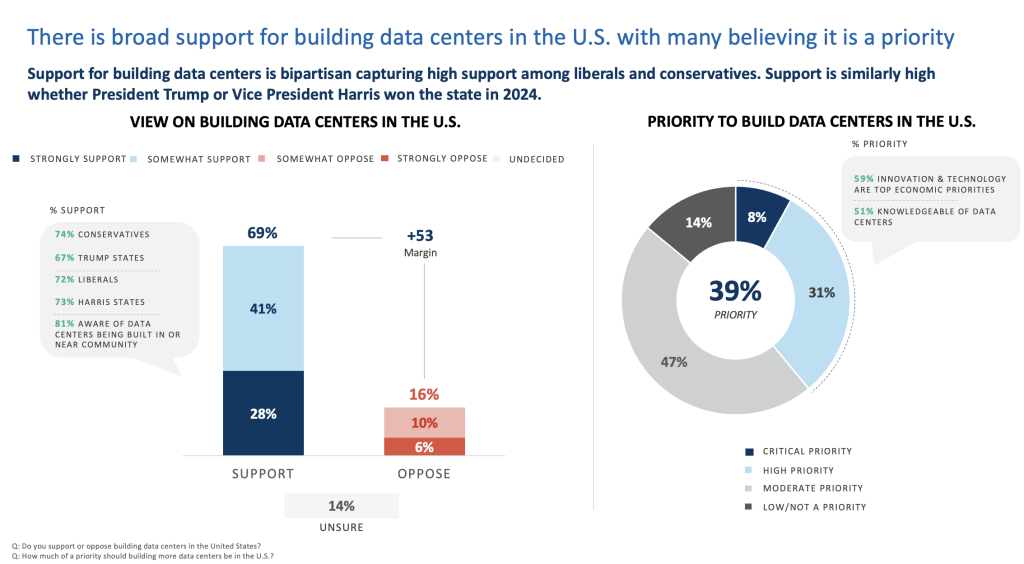
There is broad bipartisan support for building data centers as a key to future economic prosperity. Opposition to constructing data centers for the perceived disruptions they could cause in communities does not fall along party lines, yet. Rather, we found partisan differences fall within the margin of error.

About seven in 10 voters, regardless of whether they live in a red or blue state, support building more data centers in the United States. Broken down along party lines, that support sits at 73% in states Vice President Kamala Harris won in the 2024 presidential election, and 67% in the states President Trump won.

Crucially, the total level of support jumps to eight in 10 voters (81%) among those American voters who are aware of a data center being built in their community. That may come as a surprise to analysts who have observed the targeted, vocal attacks on the industry that have led to stalled construction in some jurisdictions.

That support stands in stark contrast to another finding in the FTI Consulting survey: Fewer than four in 10 American voters (39%) say building data centers should be a national priority. This suggests that the message from hyperscalers and data center operators promoting data centers as economic drivers and strategic assets needs more explanation and amplification.

Americans Want to be Educated on the Opportunities and Costs of Data Centers

Voters are just beginning to understand the values and drawbacks of data centers, leaving the industry an opening to define itself, particularly in the communities that are targets for new sites.

Our survey found pro-data center arguments are more persuasive than opposition messaging, at a wide margin: 57% to 34%. And after hearing arguments supportive of data centers as well as those opposed to them, 48% voters preferred candidates who pledged support for data centers, while 33% of voters preferred candidates opposed, suggesting negative attacks on data centers do not resonate with voters when they are getting all sides of the story.

A loud minority is filling the void right now and rushing to define data centers and the companies that operate them, and they are dominating coverage in the process. This means the industry is still in the early stages of defining itself and has room to beat back the opposition with transparent, informative messaging that Americans say they want.

Looking Ahead to 2026

The big takeaway: The data center industry must spend 2026 educating voters rather than allow opponents to define data centers for them and allow the attacks to go unanswered.

The FTI Consulting survey found that 36% of voters expect data center developers to be transparent about risks and impacts to the community, which was their top request. Taken together, the survey’s findings show the industry has a window, albeit one that is closing given the head start opponents have, to provide a more robust education and accessible information to American voters on the necessity and economic value of data centers. What’s clear from the survey is that plenty of respondents want more information to understand how data centers power the technology they use and could be using. Americans expect some downside risks along the way, but they’re primed to be more understanding when companies are forthright about all the community impacts.

FTI Consulting offers a diverse bench of experts with wide-ranging capabilities essential for supporting organizations operating in the evolving data center and AI landscapes. We welcome the opportunity to discuss the topic of this article further.

Key Contacts

Untitled design (51)

Erin McPike
Managing Director
[email protected]

John Sutter
Managing Director
[email protected]

James Condon
Managing Director
[email protected]

Andrew Batcheller
Director
[email protected]

Related Insights

The views expressed herein are those of the author(s) and not necessarily the views of FTI Consulting, Inc., its management, its subsidiaries, its affiliates, or its other professionals.

FTI Consulting, Inc., including its subsidiaries and affiliates, is a consulting firm and is not a certified public accounting firm or a law firm.

FTI Consulting is an independent global business advisory firm dedicated to helping organizations manage change, mitigate risk and resolve disputes: financial, legal, operational, political and regulatory, reputational and transactional. FTI Consulting professionals, located in all major business centers throughout the world, work closely with clients to anticipate, illuminate and overcome complex business challenges and opportunities. ©2025 FTI Consulting, Inc.
All rights reserved. fticonsulting.com

Related Articles

4th Annual Shareholder Activism State of the Market

September 8, 2025—4th Annual Shareholder Activism State of the Market Request Report The 4th Annual Shareholder Activism State of the Mark...

Use It or Lose It: U.S. Hydrogen Industry Must Act To Maintain Momentum

July 12, 2025—Key takeaway: Following the passage of the “One Big Beautiful Bill Act”, time is of the essence for hydrogen produce...

Quick Analysis: ‘One Big Beautiful Bill’ Drives More Gas and Batteries, Less Renewables

July 3, 2025—With the recent passage of the “One Big Beautiful Bill” (“OBBB” or the “Legislation”),[1] FTI Consulting’s...

IR Monitor – 10 June 2026

June 10, 2026—In this week’s newsletter: The stories that investor relations professionals need to read this week: Elon Musk’s Spa...

How Defense Tech Companies Can Turn Stakeholder Engagement Into a Growth Engine

June 9, 2026—The defense technology market has become increasingly crowded, but many companies still struggle with a fundamental chal...

FTI Consulting News Bytes – 5 June 2026

June 5, 2026—FTI Consulting News Bytes This week, we kick off with news of Hyve’s acquisition by private equity leader, Hellman &am...