As we approach the mid-way point of what has been described in previous reports as “The Decade of Disputes”, FTI Consulting has undertaken research with over 250 leaders of large businesses, representing aggregate annual turnover in excess of $1tn and over 6 million employees, to understand how litigation has shaped decision-making in their respective organisations.
We are seeing a steady increase in litigation as a boardroom agenda item.
Boards and Executive Committees are more concerned about litigation risk than others in senior management roles.
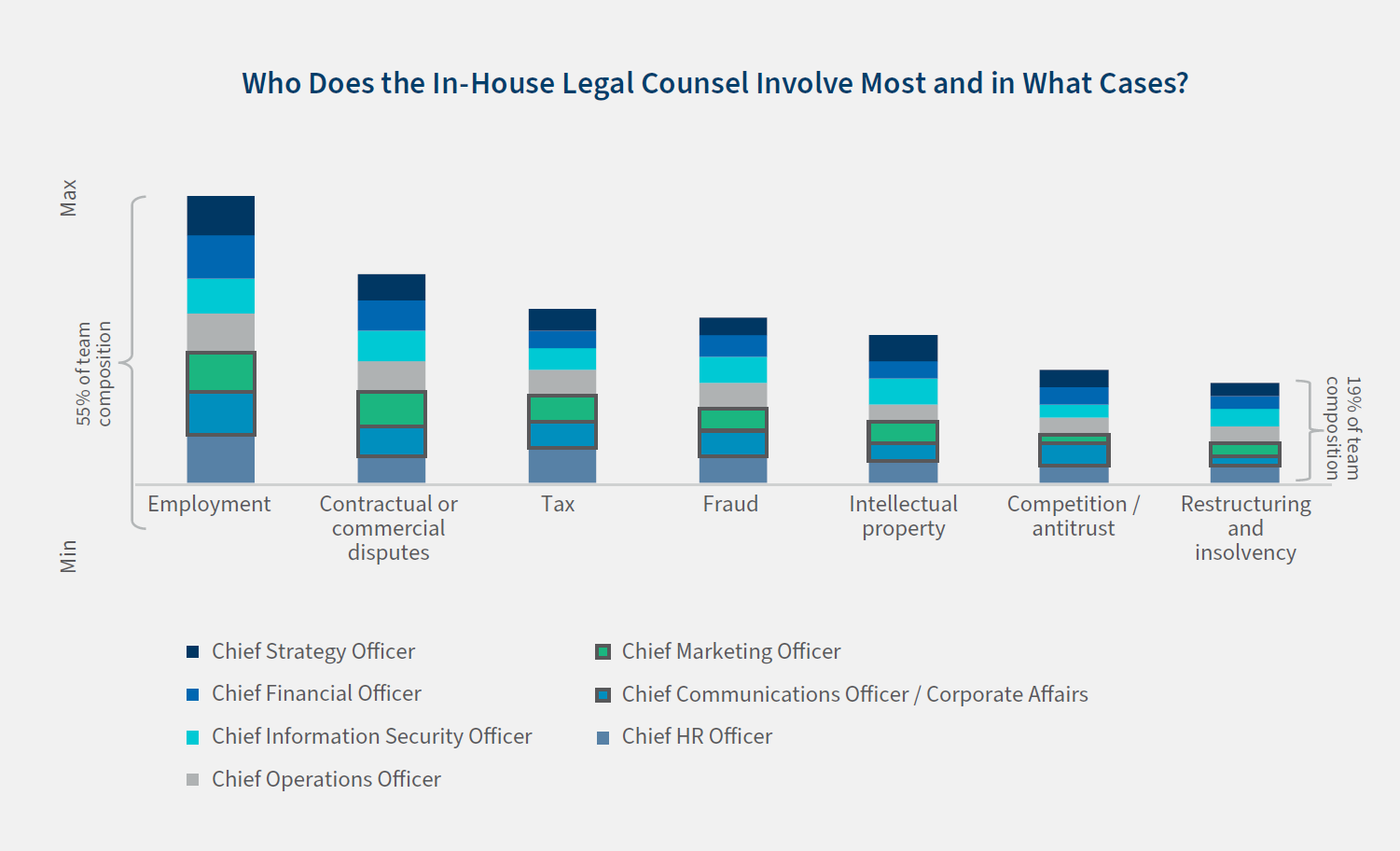
The risk of business disruption is best mitigated with a broad cross-functional team.
5 years ago, FTI undertook the first edition of this research series, finding that business leaders were anticipating an increase in litigation in the years ahead. This trend has been born out over the years by our research.
Approximately 6 in 10 (59%) of business leaders surveyed in 2024 have seen an increase in litigation compared to a year ago, and over half (52%) are concerned by the risk of litigation in the next 12 months (this includes current and prospective litigation).
The most common types of disputes relate to: 1. Employment (45%) 2. Contractual/commercial disputes (28%) 3. Fraud (24%) 4. Tax (24%)
Additionally, the research has found that over 1 in 3 large companies (35%) are currently engaged in material litigation. Of those surveyed, the average size of largest claim facing the company was found to be $425m. Over 8% of respondents have been engaged in litigation in the last 12 months for a claim in excess of $1bn.
One factor that may be contributing to the impact of material disputes is the rise in class actions seen by businesses. It is noteworthy that over half (53%) of companies surveyed reported that class actions or mass claims are becoming more costly for their company to manage.
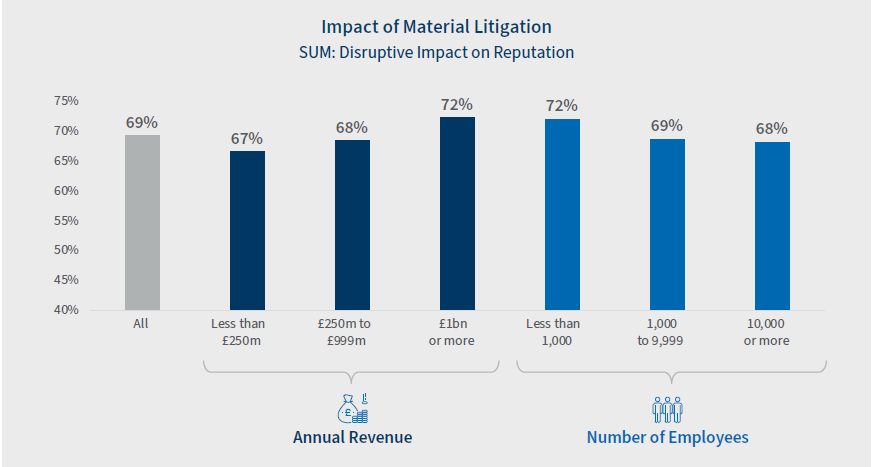
In terms of impact, the largest companies in terms of revenue found that material claims have the greatest disruptive impact to the organisation’s overall reputation. Meanwhile, the largest companies in terms of number of employees found that the opposite was true. It suggests that material claims, by nature of their large value, matter from a financial and investor perspective but become business-as-usual for large organisations whose employees may be concerned with a range of other issues on a day-to-day basis. This trend should not be overstated though, with more than two-thirds of businesses employing over 10,000 people still finding such claims to be reputationally disruptive.
Reputationis the Highest Priority for Many Business Leaders
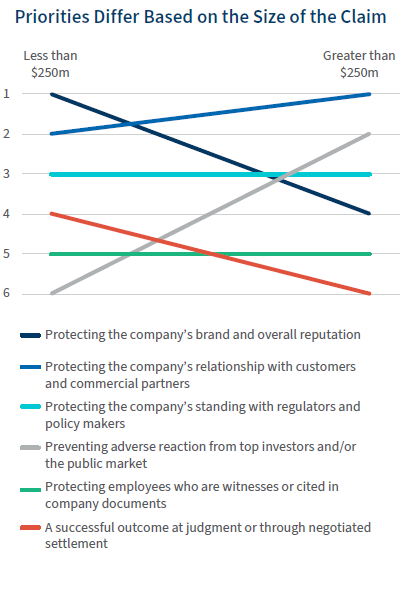
When determining their legal strategy, large UK organisations prioritise the following considerations in the order set out below. It is noteworthy that businesses place a greater emphasis on protecting the company’s overall reputation and relationships with corporate stakeholders than achieving a successful outcome at judgment or through negotiated settlement.
This is reflective of a Boardroom perception of the disruptive impact of litigation, with 69% of respondents saying such cases gave serious concern for damaging reputation, 63% stating that it risked increasing future regulatory scrutiny and 60% stating that it damaged investor confidence. According to respondents at Board level, 13% reported that their company was facing one or more cases that could have an existential impact on the future of the business and more than one in four (29%) of material cases were found to meet this description.
Nonetheless, when looking at claims in excess of $250m, we start to see a difference in priorities among business leaders. For these large claims, financial factors take precedence – both from a revenue and investment perspective – with the company’s customers, commercial partners and shareholders becoming the most important stakeholders to manage.
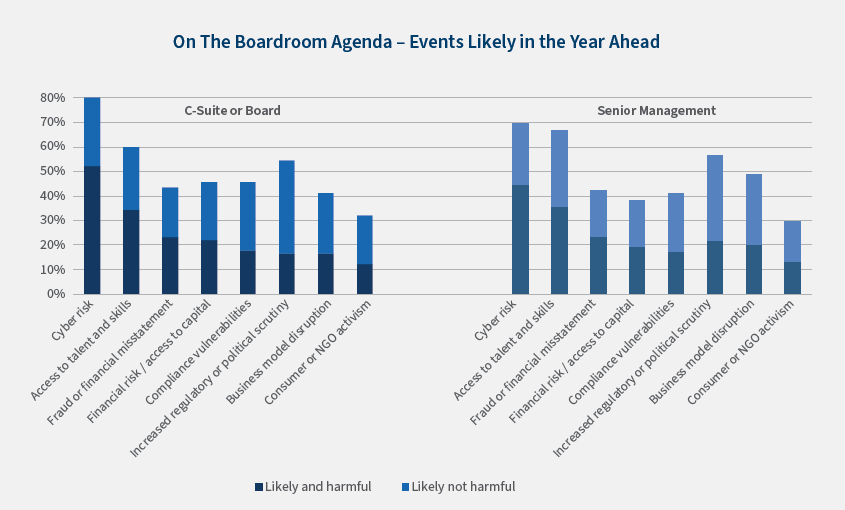
Our research found that Board members and
those in C-suite executive positions view the reputational
risks posed by litigation as the most significant risks
facing their businesses. This suggests that litigation risk
counts as one of the principal, strategic considerations of
large companies, rather than being a purely operational
or legal concern.
Additionally, they are 31% more likely than senior
management in non-Board roles to anticipate a
vulnerability from fraud or financial misstatement, 33%
more likely to foresee compliance vulnerability and 34%
more likely to see risk of class action.
Mitigating Against the Risk of Disruption Requires Broad Engagement Across C-Suite Functions
Despite reputational damage being the biggest priority for business leaders when defining a legal strategy, FTI Consulting’s research has found that only 24% of businesses are including their Corporate Affairs team in the organisation’s response to material litigation.
In order to successfully mitigate against reputational damage, Corporate Affairs should be included from the start so they can adequately implement reputation protection strategies. Additionally, when dealing with litigation, business leaders should look to their wider C-suite to advise on potential risks and response plans to enhance their risk mitigation planning.
We use cookies on our website to give you the most relevant experience by remembering your preferences and repeat visits. By clicking “Accept All”, you consent to the use of ALL the cookies. However, you may visit "Cookie Settings" to provide a controlled consent.
This website uses cookies to improve your experience while you navigate through the website. Out of these cookies, the cookies that are categorized as necessary are stored on your browser as they are essential for the working of basic functionalities of the website. We also use third-party cookies that help us analyze and understand how you use this website. These cookies will be stored in your browser only with your consent. You also have the option to opt-out of these cookies. But opting out of some of these cookies may have an effect on your browsing experience.
Necessary cookies are absolutely essential for the website to function properly. These cookies ensure basic functionalities and security features of the website, anonymously.
Cookie
Duration
Description
cookielawinfo-checkbox-analytics
11 months
This cookie is set by GDPR Cookie Consent plugin. The cookie is used to store the user consent for the cookies in the category "Analytics".
cookielawinfo-checkbox-functional
11 months
The cookie is set by GDPR cookie consent to record the user consent for the cookies in the category "Functional".
cookielawinfo-checkbox-necessary
11 months
This cookie is set by GDPR Cookie Consent plugin. The cookies is used to store the user consent for the cookies in the category "Necessary".
cookielawinfo-checkbox-others
11 months
This cookie is set by GDPR Cookie Consent plugin. The cookie is used to store the user consent for the cookies in the category "Other.
cookielawinfo-checkbox-performance
11 months
This cookie is set by GDPR Cookie Consent plugin. The cookie is used to store the user consent for the cookies in the category "Performance".
viewed_cookie_policy
11 months
The cookie is set by the GDPR Cookie Consent plugin and is used to store whether or not user has consented to the use of cookies. It does not store any personal data.
Functional cookies help to perform certain functionalities like sharing the content of the website on social media platforms, collect feedbacks, and other third-party features.
Performance cookies are used to understand and analyze the key performance indexes of the website which helps in delivering a better user experience for the visitors.
Analytical cookies are used to understand how visitors interact with the website. These cookies help provide information on metrics the number of visitors, bounce rate, traffic source, etc.
Advertisement cookies are used to provide visitors with relevant ads and marketing campaigns. These cookies track visitors across websites and collect information to provide customized ads.