Crisis & Litigation Communications

The Decade of Disputes: 2025 Edition

Download a PDF of this article


At the halfway mark of what FTI Consulting has termed “the decade of disputes”, we examine how senior legal decision makers (e.g. General Counsels) at large international business are mitigating against the risk of reputational harm and business disruption from high-stakes litigation.

Five years ago, at the start of the 2020s, FTI Consulting undertook research with over 2,000 business leaders of large companies,1 forecasting an increase in disputes on the Boardroom agenda and a reassessment of how proactively such businesses should prepare for the impacts of high-stakes disputes. In the years since, the focus of legal claims in the spotlight has varied – including environmental litigation,2 antitrust disputes3 and class actions4. So too has the corporate response,5 with organisations deploying crossfunctional teams to mitigate against the risk of business disruption from such cases which, back at the start of this research series, were found to result in a 6% loss in earnings. With high value at stake, we take a look here at the prevailing trends and analyse the driving factors behind a change in how organisations respond and adapt public and media attention in an increasingly febrile and unpredictable environment.

Few Businesses Know Who Is on the Team for Crisis Response

While it is commonly held that dedicated cross-functional crisis response teams are pivotal in the eye of the storm, nearly 70% of organisations do not have this in place. The same applies to a pre-selected list of external crisis response advisors, according to the findings from ‘Turbulent Waters, Trusted Anchors: The General Counsel’s Evolving Role in Navigating Crises’ – An Economist Impact Report Sponsored by FTI Consulting.6

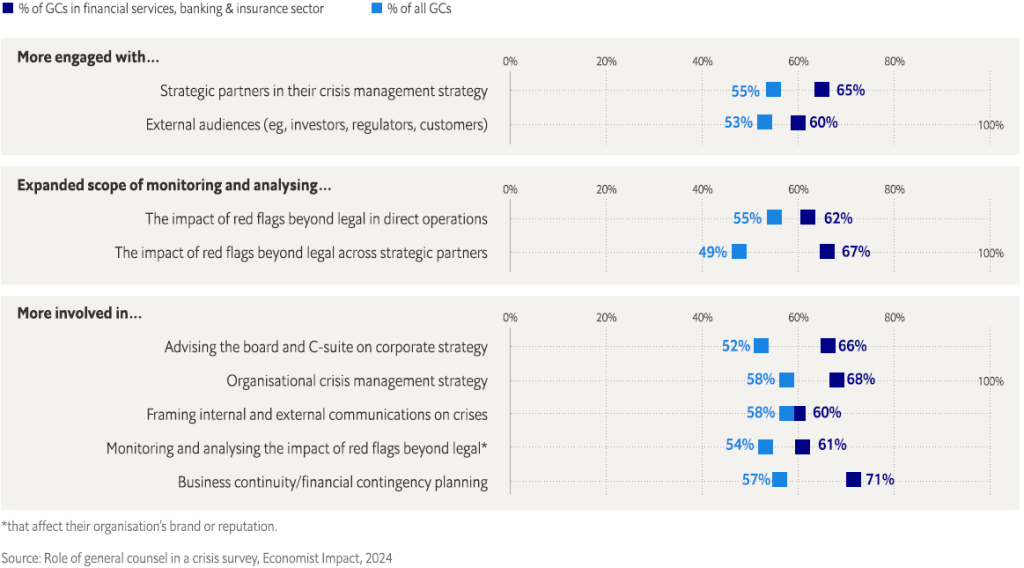
Those who do not have their crisis team ready to deploy risk inefficiency and ineffectiveness when seeking to address the legal, reputational, financial and organisational dimensions simultaneously in a high profile and high stakes situation. While the majority of General Counsels (55%) believe they are more engaged now than before with strategic partners in crisis planning, the inclusion of specialist expertise within boardroom discussions is an important step in improving overall organisational resilience.

In high-stakes disputes, a siloed approach could lead to misalignment and missed opportunities for effective resolution. By working together from the outset, litigation and crisis teams can anticipate risks more effectively and craft a unified strategy that protects both the company’s legal position and its public image.

Senior Legal Decision-Makers Are Widening the Scope of Contingency Planning

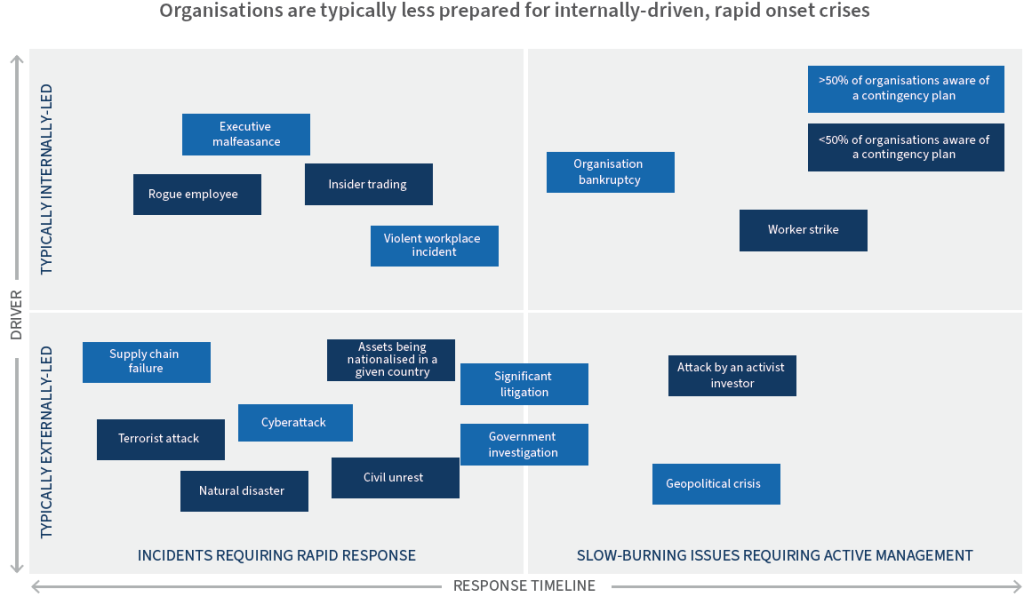
Analysis by FTI Consulting found that the majority of corporate crises require rapid response, given the often material and potentially existential nature of these events.

Amid an increasing likelihood of cyberattacks, geopolitical crises, workplace disruption or issues arising from terrorism or natural disaster, GCs often believe that their companies do not have appropriate contingency plans in place – or, more troublingly, do not know whether their companies have these contingency plans developed in the first place.

As shown in the lower-left quadrant above, research suggests organisations are less prepared for incidents requiring a rapid response. Also noteworthy is the lack of preparation for internally-led scenarios – namely from employee misconduct – which are more likely to occur than the relatively rare externally-led crisis examples considered above. By addressing a full range of potential crises in the planning stages, especially those which require immediate responses, companies can improve their readiness no matter what comes their way.

Financial Services Investment in Crisis Preparedness

The financial services sector is widely regarded as a leader in crisis and risk management, driven by increasingly stringent regulatory requirements and enhanced access to big data and advanced analytics capabilities. For example, the Prudential Regulatory Authority (Supervisory Statement SS1/21) requires firms to develop communication strategies for both internal and external stakeholders as part of their planning for responding to operational disruptions. These communication plans should be developed with a view to reducing harm to counterparties and other market participants and supporting confidence in both the firm and financial sector.

So it is not surprising that the survey indicates that the financial services, banking and insurance sectors are ahead of other industries in integrating GCs into a broad range of crisis management responsibilities, reflected by 68% of GCs within the financial services, banking & insurance sector reporting to have active involvement in their organisations’ crisis management strategies – significantly higher than the cross-industry average of 58%. Of note, over two-thirds of GCs in this sector have also extended the scope of monitoring and analysis to encompass strategic partners beyond the legal function.

As other sectors of the economy look to best practice for industrial resilience to withstand a volatile and often unpredictable environment, this indicates that there is a particular role for regulators to play in helping bring organisations up to best practice for crisis response in order to avoid value destruction and wider contagion. It may be advisable that companies in all sectors also heed the approach required and recommended in the financial services sector because of the inherent value of protecting stakeholder relationships – whether that’s with investors, talent, clients/customers or other industry partners.

Board vs C-suite: Responsibilities in a Crisis

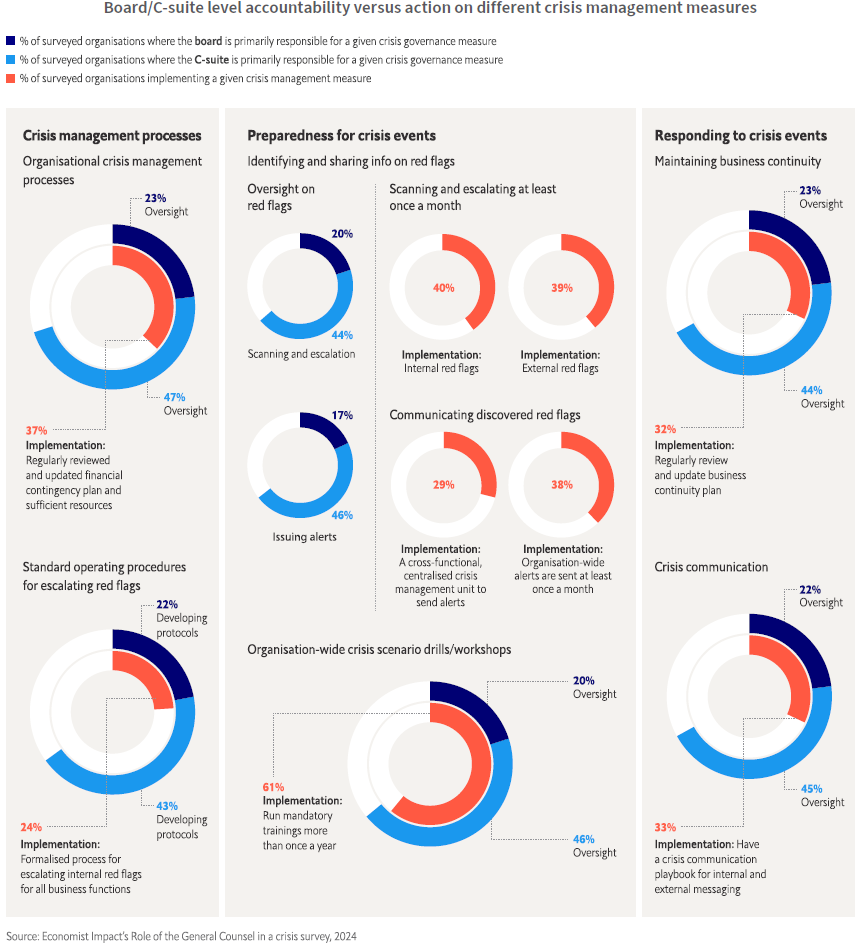
While there is some lack of clarity over the divisions of crisis management and preparedness responsibilities, the majority of these responsibilities are seen by General Counsels as coming under the purview of the executive team – which also means that generally, it is the C-suite who will be seen as accountable for the handling of any live crises.

Indeed, fewer than 25% of GCs state that the Board is primarily responsible for oversight of the crisis management processes, maintaining business continuity, overseeing crisis communications, or implementing preparedness training. In contrast, over 40% of GCs believe that the C-suite is responsible for these same tasks.

This perception gap can lead to weaker preparedness and ultimately a crisis response which is seen as inadequate by the Board and wider stakeholders. The 2020s have already seen major boardroom crises – the pandemic and its numerous implications, employee activism,
information wars, trade wars, the impact of military conflict, the explosion of generative AI and plenty more. As the major crises of this era are reviewed in the rear view mirror, so will questions be asked about crisis governance in order to enhance organisational resilience
for decades to come.

Methodology: Role of the General Counsel in a Crisis Survey

The GC survey, run by Economist Impact and sponsored by FTI Consulting, explored the perspectives of primary legal decision-makers on the nature of the crisis landscape today, their organisation’s crisis preparedness strategy and how their role has evolved in managing
these events.
The survey was fielded online and by telephone between April and May 2024. It covered a total of 600 primary legal decision-makers across North America, EMEA and APAC. It was fielded according to the following specifications:

  • Method: CATI/Online
  • Sample size: 600
  • Length: 25 questions (20 content + 5 demographic)
  • Function: legal only (GC or equivalent, e.g., chief legal
    officer)
  • Seniority: Director+
  • Screener: holds primary responsible for legal decisions
  • Sectors: Even split between:
  • Banking/financial services/insurance (including
    private equity)
  • Energy, oil and gas
  • Healthcare and life sciences
  • Technology and media
  • Retail and FMCG
  • Manufacturing
  • Geographies:
  • North America (n150): US
  • EMEA (n300): UK, Germany, Spain, France, UAE, Saudi Arabia
  • APAC (n150): China, Australia
  • Company size: US$1bn+ in annual revenue

Read our previous reports below

Endnotes
1 https://fticommunications.com/decade-of-disputes-the-trillion-dollar-investor-view/
2 https://fticommunications.com/the-decade-of-disputes-spotlight-on-environmental-litigation/
3 https://fticommunications.com/the-decade-of-disputes-no-barriers-to-antitrust-claims-from-corporate-activists/
4 https://fticommunications.com/the-decade-of-disputes-class-actions-financial-disputes-and-fraud-dominate-the-litigation-landscape-facing-media-scrutiny-in-2022/
5 https://fticommunications.com/the-decade-of-disputes-litigation-is-on-the-boardroom-agenda-for-the-year-ahead/
6 https://impact.economist.com/perspectives/sites/default/files/download/ei_turbulent_waters_trusted_anchors_-_the_general_counsels_evolving_role_in_navigating_
crises_report.pdf

The views expressed in this article are those of the author(s) and not necessarily the views of FTI Consulting, its management, its subsidiaries, its affiliates, or its other professionals.

©2025 FTI Consulting, Inc. All rights reserved. www.fticonsulting.com
Related Articles

4th Annual Shareholder Activism State of the Market

September 8, 2025—4th Annual Shareholder Activism State of the Market Request Report The 4th Annual Shareholder Activism State of the Mark...

Use It or Lose It: U.S. Hydrogen Industry Must Act To Maintain Momentum

July 12, 2025—Key takeaway: Following the passage of the “One Big Beautiful Bill Act”, time is of the essence for hydrogen produce...

Quick Analysis: ‘One Big Beautiful Bill’ Drives More Gas and Batteries, Less Renewables

July 3, 2025—With the recent passage of the “One Big Beautiful Bill” (“OBBB” or the “Legislation”),[1] FTI Consulting’s...

FTI Consulting News Bytes – 12 June 2026

June 12, 2026—FTI Consulting News Bytes From drones to chatbots to humanoid robotics and more, it has been a busy week as business and...

Global Public Affairs Newswire – 12 June 2026

June 12, 2026—Welcome to the latest instalment of FTI Consulting’s fortnightly Global Public Affairs Newswire. This week, we bring y...

ESG+ Newsletter – 11 June 2026

June 11, 2026—In this week’s ESG+ Newsletter, we first dive into updates within the sustainable reporting landscape, as Norges B...