Latin America 2026: The Rise of Special Situations
Current Latin American Political Dynamics Are Neither Regional Nor Pendular
If historical trends were the only guide, Latin America might be entering a new right-of-center “blue” cycle after the ebbing of the so-called second pink tide. The presidencies of Javier Milei in Argentina, Santiago Peña in Paraguay, Daniel Noboa in Ecuador, and Nayib Bukele’s recent reelection in El Salvador all point to a broader rightward shift.
Get our 2026 Latin America Insights in your inbox – Subscribe Now
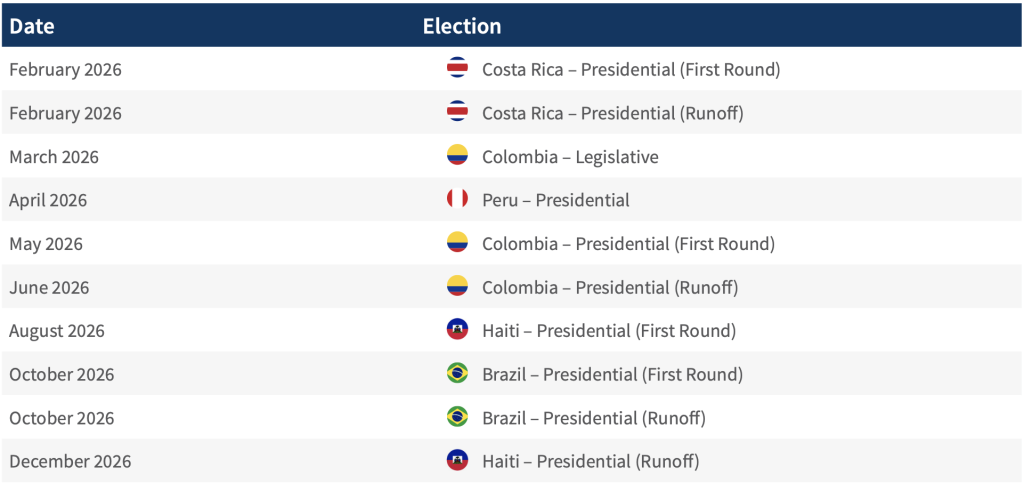
Current polling data provides little evidence that Brazil, Colombia, Costa Rica, Haiti, and Peru will inevitably elect conservative presidential candidates in 2026. But some analysts interpret the so-called “Trump Corollary” to the Monroe Doctrine as a new geopolitical vector potentially challenging even traditionally left-leaning strongholds. The arrest and pending U.S. trial of Venezuela’s Nicolás Maduro may represent just the beginning of a broader push for regional realignment.
Presidential elections in 2026
Despite any anticipated political shifts, investors in Mexico, Chile, Honduras, Colombia, and Brazil operate without the expectation of imminent new waves of pro-market reforms. Mexico’s judicial reform and energy counter-reforms, Chile’s constitutional uncertainty, Colombia’s pension and capital control regulatory issues, and Honduras’s renewable energy disputes demonstrate the region’s persistent tendency toward government intervention.
Paradoxically, sectors most affected by these dynamics continue attracting significant foreign investment. Leading companies, even when facing apparent existential threats, are staying committed – some expanding their regional presence through a broader and more diversified portfolio.
For businesses operating in Latin America, the limitations of viewing the region as an integrated whole have become undeniable. Applying simplistic “pendular politics” assumptions often results in flawed conclusions.
Country-specific and sectoral analyses provide better insights. But they remain imperfect for corporate decision-making. Traditional economic theory struggles to explain high investment appetite amid declining legal certainty and increasing political risk. Mexico is a particularly compelling case study.
Mexican risk paradox
- President Sheinbaum’s tenure, despite initial hopes for improved investment climate after AMLO’s confrontational years, has institutionalized concerning changes for investors. Judicial powers, anti-trust agencies, and energy regulators now operate with diminished independence, while draft energy policies suggest continued threats to existing investments.
- U.S. national security priorities, including cartel terrorist designations, have also created unconventional risks for businesses operating in Mexico given cartels’ extensive economic infiltration.
- While some major players like Iberdrola have divested assets and other industrial companies are marketing significant portions of their portfolios, most investors remain committed for the moment. Even in the heavily regulated electricity sector, participation in regulatory discussions and priority permitting rounds indicates ongoing interest, particularly among asset managers and private equity firms with existing Mexican exposure. Consolidation around specific asset classes, as opposed to foreign direct investment flight, seems more likely.
Rather than dismissing political and regulatory risk trends, leading investors and companies are adopting much more nuanced risk and opportunity assessment methods. They analyze specific situations with remarkable precision, looking at both risk and opportunity – not just case by case but situation by situation.
The Rise of Special Situations In Latin America
Pursuing opportunities against prevailing market trends rarely guarantees success. Unlike more traditional strategies, which follow a more standardized approach of completing standard regulatory and operational checklists for market entry or transactions, operating in Latin America’s volatile, uncertain, complex and ambiguous (VUCA, to use technical acronym) environments often requires strategic differentiation across key stakeholder groups. This requires insightful understanding of baseline stakeholder expectations and predispositions and a clear path to positively affect them.
Not all organizations are suited for success here. Though increasingly common throughout the region, these special situations, ranging from market entry, cross-border M&A, and managing government interventions, remain challenging. Successfully navigating them has evolved from a specialized skill to an essential capability for those aiming to unlock exceptional value.
Embracing high-stakes complexity
- Between January and November 2025, Latin America recorded 2,656 deals, a 3% decline in count year on year. But total disclosed rose by 13% to USD 95.9 billion. Deals exceeding the USD 1 billion threshold continues to rise. 62% of investors believe the opportunity in Latin America “has never been greater”.
- Liability management exercises “continue to take the spotlight in 2025,” driven by macro and political risk and looming maturities. These transactions are becoming “increasingly sophisticated and controversial.”
- Around two‑thirds of family-owned companies will either be sold or go out of business in the coming years. Family-controlled companies account for 75% of the region’s firms valued at USD 1 billion or more.
- Of 32 global investor–state resource cases initiated in 2025 globally, 11 were related to Latin America. Commercial arbitration is also booming, as rule of law considerations continue to weaken in countries like Mexico.
- According to World Bank data, the region has experienced a 25% annual growth rate in cyber incidents, now facing more complex and sophisticated attacks, particularly ransomware and financial malware.
- Between 2016 and 2025, four of the top eight countries with improper payments leading to Foreign Corrupt Practices Act (FCPA) actions were in Latin America. Further, the U.S. designation of a series of Latin American drug cartels as foreign terrorist organizations means that there are now more avenues for corporate disruption.
From Trend-Savvy to Situationally Aware
In Mexico, responding to stakeholder concerns means accounting for cartels’ opaque but widespread presence in many regions of the country and sectors of the economy, and for the impact of their designation as terrorist groups. It also requires weighing various scenarios on the future of the USMCA. Companies also need to continue to manage direct government intervention. The challenge is not only to take effective action on these fronts, but to communicate in a nuanced manner the adopted strategies.
No single recipe for action has emerged, or is likely to emerge. Companies are being called to ‘do more’ on third-party engagement, government relations, operational resilience, and compliance and internal controls, among other fields, but what exactly is meant by ‘doing more’ is up for debate. Ignoring an evolving risk profile may lead to legal or reputational problems; focusing solely on it can result in substantial business opportunities being allowed to pass by.
More than ever, risk mitigation needs to be tailored to a company’s specific business model, geographic footprint, and areas of material importance. It is not the same to develop and operate a major fixed asset in an area with a strong presence of organized crime, for instance, than to manage a diversified financial portfolio. And even within categories of this type, companies are following different paths. There are sellers exiting the market, and they have found purchasers eager to step in their place.
To prudently pursue opportunity in Mexico while remaining within a company’s expected risk profile, executives are updating their understanding of enterprise risk and of how exactly it could become material. They are turning to purpose-specific programs to help their leadership teams generate integrated internal analyses and deploy timely and proportional preventive measures and responses to potentially critical situations.
Key tenets of situational awareness in special situations
Being situationally aware means adopting a stakeholder-centric approach. Such an effort, structured around specific special situations, should emphasize:
Comprehensive identification rather than focusing only on obvious stakeholders
Pattern recognition by examining historical behaviors and analogous situations
Dynamic monitoring of stakeholder positions and coalitions as they shift
Scenario-based thinking to anticipate multiple plausible futures rather than planning for a single outcome
Proactive engagement designed to shape stakeholder perceptions rather than merely react to them, often seeking differentiation of the specific situation to the broader category
Continuous adaptation as new information emerges and stakeholder landscapes evolve
Organizations that rigorously apply this stakeholder centric approach, can identify value where others see only risk, and navigate complexity with greater confidence and precision in material, high-stakes situations.

Ana Heeren
Senior Managing Director, Public Affairs
Ana Heeren is a Senior Managing Director in the Strategic Communications segment and serves as the Head for Latin America and the Caribbean. Ms. Heeren brings deep experience and a global perspective to her clients, having developed comprehensive external and internal communication plans, public relations strategies and stakeholder engagements in the United States, Europe and Latin America.

Pablo Zarate
Senior Managing Director, Public Affairs
Pablo Zárate is a Senior Managing Director in the Strategic Communications segment, based in Houston and Mexico City. Mr. Zárate focuses on developing and overseeing issue management programs to address high-stakes corporate challenges such as acute political risk, disputes, complex financial transactions, regulatory issues, and reputational crises.
Related Insights




About Our Latin America Practice
FTI Consulting advises companies doing business across Latin America to navigate the stakeholder dynamics around special situations and high profile corporate events, from transactions and market entry to crisis, disputes and litigation. We help clients anticipate critical political, policy and reputational risks and effectively overcome them, unlocking long term opportunity. Our Latin America practice works in a coordinated manner through our offices in Mexico City, Bogotá, and São Paulo, as well as with our teams in Washington D.C., Brussels, Madrid, Houston, Miami, and other important hubs. Through our vast network of strategic partners, we have coverage on all Latin American countries.
Washington D.C. | Houston | Mexico City | Bogotá | São Paulo
The views expressed in this article are those of the author(s) and not necessarily the views of FTI Consulting, its management, its subsidiaries, its affiliates, or its other professionals. ©2026 FTI Consulting, Inc. All rights reserved. www.fticonsulting.com |