Global Public Affairs Newswire – 8 August 2025

Welcome to the latest instalment of FTI Consulting’s fortnightly Global Public Affairs Newswire.
This week, we bring you updates from FTI Public Affairs teams across the world’s major markets, including the United States, the United Kingdom, the European Union, China, Germany, Colombia, Australia, Brazil, India and France. This week’s update also brings readers market insights from FTI Public Affairs experts from around the world, explaining what these updates mean for your business.
Market updates
- President Trump to Meet with President Putin Over Ukraine Crisis: Multiple media outlets are reporting that President Trump will meet with Russian President Vladimir Putin to address the ongoing conflict in Ukraine in the coming weeks. Recently, Trump has expressed mounting frustration with Putin and the continued escalation of military aggression. In addition to applying direct diplomatic pressure and maintaining strict economic sanctions on Russia, the President is also using trade policy as leverage—imposing steep tariffs on nations that continue to import Russian oil. This includes a 50% tariff on goods from India, aimed at discouraging support for Russian energy exports.
- Governors Clash Over Redistricting Ahead of Midterms: Congressional district boundaries in the U.S. are drawn by individual state legislatures, a process historically used to benefit the party in power—commonly known as gerrymandering. While not new, redistricting has become a renewed flashpoint in recent weeks as the Texas legislature invoked its constitutional authority to redraw its congressional map ahead of the 2026 midterm elections. In response, Democratic legislators from Texas fled the state in an attempt block the proceedings. The move has triggered a broader partisan standoff, with several Democratic governors from blue states now signaling they may pursue their own redistricting efforts before 2026. With the balance of power in the U.S. House of Representatives hanging on razor-thin margins, the outcome of these redistricting battles could play a pivotal role in determining control of Congress.
For more information about FTI’s Public Affairs services in the Americas, please contact [email protected].
- The UK Conservative Party is facing mounting pressure following several recent defections to rival right-wing party Reform UK. When former Conservative MP of nearly 20 years, Adam Holloway, announced last week his defection to Nigel Farage’s party, he argued the decision was not solely motivated by ambitions to become an MP again. According to Holloway, the Conservatives currently “do not provide an effective opposition” and he saw joining Reform as a “rescue mission”.
- More defections have been announced this week, including Rupert Matthews, the Police and Crime Commissioner for Leicestershire and Rutland, giving the party its first PCC. Matthews’ defection provides an additional local government milestone to Reform, and a useful office from which to make the party’s case on what it describes as Britain’s “lawlessness”. These announcements join a growing list of Conservative figures who have joined Reform since the general election, including former Party Chairman Sir Jake Berry, former Wales Secretary David Jones, and Dame Andrea Jenkyns, who won the Greater Lincolnshire mayoralty for the party in May.
- More defections are expected in the coming weeks. While the Conservatives are yet to lose any major figures, mounting defections will still cause anxieties – particularly as the critical conference season looms into view. This week’s announcements will add to the sense that the institutional Conservative Party is moribund, and that the energy on the right of British politics sits with Reform UK instead. Conversely, Reform will be cautious of acquiring too many ex-Conservatives, who they argue have created many of the issues that Reform is campaigning to tackle.
- It is not only the Conservatives, however, that ought to be concerned by Reform’s rise. Polling suggests the upstart party is making inroads into Labour’s support in working class communities in the North of England, with several leading cabinet ministers’ seats at risk from continued Reform advances.
For more information about FTI’s Public Affairs services in the United Kingdom, please contact [email protected].
- On Sunday 25 July Commission President Ursula von der Leyen met with US President Donald Trump to agree on a trade that was in the making for several weeks. While many of the details need to be ironed out the main outcomes are the following:
- The US reduced its reciprocal tariffs on EU goods from the announced 30% to 15%, this also includes pharmaceuticals that are subject of a separate investigation on the grounds of national security (section 232).
- On certain strategic goods such as semi-conductors and aircraft the tariffs are fully eliminated
- Certain agricultural goods from the US will benefit of a tariff rate quota
- The EU eliminates its tariffs on industrial goods, it is not clear what products this entails
- The EU committed to purchase energy goods with a value of $ 750bn over three years and EU companies have expressed interest in investing at least $600 billion in the US
- Several areas remain unresolved. Most importantly there has been no agreement on steel, aluminium and copper. These will be subject to ongoing negotiations but the factsheets from the sides differ significantly on this point.
- The EU has already suspended its retaliatory tariffs by six months and the two sides are currently continuing negotiations to agree on the details and come to a joint statement.
- In the EU the deal attracted a lot of critical commentary, especially from the large Member States. However, the same Member States pushed the European Commission to conclude a deal in order to avoid higher tariffs om on their national industries.
For more information about FTI’s Public Affairs services in the EU, please contact [email protected]
- China’s Politburo on 30 July launched planning for the 15th Five-Year Plan (2026–2030), emphasizing high-quality development, tech self-reliance, and domestic demand. While echoing past priorities, the new cycle places added weight on economic resilience, security, and green growth, signaling continuity with incremental shifts amid evolving internal and external pressures.
- Despite soft indicators in consumption and real estate, the Politburo called the economy “generally improving,” citing strength in manufacturing and exports. It pledged continued but measured support – “proactive fiscal”, “prudent monetary” – while cautioning against excess liquidity. Priorities include stabilizing expectations, guiding property reforms, and tackling overcapacity and disorderly competition in select sectors.
- While the Politburo projected confidence, external views remained mixed. The IMF raised China’s 2025 growth forecast to 4.8% on export strength and policy support but flagged structural risks. Rating agencies cited debt and weak private sentiment. Markets reacted tepidly amid limited stimulus signals and lingering geopolitical and regulatory uncertainties.
For more information about FTI’s Public Affairs services in China, please contact [email protected]
- Headline figures: On 30 July 2025, German Finance Minister and Vice Chancellor Lars Klingbeil presented the federal budget for 2026 to the cabinet. The €520 billion ($572 billion) plan represents a 4.4% increase from 2025, with nearly a quarter (24.3%) dedicated to investments. The budget is balanced through €346 billion in revenues and €174 billion in debt, including €90 billion in new borrowing and €84 billion from special funds. Of these special funds, €25 billion is earmarked for defense and €59 billion for climate adaptation, reflecting the government’s twin priorities of security and sustainability.
- Budget winners and losers: The largest allocations go to the Ministry of Labour and Social Affairs (~€197 bn) for pensions and benefits, followed by the Defense Ministry, whose spending rises from €83 bn in 2026 to €161.8 bn by 2029 to reach NATO’s 3.5% GDP goal. Major subsidies target agriculture (€590 m via the GAK programme) and hydrogen/energy projects (€2.8 bn for IPCEI Hydrogen and the National Hydrogen Strategy). The biggest loser is the Ministry for Research, Technology and Space (BMFTR), cut by €1.1 bn (from €22.4 bn to €21.3 bn) after the Digitalpakt Schule ended, alongside reduced transport, international cooperation, and development funding.
- Medium-term financing gap: A €172 billion shortfall looms for 2027–2029, as spending commitments (e.g. on pensions, local government compensation, and interest costs) outpace projected revenues and allowable borrowing under the amended debt brake. Klingbeil has thus already called for spending discipline across all ministries, though specific cuts remain unclear. Early proposals, such as Economy Minister Reiche’s call for pension reforms to extend working lives and reductions to development aid, have already sparked significant public debate.
For more information about FTI Consulting’s Public Affairs services in Germany, please contact [email protected]
- On July 28, a judge found former president Álvaro Uribe guilty of procedural fraud and witness tampering, sentencing him to 12 years of house arrest. This landmark ruling, the first conviction of a Colombian president, underscores the weight of judicial independence while also amplifying political tensions and public debate nationwide.
- The ruling is expected to reshape the 2026 electoral landscape, dominating public debate and fueling polarization. Analysts anticipate that Uribe’s conviction will overshadow policy discussions, turning the elections into a battle between those viewing it as justice and others as persecution, with institutional legitimacy becoming a central issue in 2026.
- The decision also sparked international reactions, particularly from U.S. leaders. Secretary of State Marco Rubio and Senator Mario Díaz Balart condemned the verdict, calling it the work of “radical judges” and warning of its implications. Their comments add diplomatic strain amid regional debates on judicial autonomy, echoing recent tensions seen in Brazil.
For more information about FTI Consulting’s Public Affairs services in Colombia, please contact [email protected].
- Last week, Victorian State Premier Jacinta Allan, outlined her government’s plan to implement legal protections for employees who want to work from home for at least two days per week.
The topic came as a major tipping point of the Federal Election in May, with the Liberal/National Party Coalition backflipping mid-campaign on a major policy to ban public servants from working from home. - Working from home became common place across the country during the Covid-19 pandemic, a trend which has persisted since. However, no other Australian states have implemented legislation enshrining workers’ rights to work from home. Currently, it is up to employers to determine their own arrangements with employees.
- Ms Allan said the reform was about recognising modern work patterns, protecting employees from having flexible arrangements arbitrarily revoked and increasing productivity and inclusivity in the workforce. However, the Victorian Chamber of Commerce and Industry has raised “major concerns” on whether the plan could create inequality in the workforce due to the small percentage of workers that are able to work from home.
For more information about FTI’s Financial Services Public Affairs support in Australia, please contact [email protected].
- Brazil’s Supreme Court case against former President Jair Bolsonaro has entered its final phase, with a final ruling and sentence expected by October. Bolsonaro faces charges that include attempted coup and violent abolition of the rule of law. Justice Alexandre de Moraes, who has led the highly politicized case and has long been publicly antagonistic toward Bolsonaro, imposed precautionary measures in July after signs of obstruction – including evidence linking Bolsonaro’s son to recent U.S. tariff measures against Brazil. Despite restrictions, Bolsonaro continued to engage publicly, prompting the Court to order house arrest. The move triggered strong backlash: his political base and family are now pressuring the judiciary, and his party, PL, boycotted Congress this week, threatening to block all legislative activity.
- While the political climate remains volatile, the economic front has seen cautious progress since the Trump administration announced 50% tariffs on July 9. With diplomatic channels effectively frozen, Brazilian officials and private actors launched an improvised lobbying effort that secured exemptions for key exports like oil, fertilizers, and critical minerals. Though the tariffs are now in force, negotiations continue, and the government hopes to extend relief to other sectors, including meat and coffee.
- In parallel, the government is working to diversify trade partners. Vice President Geraldo Alckmin met with EU officials to push ratification of the stalled Mercosur–EU agreement. With the U.S. market under strain, sealing this deal is more urgent than ever. But domestic tensions—especially over Lula’s climate agenda and plans for oil exploration in the Amazon—risk undermining European support at a critical moment.
For more information about FTI’s Public Affairs services in Brazil, please contact [email protected]
- On August 6, President Trump announced a new 25% tariff on U.S. imports from India, adding to the 25% levy imposed last week and raising the total tariff burden to 50%, among the highest for any major economy. He also warned of further duties if India continues buying oil from Russia and again labelled the BRICS bloc a “threat.” The move marks a sharp tonal shift from the White House, which had long tolerated India’s ties with Moscow while courting it as a counterweight to China. New Delhi called Trump’s remarks “unjustified” and vowed to protect its economic interests. The warning comes ahead of an August 8 deadline for Russia to reach a truce with Ukraine, with potential secondary sanctions looming over countries that continue purchasing Russian energy.
- Indian exports to the U.S. totaled $87 billion in 2024, led by gems and jewelry ($8.5B), pharmaceuticals ($8B), and petrochemicals ($4B), all vulnerable to potential disruption. The U.S. is also India’s third largest source of FDI ($68B since 2002). While hit to India’s GDP is projected at just 0.2%, sectorspecific risks may be significant. Markets reacted with volatility on the announcement but stabilized, view the tariffs as a negotiation tactic.
- India’s trade stance remains firm, with clear red lines for sensitive sectors like agriculture, dairy, and GM products. PM Modi has shown little willingness to open these areas, even in recent trade agreements with the UK. Meanwhile, his Make in India” push has intensified, emphasizing self-reliance amid external pressure while remaining open to dialogue, with trade talks expected to continue late in August.
For more information about FTI’s Public Affairs services in India, please contact [email protected].
- French political leaders have been among the most outspoken critics of the EU-US tariff agreement. Prime Minister François Bayrou described the deal as a “dark day” for Europe, claiming the EU had “resigned itself to submission” by signing the agreement. President Emmanuel Macron echoed this sentiment in his 30 July remarks, asserting that the EU is “not feared enough” and pledging that France would adopt a firm and demanding approach in future negotiations with Washington.
- Other members of the French government acknowledged the agreement’s imbalance but viewed it as a short-term stabilising measure. Foreign Trade Minister Laurent Saint-Martin and Digital Affairs Minister Clara Chappaz stressed that France would continue to push for a more equitable deal, particularly in the area of digital services.
- The broader French political response has been overwhelmingly negative. Figures from both the far-left and far-right condemned the agreement, with far-right leader Marine Le Pen branding it a “political, economic, and moral fiasco.” Even within the presidential majority, disapproval was strong. Gabriel Attal, former Prime Minister and head of the pro-Macron Renaissance party, called for a rebalanced digital trade relationship. He urged the immediate imposition of substantial tariffs on digital giants, the activation of the EU’s anti-coercion mechanism, and the adoption of a “Buy European Act.”
For more information about FTI’s Public Affairs services in France, please contact [email protected]
Expert Analysis |
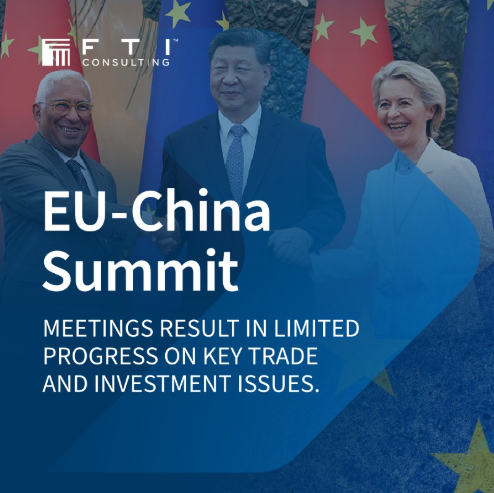
EU-China Summit
At the recent EU-China Summit in Beijing, EU and Chinese leaders discussed trade, geopolitics, and climate. But what were the main outcomes?
Our experts Samuel Wejchert and Rachel Hsueh share the top takeaways and their business impact.
FTO Designations in Mexico
Recent FinCEN orders and FTO designations mark a significant shift in U.S. financial enforcement, thrusting three Mexican banks into the spotlight.
In our latest article, our experts offer their analysis on how to strategically navigate the issue of FTO designations in Mexico.
Upcoming Elections
- 17 August: General election (Bolivia)
- 08 September: Parliamentary elections (Norway)
- 14 September: State elections (Russia)
- 16 September: General election (Malawi)
- 27 September: General election (Seychelles)
To be added to the distribution list for the Global PA Newswire, or for further information on the dedicated Public Affairs team at FTI, please contact [email protected]. |
The views expressed in this article are those of the author(s) and not necessarily the views of FTI Consulting, its management, its subsidiaries, its affiliates, or its other professionals.
©2025 FTI Consulting, Inc. All rights reserved. www.fticonsulting.com