ESG+ Newsletter – 25 June 2026
We open this week’s ESG+ with a look at the growing momentum behind pass-through voting, as investor appetite and technological capability continue to reshape how proxy votes are cast. We then turn to the EU’s release of draft sustainability reporting standards for non-EU businesses, California’s lawsuit against the EPA over the reclassification of Clean Air Act waivers, and the EU Commission’s plans to extend free CO2 permits to heavy industry. We close with a look at the newly launched Taskforce on Inequality and Social-Related Financial Disclosures, which aims to build a common language around how social issues financially affect businesses. First, our weekly poll.
This week’s poll
Should domestic EU producers receive more lenience on emission limits to assist international competitiveness?
- No, competitiveness can be supported without permitting increased emissions.
- Yes, international competitiveness should take precedence over climate concerns.
Last week’s poll
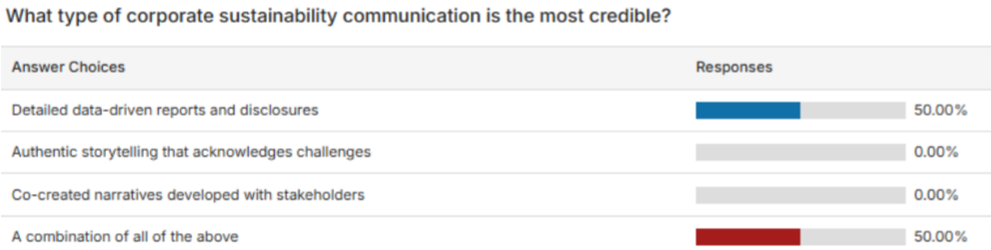
Pass-through voting gains ground
Momentum is building behind pass-through voting – programmes that allow investors greater flexibility over how their shares are voted by asset managers – with both investor appetite and technological capability pointing in the same direction, according to GovernanceIntelligence.
Vanguard data reveals that 83% of surveyed investors believe fund managers should take investor preferences into account when casting proxy votes, with 60% expressing interest in participating in a pass-through voting programme. The prevailing model does not require investors to vote on every individual ballot item. Instead, most programmes offer a menu of voting policies, enabling meaningful participation without overwhelming investors with thousands of discrete decisions.
Swatika Rajaram, President of Bank and Broker-Dealer Solutions at Broadridge, notes that the firm now powers pass-through voting for more than $8 trillion across 900 funds, up from 400 funds last year and just eight funds three years ago. She attributes the acceleration to growing investor awareness of these solutions, as well as an improved user experience, and suggests that AI could ultimately push the market beyond simple menus of voting policies toward greater customisation.
EU releases draft sustainability reporting standards for US businesses
|
State of California sues EPA over reclassification of environmental waivers
The state of California has sued the US Environmental Protection Agency (EPA), Reuters reports. This follows a move from the EPA to reclassify four Clean Air Act waivers that allow California to enforce emission standards beyond those set at the federal level. The reclassification would see these waivers altered from orders to rules, enabling a congressional review, which could result in a reduction of California’s ability to mandate in-state emissions standards. In its June 12 announcement, the EPA stated that the move was intended to promote “consumer choice and ensuring affordable vehicles for all Americans.” Likely alluding to the fact that California requires automakers to sell an increasing number of electric vehicles and meet limits on tailpipe emissions. California Attorney General, Rob Bonta, has claimed that the review, if resulting in a reclassification, would “mean more pollution, poorer air quality, more market uncertainty and greater health risks for communities already overburdened by emissions.” Notably, this is not the first time California has challenged the EPA under the current administration, having previously led a coalition of states in a similar lawsuit in 2025.
EU to introduce free C02 permits for heavy industry
The EU Commission is preparing to grant additional free CO2 permits to heavy industry, ESG News reports. The move comes amid growing pressure on domestic producers from international competition, as well as pushback from certain member states over the cost burden of EU carbon pricing. The credits would be allocated through the existing Emissions Trading System (ETS), under which companies purchase permits to cover greenhouse gas emissions released during production. A portion of permits are already allocated at no cost, a practice that would be expanded under the current proposal. The short-term impact would be a reduction in compliance costs for EU producers, though the degree to which further ETS revisions will affect long-term climate policy remains to be seen. The ETS revision is due to be presented in mid-July and will include proposals regarding the additional free credit allocation. If approved, the additional allocation is expected to apply from 2026.
Launch of a new framework for social impact related financial disclosures
Social issues are poorly measured and managed, as described by Namit Agarwal of the World Benchmarking Alliance, who spoke at the launch of the Taskforce on Inequality and Social-Related Financial Disclosures (TISFD) at London Climate Action Week. Released recently, the framework is setting out to build a common language on how people and social issues can financially affect businesses to give clear direction on the business case for social impact.
Framed as a continuum of materiality, both impact and financial, TISFD addresses businesses dependencies on people that could lead to a material risk for a business. For example, the current wave of local community opposition to data centres in the US and Europe could lead to an operation and financial risk for big tech.
The TISFD will address four key areas: strategy, risk management, governance and metrics & targets (in line with TCFD and TNFD approaches). Social issues especially inequality are underdiscussed and undervalued says the Technical Director of the TISFD Andrea Saldarriaga and addressing inequality is an important way to bridge exacerbating political divides. There is also evidence from Generation Investment Management that social topics are increasingly on the minds of investors.
With challenges such as comparability and data gaps, the next phase will focus on the development of metrics & targets. Version 1.0 is out now for public consultation until July 31st.
| The views expressed in this article are those of the author(s) and not necessarily the views of FTI Consulting, its management, its subsidiaries, its affiliates, or its other professionals.
©2026 FTI Consulting, Inc. All rights reserved. www.fticonsulting.com |