Global Public Affairs Newswire – 7 March 2025
Welcome to the latest instalment of FTI Consulting’s fortnightly Global Public Affairs Newswire.
This week, we bring you updates from FTI Public Affairs teams across the world’s major markets, including the United States, China, India, the United Kingdom, Germany, Ireland, South Africa, Brazil, Colombia, and Spain. This week’s update also brings readers market insights from FTI Public Affairs experts from around the world, explaining what these updates mean for your business.
Market updates
President Trump delivered an address before a joint session of the U.S. Congress Tuesday night to highlight the accomplishments of his first weeks in office and preview his legislative agenda. The 100-minute speech was the longest ever delivered before a joint session (take that, Bill Clinton!) and received the anticipated partisan reactions: Republicans were elated by the president’s take charge approach; Democrats disgruntled about the partisan attacks. The speech was an important moment in the congressional calendar as the president’s budget and tax legislation are being considered by both chambers; the passage of both is critical to the president’s domestic agenda. Given the slim Republican margin in the House of Representatives, some observers were surprised by the lack of outreach to Democrats to build broader support, but between the name calling (Hi, Elizabeth Warren) and the antics of some House Democrats (oh boy, Al Green), it seems both the White House and the Democrats have no interest in a compromise. By the way, Greenland!
Here come the tariffs (or not)! Earlier in the day on Tuesday, President Trump used his executive authority to levy the expected 25% tariffs on the U.S.’s largest trading partners, Mexico and Canada, as well as a 20% tariff on exports from China. Markets reacted cautiously, reflecting a belief that the tariffs are being used as a negotiation tool. By Wednesday, the administration was signaling flexibility, reminding market observers that the tariffs can be rescinded or amended as easily as announced. By Thursday, the White House made significant reductions and pauses to implementation. Some corporate leaders (if not members of the Republican Senate Caucus) are showing concern about the uncertainty created by changing tariff scheme as it interferes with both short-term and long-term business assessments related to growth strategies.
Um, that did not go well: As President Trump commented, last week’s meeting with President Zelenskyy at least made great television. President Zelenskyy met with President Trump in the Oval Office for a press avail to highlight continuing cooperation between the U.S. and Ukraine in resolving the Ukrainian crisis. The meeting turned contentious after Vice President JD Vance suggested President Zelenskyy had not shown the proper appreciation for the U.S. contribution to the security of Ukraine. The rest of the visit was cancelled, and the U.S. suspended portions of its military aid package. In the following days, the Ukrainian government and U.S. government re-engaged.
Democrats continue to struggle: The opposition party is still trying to find its footing after last fall’s defeat and the president’s assertive policy roll out in the last weeks. Conflicting messages and strategies preceding and following the president’s address to Congress emerged. The left wing of the Democratic party is increasingly frustrated by a perceived lack of fight by Democrats in the Congress; centrists rally around strategist James Carville’s counsel to “play possum” over the next months – betting any negative effects of the president’s policies will soon be felt by the public, undercutting the GOP’s political standing and its policy agenda.
Early warning signs in the districts?: Carville may be on to something. After a few disruptive town hall meetings some Republican congressmen held in their districts, the campaign arm of the House Republicans strongly suggested members postpone future “in person” town halls. Constituent concerns about Elon Musk’s DOGE initiative and its impacts on jobs and benefits were driving vocal discontent, dominating local and national media coverage of the public meetings.
For more information about FTI’s Public Affairs services in the Americas, please contact [email protected].
China hit back at U.S. imports on 4 March, one day after the Trump administration’s fresh tariffs took effect. After denying any wrongdoing in the alleged fentanyl issue, China’s Commerce Ministry spokesperson previously vowed to take countermeasures to firmly safeguard China’s legitimate rights and interests at a regular press conference. As a result, China decided to import levies on a spectrum of goods ranging from American agricultural and food products. Beijing will impose an additional 15% tariff on U.S. chicken, wheat, corn, and cotton and an extra 10% levy on U.S. soybeans, sorghum, pork, beef, aquatic products, fruits and vegetables, and dairy imports from 10 March, according to the statement from the Ministry of Finance.
On the same day as announcing retaliatory duties, China added 15 U.S. companies to an export control list, asking to halt all ongoing export activities and requesting special permissions from the MOFCOM for any future exports. According to the MOFCOM statement, another 10 American enterprises were put on China’s list of unreliable entities, which would prevent them from investing within the country. Both updates on China’s export control took effect immediately.
Following the levies and export controls, China initiated its first anti-circumvention investigation, targeting related U.S. fiber optic products. The notice from the Ministry of Commerce noted relevant fiber optic products are suspected of circumventing China’s anti-dumping measures, and the ministry launched the probe at the request of domestic industries. In addition, the General Administration of Customs of the PRC issued an announcement on 4 March to suspend lumber imports from the United States, citing ecological security.
For more information about FTI’s Public Affairs services in China, please contact [email protected]
European Commission president Ursula von der Leyen and Prime Minister Narendra Modi have promised a free trade agreement (FTA) by end-2025, after years of talks. The two leaders’ joint press meet on February 28 rounded off the first-ever trip to India of the EU’s 27-member Commissioners College, in the backdrop of Trump’s tariff threats against both India and Europe.
The EU is India’s largest trading partner, with goods trade at USD 137.5 billion in fiscal 2024, nearly doubling over a decade. Europe wants increased access to India’s protected market, with lower tariffs on imported cars, whiskey and wine, while India wants better access and tariffs for its chemicals and drugs, textiles, garments and leather products, as well as a friendlier visa regime for Indian professionals. India also opposes EU’s proposed CBAM tariffs on high-carbon steel, aluminum and cement in 2026.
An India-EU joint statement committed to cooperation in trade and de-risking of supply chains, investment, emerging critical technologies, innovation, talent, digital and green industrial transition, space and geospatial sectors, and defence. Also promised were partnerships for connectivity, clean energy and climate, water, smart and sustainable urbanization, and disaster management. Energy (clean hydrogen, offshore wind, and solar) got a special mention.
The FTA talks gain urgency amid shifting global dynamics and rising US-EU tensions, with disputes over multiple issues and Trump’s claim that the European Union was “formed to screw the United States”. India has 13 FTAs and is working on a trade pact with the USA focused on pharma and tech, with a first tranche committed by fall of 2025, and a UK FTA, which has seen 14 rounds and disagreements over Scotch whisky tariffs and UK demands for EV market access. A successful India-EU FTA would be very important for both.
For more information about FTI’s Public Affairs services in India, please contact [email protected]
Following a meeting last week with US President Donald Trump, which took place shortly before Trump and Vice President JD Vance’s meeting with Ukrainian President Volodymyr Zelenskyy, the UK’s Prime Minister, Sir Keir Starmer, has spent much of the last two weeks seeking to establish himself as a diplomatic bridge between the United States and Europe.
On 2 March, European leaders gathered in London for the “Leaders’ Summit”, hosted by Starmer at Lancaster House. This meeting aimed to reinforce European support for Ukraine in the wake of Zelenskyy’s meeting with Trump and coordinate a unified approach to the ongoing conflict.
The “Leaders’ Summit”, described by Starmer as a “once-in-a-generation moment for the future of Europe”, brought together leaders from over a dozen nations, including France, Germany, Italy, Poland, and officials from NATO and the European Union. The summit culminated in the formation of what Starmer described as a “coalition of the willing,” that will seek to craft a peace strategy for Ukraine to be presented to the United States. In addition to his diplomatic efforts, Starmer concurrently announced a new £1.6bn missile deal for Ukraine that will see the production of over 5,000 lightweight-multirole missiles in Belfast, Northern Ireland.
Throughout discussions, Starmer has emphasized the need for Europe to “take the lead” while ensuring US backing for any peace plan. In light of increased tensions between Ukraine and the United States, Starmer has sought to position the UK as a mediator, leveraging his recent productive meeting with President Trump to refocus negotiations. The success of this strategy will largely depend on Starmer’s ability to maintain European solidarity, effectively engage with the Trump administration, and deliver tangible results in the peace process for Ukraine.
If successful, this European-led approach to international security could potentially reshape the global arms market. As European countries increase defence budgets to plug the hole left by the withdrawal of US support, nations are likely to channel increased spending towards their own domestic manufacturers, exemplified by Starmer’s missile deal. The increased focus on domestic production could lead to a substantial boost in innovation, job creation, and economic growth within the European defence sector, as seen by the current surge in European defence stocks.
For more information about FTI’s Public Affairs services in the United Kingdom, please contact [email protected]
The SPD suffered a significant loss, leading Chancellor Olaf Scholz to announce his retirement from politics. The Greens underperformed compared to expectations, while the FDP failed to re-enter the Bundestag, prompting FDP leader and former Finance Minister Christian Lindner to step down from politics. The Left Party managed a strong comeback and secured representation in parliament, while the AfD doubled its vote share but remains excluded from coalition talks due to its far-right stance. With the BSW failing to pass the 5% threshold, the most likely governing option is a Grand Coalition between CDU/CSU and SPD, which would secure a narrow parliamentary majority. While this coalition is politically feasible, it comes with challenges, including internal SPD divisions, voter dissatisfaction with past Grand Coalitions, and potential difficulties in passing legislation due to the slim majority. Markus Söder, CSU leader, strongly opposes working with the Greens, and given the parliamentary arithmetic, no broader coalition is being seriously considered. Merz has emphasized the need for swift coalition talks, aiming for negotiations to conclude by Easter, with the Bundestag set to convene for its first official session on March 25. Final coalition negotiations will focus on bridging policy differences between CDU/CSU and SPD while ensuring the stability of the government despite its narrow majority. If talks between CDU/CSU and SPD were to break down, alternative government formations would be highly difficult, leaving few viable options outside of new elections or a minority government.
Taoiseach Micheál Martin is expected to raise the potential impact of US tariffs on Ireland’s “small, open economy” when he meets with President Trump next week. Taoiseach Martin will travel to the White House on 12 March as part of Ireland’s annual St Patrick’s Day Programme. Ireland has stepped up its engagement with the Trump Administration and has been keen to emphasis the strong economic ties between the two countries. Ireland exports €72 billion of goods to the US, with €58 billion worth of those goods manufactured by pharmaceutical companies. President Trump’s threat to impose 25% tariffs on pharmaceutical imports leaves Ireland’s economy particularly exposed, with the Taoiseach acknowledging that such tariffs would be challenging.
The White House meeting follows a call this week between Tánaiste and Minister for Foreign Affairs and Trade, Simon Harris and US Secretary of State Marco Rubio in which the two discussed energy security and co-operation with US companies operating in Ireland. Ukraine is also likely to come up as the meeting will take place following this week’s EU Council Summit. Taoiseach Martin described the recent meeting between President Trump and President Zelenskyy as a “serious setback”.
For more information about FTI’s Public Affairs services in Ireland, please contact [email protected]
Business Unity South Africa (BUSA), the nation’s apex industry association, has strategically positioned itself to drive the B20 agenda under the banner “Inclusive Growth and Prosperity through Global Co-operation.” During the global business forum held in Cape Town from 24–25 February, BUSA underscored the pivotal role of the business community in both collaborating with and constructively challenging government initiatives, all within today’s complex geopolitical environment.
As the final B20 host from the Global South, the forum is dedicated to ensuring continuity with previous presidencies while placing the African agenda centre stage. With Africa home to some of the world’s fastest-growing economies and a rapidly expanding workforce, addressing the continent’s challenges is essential for shaping global economic reforms. The event’s Task Force Chairs and panellists stressed the importance of heightened government and business engagement, urging the private sector to mobilise investments, drive innovation, and develop solutions to common challenges.
South Africa’s B20 key priorities are integrated into the strategic approach: accelerating a just energy transition, unlocking inclusive economic participation, investing in human capital to nurture thriving skills markets, and strengthening both global and regional supply chains. These objectives will be achieved through the concerted efforts of eight dedicated task forces, ensuring that policy recommendations are succinct and implementable.
For more information about FTI’s Public Affairs services in South Africa, please contact [email protected]
On 5 March, in a televised address, President Macron warned that Russian aggression would not stop at Ukraine and is a direct threat to France and Europe, arguing that a true peace in Ukraine would need to be backed by security guarantees for Kyiv. He urged Europe to increase preparations for the possibility of reduced US involvement on the continent, celebrating recent efforts at the EU level to reform the Stability and Growth pact to allow for increased defence spending. He pledged that France would step up its defence efforts through both public and private means and said he would discuss with European partners extending French nuclear deterrence to other countries on the continent, although he clarified that the decision and control would always remain in the hands of the French president.
Macron’s speech came as he intensified diplomatic efforts to reinforce European unity in response to the Trump administration’s abrupt policy shift on Ukraine, especially following the heated exchange between Trump and Zelenskyy in the Oval Office on 28 February. The clash was widely condemned across the French political spectrum, including by the far right, during a parliamentary debate on Ukraine. A new poll revealed that 73% of respondents believed the “USA was no longer a French ally.” Further fuelling tensions, remarks by U.S. Vice President J.D. Vance seemingly mocking Franco-British peace efforts were sharply criticized by French Defence Minister Sébastien Lecornu. His response—”The approximately 600 soldiers who died for France deserve respect”—was met with a standing ovation in the National Assembly.
On 2 March, Macron met with European leaders in London, where he and British Prime Minister Keir Starmer pledged to lead talks on forming a “coalition of the willing” to provide security guarantees for Ukraine if a ceasefire is reached. The French delegation also proposed a one-month partial truce covering air, sea, and energy infrastructure, with Foreign Minister Jean-Noël Barrot stating that “such a truce would allow us to determine whether Vladimir Putin is acting in good faith.” However, the proposal has not gained traction with Ukraine or France’s European partners.
For more information about FTI’s Public Affairs services in France, please contact [email protected]
President Donald Trump has announced new tariffs on America’s main trading partners—Mexico, Canada, and China—escalating trade tensions and prompting swift reactions from affected nations. In a congressional address, he singled out Brazil, which he claimed has historically imposed high tariffs on American products, reinforcing his administration’s decision to retaliate.
The impact of these policies on Brazil’s economy is expected to be mixed. The aluminum sector, for instance, may face competitiveness challenges. Although Brazilian aluminum accounts for less than 1% of U.S. imports, the American market represents nearly 17% of Brazil’s aluminum exports. Although recent negotiations on quotas mitigated the entire impact, the new tariffs increase costs, generating miscomprehension on the actual changes in prices and thereby making Brazilian products less attractive to the American market.
On the other hand, Brazilian agribusiness could see a silver lining. In response to U.S. tariffs, China has imposed retaliatory duties on American agricultural products, including soybeans, pork, and poultry. As a result, Brazil may be well-positioned to expand its market share as a key alternative supplier.
Beyond these sector-specific effects, the broader economic consequences could be significant. Trade disruptions may heighten exchange rate volatility and inflationary pressures, while a stronger U.S. dollar and rising interest rates could create additional hurdles for Brazil’s economic stability. The Brazilian government is closely monitoring the situation, with Vice President Geraldo Alckmin seeking discussions with U.S. Commerce Secretary Howard Lutnick. As discussions unfold, companies with exposure to U.S.-Brazil trade should closely monitor developments to anticipate potential shifts in market dynamics.
For more information about FTI’s Public Affairs services in Brazil, please contact [email protected]
On February 25th, the 16th Conference of the Parties to the Convention on Biological Diversity (COP16), which began in Cali, Colombia, was resumed in Rome.
Led by Colombian Minister Susana Muhamad, the meeting ended without a clear agreement on how developed nations will provide the necessary US$20 billion per year by 2025—or the US$200 billion annually needed by 2030—to support biodiversity conservation in developing countries. However, countries agreed on a roadmap to establish a financial mechanism by 2028 and set indicators to assess conservation progress at COP17.
For now, funds will be managed through the Global Biodiversity Framework Fund (GBFF), though concerns remain over equitable access. Main outcome for Colombia and the Petro Administration was the launch of the Cali Fund, which requires global companies in sectors like pharmaceuticals and agriculture to contribute a share of revenues from genetic resource use. Its success, however, depends on national legislation, and U.S. companies, despite being major patent holders, remain outside the COP16 framework.
The 17th Conference of the Parties (COP17) will take place in Yerevan, Armenia, in 2026. In the meantime, ministers of finance and environment will meet regularly to explore alternative funding sources while efforts continue to phase out US$500 billion of subsidies.
The summit also marked Minister Muhamad’s final appearance before her resignation from government, leaving her next steps open to roles in international cooperation or regional planning in Latin America.
The Mobile World Congress (MWC) 2025, held in Barcelona from March 3 to 6, has once again positioned Spain at the forefront of global technological innovation. This year’s edition has not only focused on technological innovation, but also on the role of Spain and Europe in increasingly competitive digital landscape shaped by artificial intelligence (AI), 5G, and technological autonomy. Inaugurated by His Majesty King Felipe VI and Prime Minister Pedro Sánchez, MWC 2025 attracted over 100,000 attendees and served as a platform for major industry players to discuss advancements in cybersecurity, defense, or sustainability.
Beyond innovation, MWC 2025 has once again put on the table the need to strengthen European technological sovereignty. Spain is positioning itself at the heart of this effort, backed by a growing ecosystem of technology start-ups and strong investment in digitalization. With this view, Prime Minister Pedro Sánchez emphasized Spain’s readiness to take a leading role in Europe’s digital transformation, with a clear focus on cybersecurity, artificial intelligence, and digital rights as key pillars of its technological agenda.
MWC 2025 underscores that Spain has the potential to be more than just the host of one of the world’s largest technology summit—it has the opportunity to establish itself as a true global digital leader. The challenge now lies in translating this momentum into long-term impact, ensuring that the country’s growing technological ecosystem and policy initiatives materialize into sustainable leadership. If Spain successfully capitalizes on this platform, it could position itself as not just a European reference, but a key player in the global digital landscape.
For more information about FTI’s Public Affairs services in Spain, please contact [email protected].
Expert Analysis |
UK Public Affairs Snapshot: Britain’s Critical Minerals Approach
Critical minerals and their global supply chains are an area of increasing political focus at a time when technological demand is growing while norms in international trade diminish.
FTI Consulting’s UK Public Affairs team explores whether the foundations are in place for a government strategy that brings together the country’s natural resources, essential infrastructure and market leading expertise in mining and financial markets.
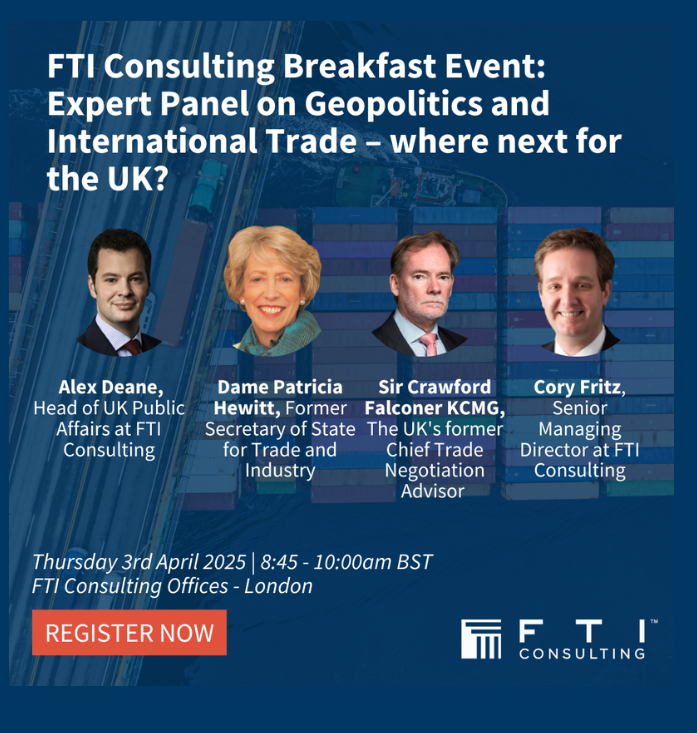
Breakfast Event: Expert Panel on Geopolitics and International Trade
Against the backdrop of an increasingly complex and contested geopolitical and international trade environment, FTI Consulting is delighted to be hosting an expert panel to explore the implications of recent events for UK businesses and investors. During the event, the panel will explore US policy toward the UK and Europe, a potential UK-US trade agreement and UK resets with the EU and China.
Following a moderated Q&A, there will also be an opportunity for attendees to ask questions to the panel. Breakfast will also be served.
Date:Thursday 3rd April | 08:45-10:00 BST
Location: FTI Consulting London Office
Clean Industrial Deal: The Green Future of EU Industry
Last week, the European Commission published its Clean Industrial Deal (CID), which marks a significant milestone!
The CID is marked as a “transformative business plan”, expected to develop the governance needed for a ‘true Energy Union’ and progress the transition towards renewable energy sources.
Our Energy colleagues in Brussels take a look at what the Clean Industrial Deal entails, and outline the ways in which these developments can affect your business.
What Directors Think: A Changing Risk Landscape
FTI Consulting partnered with Corporate Board Member and Diligent Institute in late 2024 to survey directors of publicly traded companies in the United States about their company’s top priorities, potential disruptors and other pressing topics on the board’s agenda in 2025.
Learn more about how directors anticipate navigating these opportunities and challenges.
Upcoming Conferences, Elections and Webinars
- 08 March: Regional election (Western Australia, Australia)
- 23 March: Snap regional election (Madeira, Portugal)
To be added to the distribution list for the Global PA Newswire, or for further information on the dedicated Public Affairs team at FTI, please contact [email protected]. |
The views expressed in this article are those of the author(s) and not necessarily the views of FTI Consulting, its management, its subsidiaries, its affiliates, or its other professionals.
©2025 FTI Consulting, Inc. All rights reserved. www.fticonsulting.com