Global Public Affairs Newswire

Global Public Affairs Newswire – 17 October 2025

Welcome to the latest instalment of FTI Consulting’s fortnightly Global Public Affairs Newswire.

This week, we bring you updates from FTI Public Affairs teams across the world’s major markets, including the United States, the United Kingdom, France, China, India, the European Union, Brazil, Spain, Australia, Colombia, and South Africa. This week’s update also brings readers market insights from FTI Public Affairs experts from around the world, explaining what these updates mean for your business.

Market updates

Trump’s high-stakes week: war, peace, and shutdown politics
  • Trump on the March: President Trump is pressing an assertive foreign policy agenda across Europe, the Middle East, and Latin America—attending the signing of a U.S.-brokered Israel-Hamas peace deal, authorizing strikes on alleged drug vessels in Venezuela, and signaling readiness to send Tomahawk missiles to Ukraine. While media coverage has been broadly favorable, analysts question the durability of the cease-fire, the legality of Venezuela operations, and inconsistencies in Ukraine policy.
  • Who Pays the Soldiers?  The federal government remains shut down amid stalled congressional budget talks, with growing political impact as government services slow across the country. A flashpoint has emerged over whether the military will be paid throughout the shutdown, with Democrats seizing on the issue and the President pledging that troops will still be paid through an alternative Department of Defense funding mechanism.
“President Trump’s leadership and influence was on display this week at home and abroad. His reach is also being tested by the courts, entrenched challenges in the Middle East, and by President Xi. It remains to be seen if these will pose real limits to his influence or be temporary setbacks.”
Jennifer Kaplan
Managing Director, US Public Affairs

For more information about FTI’s Public Affairs services in the Americas, please contact [email protected].

Controversy over China espionage case intensifies
  • With MPs returning to Parliament following the party conference recess, Prime Minister Keir Starmer faces new pressure over the collapse of an espionage case against two British men, including a former parliamentary aide, both of whom were accused of spying on behalf of China. It had been reported that the Crown Prosecution Service (CPS) could not move ahead with the prosecution because the previous UK government had refused to say whether China was a threat to national security at the time of the alleged offences (2021 – 2023).
  • Witness statements released by the Government this morning have cast doubt on that narrative, as they include the acknowledgement from the UK’s director of public prosecutions that China’s intelligence services “harm the interests and security of the UK”. Opposition parties are more focused, however, on the statement from deputy national security adviser Matthew Collins, which notes that “the Government is committed to pursuing positive relationships with China”. Addressing Starmer at Prime Minister’s Questions this week, Opposition leader Kemi Badenoch described the Government’s account of events as “simply unbelievable”, arguing that the failure of the case was a result of Starmer’s desire for closer bonds with China.
  • Starmer has nevertheless sought to pin blame squarely at the door of his predecessors, noting that “the substantive evidence was written and disclosed and submitted in 2023 by the last Government”, who were reticent to describe China as a threat. But in any event, the story is further unwelcome critique for a Prime Minister still seeking to steady the ship after a series of high-profile scandals that have led to ministerial and adviser resignations. With shadow ministers arguing that the case demonstrates the PM’s weakness on national security, and Speaker of the House of Commons Lindsay Hoyle widely reported to be furious about its outcome, this story is wounding for the Government at a politically precarious moment ahead of next month’s Budget.
"The collapse of this case raises serious questions about whether political calculation has been allowed to override national security. While the Government continues doggedly to pin the blame on the decision-making of its predecessors, in the eyes of the electorate any such nuance will be lost. This has happened on Keir Starmer's watch and it was his ministers and advisers that inherited the case and endorsed key decisions. While the news cycle will soon move on, this can only add to the pernicious erosion of public trust in the UK's institutions and its elected representatives, risking credibility at home and relationships abroad."

Ollie Welch
Managing Director, United Kingdom

For more information about FTI’s Public Affairs services in the United Kingdom, please contact [email protected].

French PM names new government and attempts to find path to a budget
  • French PM Sébastien Lecornu unveiled his new government on October 12, two days after being reappointed as prime minister. The cabinet consists of civil servants, politicians, and civil society figures. Among those staying on are foreign minister Jean-Noël Barrot, justice minister Gérald Darmanin and budget minister Amélie de Montchalin. Macron ally Roland Lescure, appointed as finance minister in Lecornu’s initial cabinet, will also stay on.
  • In a speech to Parliament on October 14, the Prime Minister made important concessions to the Socialist Party, who are kingmakers in any no-confidence vote, by announcing the suspension of the controversial 2023 pension reform. A 2026 budget draft has been filed with Parliament, which aims for a deficit of 4.7%, and includes a temporary rise in corporate tax as well as other levies and spending cuts. No-confidence motions submitted by the far-left and far-right were dismissed on Thursday morning, paving the way for a few months of stability.
  • Significant obstacles remain, including political polarisation, a hung parliament and the upcoming 2026 municipal and 2027 presidential election, as leading politicians prepare their campaigns and seek to occupy the political agenda
“Lecornu’s concessions, namely, suspending the 2023 pension reform and relinquishing executive powers to pass the budget, reflect growing unease over the potential outcome of early elections, which had been floated as the fallback option if the latest attempt at government formation failed. Moderate parties fear that a snap vote could hand the far-right the largest bloc, thus compelling President Macron to appoint a Prime Minister from their ranks. Lecornu has stated that his government has a single mission, suggesting its sole focus will be on passing the 2026 budget and addressing the immediate political crisis engulfing France. However, it's unclear how approving a budget would resolve the deeper parliamentary deadlock. While approving a budget might reassure financial markets and offer short-term stability, Lecornu’s government could face renewed pressure by spring, potentially increasing the likelihood of early elections.”

Gregory Grellet
Head of Public Affairs, France
For more information about FTI’s Public Affairs services in France, please contact [email protected] 

China’s rare Earth export measures and the dynamics of China-U.S. tensions
  • China’s recent augmentation of rare earth export regulations demonstrates a calibrated assertiveness in leveraging its predominance in critical minerals. By broadening the ambit of controls to encompass a wider array of materials, technologies, and downstream supply chains and projecting regulatory influence beyond its borders, China appears to be directly countering U.S. export restrictions, notably the “50% affiliates” rule.
  • The United States responded with stark threats, including the prospect of sweeping tariffs and supplementary export curbs. While some officials later adopted a moderated tone in anticipation of potential high-level discussions on the APEC margins, the initial posture underscores enduring structural mistrust and the iterative, tit-for-tat pattern that now defines bilateral economic engagements.
  • These measures exemplify the incremental, sector-specific, and strategically signaling character of contemporary China-U.S. economic interactions. This interplay highlights the intrinsic limitations of tactical instruments: they can modulate short-term bargaining positions but remain inadequate to address the deeper, structural asymmetries underpinning the bilateral economic architecture.
"China-U.S. economic interactions have adhered to a recurring, quasi-cyclical pattern: U.S. technology restrictions precipitate Chinese countermeasures, which in turn elicit threats of tariffs or additional curbs. While calibrated, modular interventions – tactical truces, sectoral agreements, or temporary regulatory forbearance – can alleviate immediate friction, they also amplify market volatility and reinforce structural decoupling and strategic hedging. Entrenched asymmetries, domestic political imperatives, and mutual strategic distrust suggest that durable, comprehensive compromises in the near term remain improbable, leaving the broader trajectory oriented toward sustained, managed competition rather than systemic reconciliation."

Rachel Hsueh
Head of Strategic Communications, China

For more information about FTI’s Public Affairs services in China, please contact [email protected]

U.S. tech majors’ deepening commitment to India
  • Google has announced plans to invest $15B into a new AI infrastructure hub, including a 1GW data center, in the port city of Vizag in Andhra Pradesh over the next five years. The southern Indian state aims to host 6 gigawatts of data center capacity by 2029, ambitious when India’s data center capacity is well under 2GW today. Google CEO Sundar Pichai said in a post on X that he had spoken with PM Modi about the Google AI Hub, which “combines gigawatt-scale compute capacity, a new international subsea gateway, and large-scale energy infrastructure.” Google said the Vizag hub will “help India secure its place as a global leader in the AI-driven future” while generating $15B in GDP for the US, with the use of American talent and resources.
  • Anthropic’s founder and CEO Dario Amodei met PM Modi to discuss India expansion and plans to set up office in India’s tech hub in Bengaluru citing a 5X increase in usage of “Claude Code” since June. PM Modi also met Cristiano R Amon, President and CEO of Qualcomm, and discussed India’s advancements in AI, innovation, and skilling and expressed appreciation for Qualcomm’s commitment towards India’s Semiconductor and AI Missions. Ahead of the India AI Impact Summit 2026 to be held in New Delhi in February 2026, India is positioning itself as convenor of the Global South, bridging innovation, inclusion, and responsible AI governance.
  • Meanwhile New Delhi is pushing hard for concluding a trade deal with Washington by November. Trade talks had stalled after the US doubled tariffs on Indian goods to 50%, calling out India’s purchase of Russian oil. Trump and US officials have struck an upbeat tone about the relationship in recent weeks, and Washington’s newly appointed US ambassador to India Sergio Gor called on Modi last week and said in a post on X that the US’s “relationship with India will only strengthen over the months ahead”
“The tariffs standoff between Washington and Delhi has not dampened investment by global tech in India. Apple ramped up India manufacturing despite Trump’s criticism, and there are major semiconductor-related investments by Micron, Intel, Applied Materials, Lockheed Martin and others. Google has now placed a huge bet on AI and data center infrastructure in India, though balanced by a careful message to Washington: Google’s India AI hub is expected to generate $15B in GDP for the US due to increased economic activity, cloud and AI adoption, and use of American talent and resources. Aligning with India’s priorities is a strategic necessity for U.S. tech majors to be able to tap the India growth story, derisk supply chains, while walking a careful line between Trump's 'America First' and Modi's Atmanirbhar (self-reliance) policies.”

Pragya Gupta
Director, India

For more information about FTI’s Public Affairs services in India, please contact [email protected].

NATO and EU defence ministers address rising tensions and Ukraine support
  • Amid airspace violations and increased Russian grey zone activity, NATO Defence Ministers met for the first time since the June Summit, while EU Defence Ministers held an extraordinary meeting to address security concerns.
  • On 15 October, NATO Defence Ministers, led by Secretary General Mark Rutte, focused on enhancing deterrence and defence posture to protect one billion citizens. Agreements included bolstered anti-drone measures, such as “Eastern Sentinel” tests and EU-private sector collaboration.
  • Ministers reaffirmed commitment to Ukraine ahead of winter, highlighting the NATO PURL initiative to acquire US defence equipment. Ukraine needs $4 billion for 10 million drones by 2026, plus long-range munitions, air defence systems, and $60 billion for 2026 defence needs – with ongoing discussions on using frozen Russian assets for Reparation Loans.
  • Concurrently, EU Defence Ministers discussed the 2030 Defence Readiness Roadmap, released on 16 October, which sets clear objectives, goals and milestones on how to be prepared in 4 years’ time. With a special focus on priority defence projects such as Eastern Flank Watch and Air Defence Shield, the Roadmap also sets out objectives related to joint procurement and plans to help industry both produce and innovate.
“As we navigate the intensifying geopolitical landscape, the presentation of EU’s 2030 Defence Readiness Roadmap marks a much-needed implementation step to address critical gaps in Europe’s defence posture. While NATO and EU commitments to Ukraine’s military support are firm, persistent logistical and political divides hinder swift action. The focus on anti-drone systems and joint procurement, along with incentivising innovation, are essential, but without accelerated unity and delivery, the Roadmap risks falling short against rising threats”.

Dr. Beatriz Cózar Murillo
Director, Defence Public Affairs, Brussels

For more information about FTI’s Public Affairs services in the EU, please contact [email protected]

Fiscal strains and political realignment: Brazil’s path to 2026
  • Brazil’s lower house recently allowed a provisional measure to expire that would have raised revenue by taxing investments and digital assets. The measure was essential for balancing the government’s 2026 budget in a key election year. It was proposed as an alternative to increasing the widely unpopular financial transaction tax (IOF), but was ultimately rejected by a majority of lawmakers, including members of parties that usually back the government. This defeat highlights cracks in the government’s political alliances, especially with key centrist parties and regional governors. Without this revenue, the government may need to cut spending or block funds allocated to legislators, risking further tensions with Congress. The setback complicates efforts to maintain fiscal stability and political support ahead of the critical 2026 election. 
  • After a key legislative defeat, Brazil’s president has begun reshuffling mid-level federal appointments previously controlled by allied political parties. The reorganization is intended to rebuild support in Congress—particularly among the leaders of both chambers—so the government can advance its legislative agenda through 2026. The president is now prioritizing loyalty, aiming to consolidate a more reliable base of support. This strategy reflects a delicate balancing act: rewarding allies without provoking backlash from powerful factions that expect political influence in exchange for their cooperation. Meetings with party leaders are expected to guide the final round of appointments. 
  • President Luiz Inácio Lula da Silva spoke by phone with U.S. President Donald Trump for 30 minutes. They discussed trade issues, including Brazil’s request to lift a 40% surcharge on its products, and agreed to resume bilateral talks. Trump appointed Secretary of State Marco Rubio to lead follow-up discussions. A future meeting is under consideration. The conversation signals a pragmatic shift toward diplomacy despite ideological differences. Lula emphasized mutual respect and direct dialogue, highlighting Brazil’s intention to pursue strategic cooperation without compromising national sovereignty or dignity. 
“Brazil is facing a double-edged period. Abroad, things are cooling down- Lula and Trump have advanced talks on tariffs, signaling a more pragmatic phase. At home, though, politics are still ruled by an electoral agenda with budget negotiations and short-term deals. It’s a reminder that while Brazil’s external outlook looks steadier, domestic dynamics continue to cloud predictability for businesses.”

Raquel Rocha
Head of Public Affairs, Brazil

For more information about FTI Consulting’s Public Affairs support in Brazil, please contact [email protected].

Pressure mounts on Spain’s defence budget
  • The meeting between Prime Minister Pedro Sánchez and U.S. President Donald Trump at the COP summit in Egypt marked the first encounter since Trump’s return to the White House. The brief but tense exchange over Spain’s defence spending reignited geopolitical tension, with Washington pressing allies to boost NATO contributions.
  • Trump later publicly criticised Spain for “not paying enough for NATO” and warned of potential tariffs unless Madrid raised defence expenditure to 5 % of GDP. The remarks unsettled European capitals and Spanish exporters, sparking fears of renewed transatlantic trade friction that could hit key sectors such as automotive and agrifood.
  • The EU quickly reminded that trade policy falls under its exclusive competence and vowed to “respond appropriately” to any U.S. move. Madrid, for its part, reaffirmed its 2 % defence target and commitment to balancing Atlantic obligations with domestic welfare priorities. As Sánchez stressed, Spain remains “as committed to security as to our welfare state.”
“Spain now faces a delicate balancing act. On one hand, allies are pressing for higher defence spending to strengthen NATO capabilities; on the other, domestic political dynamics make substantial increases difficult within the current coalition. Even without reaching the ambitious targets suggested by Washington, the direction of travel is clear: defence investment is rising. This creates a favourable environment for Spanish defence and technology companies, with government support and European policies coming together to strengthen industrial capacity, drive innovation, and enhance strategic autonomy.”
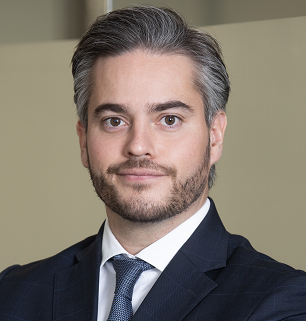
Carlos Ochoa
Head of Public Affairs, Spain
For more information about FTI Consulting’s Public Affairs services in Spain, please contact [email protected].

Regaining consumer confidence in the age of cybercrime
  • This week, The Australian Signals Directorate (ASD) released their Annual Cyber Threat Report for 2024-25. The report reveals an 83% increase in potential malicious cyber activity from the previous year. 15% of Australian businesses (small, medium and large) were victim to business email compromise fraud, resulting in financial loss. More personally, 30% of individuals self-reported as victims of identity fraud.  
  • The results come after high-profile data breaches that impacted some of Australia’s most well-known companies. The ASD has urged businesses, organisations and network owners to focus on implementing best-practice logging, replacing legacy technology, managing third-party risk and preparing for post-quantum cryptography. 
  • Deputy Prime Minister and Defence Minister Richard Marles said the report ‘sharply illustrates that the nation faces an increasingly challenging threat landscape where cyber-enabled espionage and crime are not a hypothetical risk, but a real and increasing danger to the essential services we all rely on,” reinforcing calls for industry and government to collaborate on cybersecurity issues. 
“The ASD report is a wake-up call to Australian businesses, and with the Government calling for greater collaboration to combat cybersecurity threats, corporates should be looking at how they can be best prepared to face into this challenge.”

Ben Hamilton
Head of Public Affairs, Australia

For more information about FTI’s Financial Services Public Affairs support in Australia, please contact [email protected].

Tensions rise as Petro vows to sue the U.S. after alleged "veto" at the UN
  • Colombian President Gustavo Petro announced plans to sue the U.S. in domestic courts, accusing Washington of violating international law and his diplomatic immunity after U.S. delegates walked out during his speech at the UN General Assembly. Petro characterized this move as a “political veto.” The escalation comes after weeks of mounting tension, including the revocation of his U.S. visa and Washington’s criticism of his allegations that American forces killed Colombian citizens during anti-drug operations in the Caribbean.
  • This dispute further deepens the already sharp deterioration in bilateral relations, which has been exacerbated by Colombia’s recent decertification in U.S. counter-narcotics policy. Petro’s rhetoric, which portrays U.S. actions as imperial and illegal, continues to isolate Colombia from key allies. Meanwhile, business associations and the private sector are urging Petro to prioritize Colombian interests over his personal policies. Washington’s response, measured yet firm, indicates an aim to contain the fallout while signaling limits to tolerance for Petro’s confrontational diplomacy.
  • For investors and policymakers, this clash highlights increasing geopolitical risks. Although Colombia remains strategically important for U.S. security and trade, prolonged hostility could slow cooperation, complicate multilateral financing, and intensify scrutiny of Colombia’s governance. Monitoring whether Petro recalibrates his tone or doubles down will be crucial for assessing policy continuity, market perceptions, and regional stability.
“By threatening to sue the U.S., Petro turns diplomatic friction into a stress test for Colombia’s governance, foreign policy discipline, and credibility before international markets — a test whose outcome could redefine the country’s standing with its closest ally."

Julia Gomez
Head of Public Affairs, Colombia

For more information about FTI Consulting’s Public Affairs services in Colombia, please contact [email protected].

South Africa ramps up market diversification as US tariff pressures mount
  • Over the past week, South Africa’s President Cyril Ramaphosa undertook Working Visits to Ireland and Belgium. President Ramaphosa’s working visits to underscore South Africa’s diplomatic intent to deepen strategic partnerships with EU member state amid shifting global and bilateral dynamics. The visit to Ireland was meant to elevate relations to a strategic partnership, strengthening collaboration in science, innovation, higher education, and trade. The engagements in Belgium, centred around the Global Gateway Forum (GGF), which aligned with South Africa’s objectives to attract investment in infrastructure, energy, digital connectivity, and education, key sectors in its own digital and green transition agenda.
  • The visit builds on earlier high-level interactions with the EU, reaffirming the bloc’s position as South Africa’s largest trade and investment partner and a vital contributor to development cooperation.  These visits reflect South Africa’s ongoing efforts to diversify its international partnerships and reduce overreliance on any single power bloc, particularly amid growing tensions with the United States over issues such as geopolitical alignment and trade preferences and tariffs.
  • Strengthening ties with the EU and member states like Ireland forms part of Pretoria’s broader foreign policy recalibration, balancing relations between the Global North and South, while leveraging platforms like the GGF to secure sustainable investment and infrastructure partnerships. By deepening cooperation with the EU, South Africa is both signalling its commitment to multilateralism and positioning itself within a network of trusted global partners that can bolster its economic resilience and strategic autonomy.
  • The approach supports South Africa’s long-term objective of fostering inclusive growth, technological advancement, and enhanced trade competitiveness in a fragmented global landscape. President Cyril Ramaphosa welcomed an €11.5 billion (R230 billion) investment package from the EU, describing it as a major milestone in strengthening South Africa–EU relations and advancing the country’s economic transformation.
“President Ramaphosa’s engagements in Ireland and Belgium reflect South Africa’s strategic intent to recalibrate its foreign partnerships for a rapidly evolving global order, advancing cooperation in innovation, infrastructure, and trade while deepening ties with the EU. By strengthening partnerships rooted in mutual growth and sustainable development, South Africa is reinforcing its economic resilience, asserting strategic autonomy, and positioning itself as a bridge between the Global North and South in pursuit of a more inclusive and balanced global economy.”

Lelo Skosana
Managing Director, South Africa
For more information about FTI Consulting’s Public Affairs services in South Africa, please contact  [email protected].

Expert Analysis

EU- U.S. Trade Relations Event

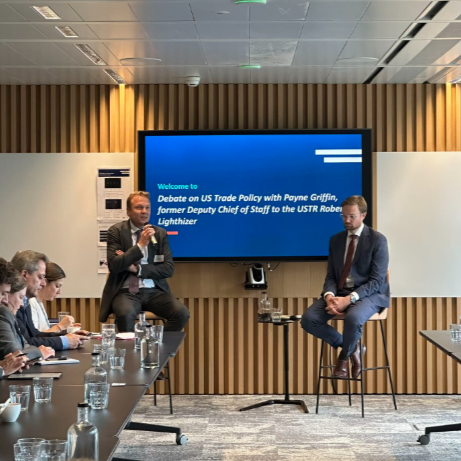
We were pleased to host an engaging EU- U.S. trade relations event at our Brussels office last week where Senior Director and former Deputy Chief of Staff to USTR Robert Lighthizer, Payne Griffin, sat down with our Head of Brussels office, Hans Hack, for an insightful discussion.

The conversation provided first-hand insights into the Trump administration’s trade approach toward the EU and other partners, as well as the current state of play in transatlantic negotiations.

View here >>

NATO Dialogues #4

Earlier this week our EMEA Defence & Aerospace teams attended the ‘NATO Dialogues #4 – Financement européen de la Défense’ in Brussels. 

Alongside officials from the European Commission, the European Defence Agency and OCCAR, Beatriz Cózar Murillo shared her insights on challenges and hurdles companies face when navigating the highly complex European defence landscape to increase their business opportunities by collaboration.

View here >>

2025 Labour and Conservative Party Conferences

The 2025 party conferences highlighted the contrasting challenges facing the two main UK parties: Labour focused on stability and managing internal tensions as the governing party, while the Conservatives aimed to redefine themselves with bold promises and a renewed sense of direction in opposition.

Our UK Public Affairs team provide their expert analysis on both conferences below.

Labour Party Conference 2025 >>

Conservative Party Conference 2025 >>

The Policy Pulse: President Trump’s Renewed Trade Agenda

Looking for insights on the current EU-U.S. trade relations and President Trump’s renewed trade agenda? Look no further!

In the latest episode of The Policy Pulse podcast, we unpack how shifting priorities in Washington are reshaping the transatlantic economic landscape. With EU- U.S. trade in goods hitting a record $976 billion in 2024, the stakes couldn’t be higher!

View here >>

Upcoming Elections

  • 26 October: Legislative elections (Argentina)
  • 29 October: General elections (Netherlands)
  • 4 November: State legislative elections (United States)

To be added to the distribution list for the Global PA Newswire, or for further information on the dedicated Public Affairs team at FTI, please contact [email protected].

The views expressed in this article are those of the author(s) and not necessarily the views of FTI Consulting, its management, its subsidiaries, its affiliates, or its other professionals.

©2025 FTI Consulting, Inc. All rights reserved. www.fticonsulting.com
Related Articles

4th Annual Shareholder Activism State of the Market

September 8, 2025—4th Annual Shareholder Activism State of the Market Request Report The 4th Annual Shareholder Activism State of the Mark...

Use It or Lose It: U.S. Hydrogen Industry Must Act To Maintain Momentum

July 12, 2025—Key takeaway: Following the passage of the “One Big Beautiful Bill Act”, time is of the essence for hydrogen produce...

Quick Analysis: ‘One Big Beautiful Bill’ Drives More Gas and Batteries, Less Renewables

July 3, 2025—With the recent passage of the “One Big Beautiful Bill” (“OBBB” or the “Legislation”),[1] FTI Consulting’s...

FTI Consulting Appoints Dilip Kejriwal as Managing Director in Capital Markets Practice

July 6, 2026—London, 6 July 2026 — FTI Consulting, Inc. (NYSE: FCN) today announced the appointment of Dilip Kejriwal as a Managing...

FTI Consulting News Bytes – 3 July 2026

July 3, 2026—FTI Consulting News Bytes This week’s TMT headlines draw attention to several dominant themes across the sector with A...

FTI Consulting UK Public Affairs Snapshot – The Defence Investment Plan – ‘A DIP into the unknown’

July 3, 2026—Autumn 2025. That was supposed to be the date when the Defence Investment Plan (DIP) would detail how the Ministry of De...