Global Public Affairs Newswire – 15 November 2024
Download a PDF of this articleWelcome to the latest instalment of FTI Consulting’s fortnightly Global Public Affairs Newswire. This week, we bring you the latest from the US Presidential Election where Donald Trump has become the second President in US history to be elected to serve a second non-sequential term, as well as updates from our Public Affairs teams in Ireland and Germany, where dates have been set for snap elections.
Additionally, we bring you our usual comprehensive market update, with analysis of the latest big public affairs developments across the world’s major markets. This week features updates covering developments in Brazil, India, Colombia, the UK, the EU, China, Ireland, Germany, France, the US, Spain, and Hong Kong.
Our global team are closely tracking the key votes and contests in this worldwide ‘Year of the Election’. In each edition of the Newswire, we look to dive into the upcoming implications, considerations, and opportunities for business.

Trump begins to assemble his Cabinet and administration: Following his election victory, President-elect Donald Trump has begun announcing his choices for Cabinet and White House appointments. His nominations and appointments so far – some of whom will require Congressional approval, and some of which will trigger special elections if appointed – include the following:
- Chief of Staff: Trump Campaign Co-Chair Susie Wiles, who will be the first female to hold the position
- Border Czar: Former Immigration Official Thomas Homan
- Environmental Protection Agency Director: Former U.S. Republican Representative Lee Zeldin
- United Nations Ambassador: House Republican Conference Chair and U.S. Rep. Elise Stefanik (NY-21)
- Homeland Security Secretary: South Dakota Republican Governor Kristi Noem
- Secretary of Defense: Fox News and veteran host Pete Hegseth
- I.A. Director: Former Republican Texas U.S. Representative and Director of National Intelligence John Ratcliffe
- Ambassador to Israel: Former Arkansas Governor Mike Huckabee
- Secretary of State: U.S. Sen. Marco Rubio (FL)
- Director of National Intelligence: Former House Member Tulsi Gabbard
- Attorney General: Former Rep. Matt Gaetz (FL-1)
Trump meets with Biden: On Wednesday, Trump travelled to Washington, D.C. to meet with President Joe Biden. Trump also addressed the House Republican Conference on Capitol Hill, stating that Republicans had “historic kinds of numbers”. This comes as Republicans garnered enough seats to maintain their majority in the House of Representatives and also re-elected Mike Johnson (R-LA) to serve as House Speaker in the next Congress. Republican Senators elected South Dakota Senator John Thune as the next Senate Majority Leader, replacing Sen. Mitch McConnell.

Following months of speculation that a general election would be called before the end of 2024, Ireland’s Taoiseach (Prime Minister) and leader of Fine Gael, Simon Harris announced a General Election will be held on 29 November 2024, marking the end of the Fine Gael/Fianna Fáil/Green Party coalition government formed in the aftermath of the 2020 General Election.
The announcement marked the start of a short three-week campaign before voting takes place to elect 174 TDs (members of parliament) across 43 constituencies. With no electronic voting and Ireland’s Proportional Representation by Single Transferable Vote (PR-STV) voting system, counting can take several days. Early tallies may give some indication, but it will be well into the first week of December before a clear picture emerges and all successful candidates have been declared elected.
As things currently stand in the polls, and has been the case in recent history, the next government may be a coalition of a number of parties. Throughout the campaign, there will be discussions about which parties are open or opposed to forming a government together, as well as their non-negotiable issues. This will be especially relevant for the outgoing government parties and whether they might consider reforming if the numbers allow. Housing, cost of living, healthcare, and immigration are key voter issues, with the cost of doing business also high on the agenda for many, as well as infrastructure, competitiveness and what each party is proposing to do with the proceeds from the Apple Tax fund.

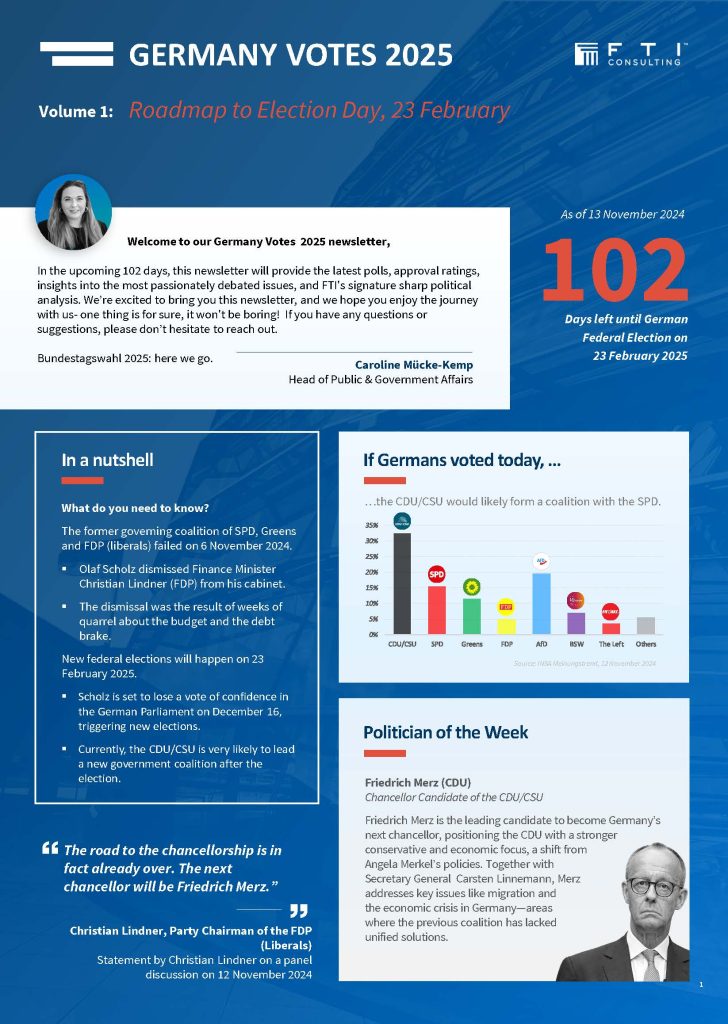
We’re launching our new Germany votes newsletter series! In the upcoming 102 days, this newsletter will provide the latest polls, approval ratings, insights into the most passionately debated issues, and FTI Consulting’s signature sharp political analysis. We’re excited to bring you this newsletter, and we hope you enjoy the journey with us- one thing is for sure, it won’t be boring! Click here to download the first edition: Germany Votes 2025 Volume 1
Market updates

The recent US election results, with Donald Trump securing another term, present a complex landscape for Brazil. Although the full impact on bilateral relations will unfold over the next months, President Lula’s open endorsement of Vice President Kamala Harris days before the election could already set a challenging tone. This tension is compounded by Brazil’s prominent role as a member of the BRICS, a multilateral forum which Russia and China appear intent on positioning as an anti-Western coalition, despite Brazilian reticence.
Another key concern shaping the future of U.S.-Brazil relations is the potential appointment of Senator Marco Rubio as Secretary of State. Initially, many Brazilians expected the region—and Brazil specifically—to remain a low priority for the Trump administration, with Trump potentially clashing with President Lula on his environmental and immigration agenda but otherwise leaving trade officials and diplomats to conduct business as usual. However, Rubio’s deep personal connections to the region, his intense criticism of Brazilian relations with Venezuela and his aggressive anti-China stance suggest a dramatic shift in the bilateral relation, potentially driving Brazil further into the dynamics of U.S.-China tensions.
Domestically, Trump’s re-election has energized segments of Brazil’s political right, particularly supporters of Jair Bolsonaro, who hope this outcome might influence legal decisions favoring Bolsonaro’s political eligibility. While Trump has no clear incentive to intervene in Brazil’s internal affairs at this time, the same cannot be said for another prominent figure in the incoming Trump administration – Elon Musk. The tech mogul has faced notable legal challenges in Brazil over content moderation on X, paying a sizeable fine after having his social media platform suspended for weeks last September, and explicitly criticizing the Federal Supreme Court.
The potential influence of figures like Marco Rubio and Elon Musk adds layers of complexity to the bilateral relationship, especially as global tensions with China and debates on tech governance intensify. We still need to have more clarity on how autonomous Rubio and Musk will be, as well as how their relationship with Trump will evolve. Regardless, the re-election of Donald Trump signals a period of diplomatic recalibration for Brazil, requiring careful navigation to balance its national interests with the realities of a shifting geopolitical landscape.

Donald Trump’s second term as POTUS is expected to significantly impact trade, geopolitics and other key issues for India, offering both opportunities and challenges. India’s largely positive response to Trump’s win reflects his professed friendship with India’s Prime Minister, the much-reported “Modi-Trump bromance” between the right-leaning, conservative leaders of the world’s two largest democracies.
Despite Trump’s previous criticism of India as a “tariff abuser” and his America First policies pointing to trade challenges ahead, analysts say the Trump 2.0 regime’s promised higher tariffs on Chinese goods could marginally benefit Indian exports. A State Bank of India report projects the rupee depreciating as much as 10% against the dollar during Trump’s second term (having depreciated 11% during his first term). This would make computers and other imports more expensive, but provide an advantage for exports of textiles, manufacturing, agriculture, and software.
However, India’s software exports (USD 205 billion in FY24, over half going to the US) could be hit by Trump tightening immigration policies and H1B work visas. And Trump’s ‘Drill, Baby, Drill’ pro-fossil-fuel energy worldview could slow efforts with India-US renewable energy cooperation, as well as American contribution to climate finance.
On the security front, the QUAD initiative and growing defense cooperation are likely to benefit India, as Trump’s promised tough stance on China shapes global geopolitics. Despite trade and immigration challenges, India’s strategic partnership with the U.S. is unlikely to diminish, and Trump’s push to diversify away from China could increase US investment in Indian supply chains and present long-term opportunities.

Between 21 October and 01 November, Colombia hosted the 16th meeting of the Conference of the Parties (COP) to the Convention on Biological Diversity (CBD), with over 23,000 delegates from 196 countries receiving accreditation to attend the conference’s Blue Zone.
The session ended without a final agreement on crucial biodiversity issues. However, the conference did make significant progress: a multilateral mechanism was established to distribute the benefits derived from digital genetic information, allowing industries using this data to contribute to sustainable development. Additionally, a new subsidiary body was created to give Indigenous peoples a stronger voice in biodiversity discussions.
The primary point of contention at the conference was the management of biodiversity funds. While Brazil and the African Union proposed an independent fund under the COP’s control, developed countries advocated for the continuation of the Global Environment Facility (GEF) as the administrator, to ensure transparency. This lack of consensus on financial matters highlights the need for stronger collaboration moving forward.
A major expectation for COP16 was that countries would present their National Biodiversity Strategies and Action Plans (NBSAPs), as agreed during COP15 in Montreal in 2022. Nonetheless, fewer than 20% of countries met this commitment, signaling a lack of political will from over 150 nations. Key topics such as financing mechanisms, the operational budget for the next two years, and the finalization of a document summarizing agreements remained unresolved.

On Thursday 14 November, Rachel Reeves delivered her first Mansion House speech as Chancellor to the City of London. Hoping to instil confidence in the financial services sector that the Government’s will be able to “fix the foundations” of the economy, Reeves announced sweeping pension reforms designed to unlock billions of pounds of additional investment for critical infrastructure and the private sector. The Pension Schemes Bill, due to be introduced in 2025, will develop eight pension “megafunds” by pooling assets from the 86 separate Local Government Pension Scheme authorities currently in place in the UK, and consolidating defined contribution schemes. HM Treasury has estimated that these reforms will deliver around £80 billion of investment, and by increasing the size of funds “unlock more private investment to fuel the government’s growth mission” into a broader range of UK assets, such as infrastructure and private equity.
Furthermore, the Chancellor announced that she will legislate to introduce PISCES (Private Intermittent Securities and Capital Exchange System), a regulated private stock exchange system to revive the UK’s stagnation of IPOs, by May next year. The London Stock Exchange’s current IPO performance puts the market on course for one of its worst years on record.
With the backdrop of Donald Trump’s recent election as President of the United States and the reports on tariffs on all potential imports to the US, the Chancellor also used her speech to stress the importance of free and open trade, and the economic opportunities of working with other countries, including economies in Europe, the Middle East, Asia and the US.
Yesterday’s Mansion House speech was more policy heavy than in previous iterations, with Government Department’s releasing a flurry of consultations and calls for evidence following the speech. Businesses across the financial services sector and beyond will be working up responses to crucial policy papers, such as the Financial Services Growth and Competitiveness Strategy, a proposal for UK Green Taxonomy, and a potential for a new approach to captive insurance. Reeves’s Mansion House speech comes just two weeks after the Labour Government’s first budget, which has received criticism for major tax rises, primarily targeted at businesses. The £40 billion budget tax bill has somewhat soured the Government’s hard-won relationship with industry, with the Chancellor attempting to position her speech to show a more positive outlook for the UK’s financial services sector. Reeves’s plans to tackle the UK’s fragmented pensions landscape have been welcomed by the financial services industry, keen to see the Government “regulating for risk, but not regulating for growth”. However, with data released this morning showing that the UK economy grew by just 0.1% during Labour’s first three months, critics question if these reforms will be enough to give the UK the boost in growth the country needs.

From 04 to 12 November, all Commissioner-designates appeared before their respective European Parliament Committees for confirmation hearings. While most were approved, Olivér Várhelyi, the Hungarian Commissioner-designate for Health and Animal Welfare, must answer further written questions. Decisions on the six Executive Vice-Presidents will be made during the week of 18 November, following political tension between the EPP and the S&D. In a statement, the S&D group warned that approval of the entire Commission was “at stake” due to the “irresponsible behaviour of their group leader, Manfred Weber.”
On content, Commissioner-designates advocated for simplifying regulatory burdens to enhance European competitiveness in key sectors, referencing recent reports by Enrico Letta and Mario Draghi. As for next steps, once all candidates are confirmed by the Parliament’s Committees, the full European Parliament will vote on the new College of Commissioners during the 25-28 November plenary session in Strasbourg, allowing the College to assume office in December 2024. This schedule is tentative, as coordinators may still reject one or more candidates, request further written responses, or schedule additional hearings.

On 08 November, China’s National People’s Congress Standing Committee (NPCSC) concluded its bi-monthly meeting, originally scheduled for October. A press conference following the meeting with the Ministry of Finance confirmed the fiscal support measures the market had long expected. Targeting the implicit debt by local governments, policymakers announced a total of RMB 10 trillion debt resolution package over 2024-2028 in support of the de-leveraging process.
Behind the record number of fiscal packages is the central government’s unwavering commitment to tackle the RMB 14.3 trillion local government implicit debt, one of the root causes of the current economic challenges, and have it resolved by 2028. Compared to the high expectations from many foreign investors, the meeting outcome may be a slight disappointment. As the market debated that there should be some forms of demand stimulation, policymakers did not announce additional issuance of central government debt for bank recapitalization and consumption.
That said, the Finance Minister has provided affirmative forward guidance on future policy supports. Tax policy in support of the property sector, reportedly slashing homebuying taxes from 3% to 1%, is in the final stage of preparation. The progress of bank recapitalization is being accelerated, and the property destocking program is under further study and will be kicked off in due course. The Finance Minister also gave signals on raising the fiscal deficit for 2025 and strengthening transfer payments to support technological innovation and people’s livelihood. With that, attention is now on the upcoming Central Economic Work Conference, likely to be held in late December 2024, and the Two Sessions next year, which should be expected in mid-March 2025.
After weeks of disputes over budget and economic policy, Chancellor Olaf Scholz (SPD) has requested that the Federal President dismiss Federal Finance Minister Christian Lindner (FDP). This prompted other FDP ministers to hand in their resignations the following day. Only Transport and Digital Minister Dr. Volker Wissing (formerly FDP) announced he will remain in office despite the coalition’s end and leave the FDP, aiming to ensure stability without joining another party. The role of Federal Minister of Finance will be assumed by Dr Jörg Kukies (SPD), previously State Secretary in the Chancellery and economic advisor to Chancellor Scholz. Following negotiations between the Parliamentary Group Leaders Rolf Mützenich (SPD) and Friedrich Merz (CDU/CSU) on 11 November, early federal elections are expected to take place on 23 February, 2025. Reportedly, the date is also aligned with the FDP and Greens.
Chancellor Olaf Scholz (SPD) is expected to bring forward the vote of confidence, likely on 16 December, to officially pave the way to early elections. The election date is to be ultimately decided on by Federal President Frank-Walter Steinmeier, following the vote of confidence. At this point, it remains unclear whether the agreement on the earlier vote of confidence will lead to the CDU/CSU supporting certain bills in the coming weeks. Merz had previously insisted that Scholz must first ask the vote of confidence before the CDU/CSU parliamentary group is willing to discuss supporting specific legislative priorities, proposing a “positives list” of acceptable initiatives (e.g. on the resilience of the Federal Constitutional Court). It is also conceivable that the FDP might agree to certain bills.
The pending 2025 budget will not be passed in its current form, as it too, requires approval from the CDU/CSU. Consequently, from 01 January, 2025, temporary budget management would apply, limited to legally mandated expenditures only. No new initiatives or positions may be created. With these developments, the current administration’s operations are suspended, and Germany enters a period of federal election campaigning. This was emphasized by Economic Affairs Minister Robert Habeck (Greens) announcing his candidacy for chancellor on Friday 08 November.

Following the election of Donald Trump as the 47th president of the United States on 5 November, French President Emmanuel Macron quickly sought to take the lead in designing the European response. Macron is known as one of Europe’s loudest advocates for the bloc’s independence from trading rivals, such as China and the United States, on everything from defence and security to cutting-edge technologies. He responded to Trump’s victory by issuing a statement on his X account congratulating the president-elect, and followed by calling German chancellor Olaf Scholz, stating that France and Germany would cooperate with the United States while also defending their own interests and values.
At the European Political Community summit in Budapest, held two days after the US presidential election, Macron reiterated his call for European strategic autonomy, stressing the need for unity and independence from U.S. reliance in defence and economic matters. He stated that “Trump was elected by the American people and will defend the interests of Americans” and that it is “for us [Europeans] to decide whether we are going to defend the interests of Europeans”. He warned against complacency in the face of global power struggles, stressing that Europe must safeguard its democratic model from external influence and propaganda. “For me, it’s simple. The world is made up of herbivores and carnivores. If we decide to remain herbivores, then the carnivores will win and we will be a market for them,” he told European leaders. He argued that Europe must take responsibility for its security, advocating for a unified defence strategy and joint European defence projects to reduce reliance on external powers. Additionally, Macron called for a coordinated European approach to manage immigration and borders, stressing the need for a collective effort to address illegal migration.
Despite this show of strength at the European level, his government’s position remains fragile domestically. The 2025 Budget Bill, which was extensively rewritten by parliamentarians, was rejected by the lower house. The ruling coalition was opposed to the significant tax increases inserted by both far-right and far-left MPs and voted down its own bill. The original text submitted to parliament will now head to the Senate for discussion. It thus remains very likely that the government will use special constitutional powers to force the bill through Parliament, a particularly unpopular measure. Similar developments are occurring on the question of the 2025 Social Security Financing Bill, which failed to be examined on time in the lower house due to the number of amendments and intensity of debates.
Lawmakers returned to Washington on Tuesday for the first time since September, kicking off the lame duck session of Congress. The final weeks of the current Congress will largely be shaped by the “red wave” of last Tuesday’s elections, with Republicans poised to take control of the White House and Senate and retain control of the House of Representatives when the new Congress convenes in January. As the incoming Trump administration and congressional Republicans set their sights on extending tax cuts from the President-elect’s first term in office, enacting sweeping reforms to U.S. immigration and trade policy, and slashing environmental regulations across a range of industries, Senate Democrats will use their remaining time in the majority to confirm as many of President Biden’s judicial nominees as possible.
Meanwhile, the Biden administration is working to expedite an additional $6 billion in military aid to Ukraine before President-elect Trump takes office, as the incoming administration is expected to end U.S. assistance to Ukraine as it continues to defend itself against Russia’s invasion. In terms of year-end legislative activity, Congress still needs to pass the annual defense authorization bill and address FY25 government funding before heading home for the holidays. The art of the possible with respect to other outstanding legislative items, such as AI and permitting reform, will be dictated in large part by what President-elect Trump says, or chooses not to say, publicly. In just over a week since his decisive victory over Vice President Harris, President-elect Trump has already started to build out his cabinet for a second term, announcing picks for key roles including Chief of Staff (Susie Wiles), Secretary of State (Marco Rubio), Secretary of Homeland Security (Kristi Noem), and Secretary of Defense (Pete Hegseth), among others.

The recent DANA that struck Valencia, an atmospheric phenomenon marked by torrential rains and widespread flooding, has not only caused significant environmental and infrastructural damage but also catalyzed tensions at various levels of governance, becoming a flashpoint for political disputes that extend from the regional level to national politics and even into European institutions.
The Community of Valencia, governed by the Popular Party (PP), faced immediate scrutiny over its response to the DANA. The regional president, Carlos Mazón, has been subject to mounting pressure to resign from opposition parties and activist groups, who argue that his administration failed to take sufficient preventative measures despite warnings of increasing climate risks.
The criticisms directed at the Valencian government have quickly evolved into a national debate, with the opposition and ruling parties leveraging the crisis to highlight broader political issues. The PSOE-Sumar coalition, for instance, has argued that the DANA underscores the urgency of their climate agenda, while the national PP, led by Alberto Núñez Feijóo, has sought to critique the central government’s approach, accusing it of exploiting the DANA for political purposes.
This institutional tension was highlighted in the European Parliament hearing for Teresa Ribera, Spain’s Minister for Ecological Transition and now Commissioner-designate. The session became a forum for debate, with some European parliamentarians, particularly from the European People’s Party (EPP), raising concerns over the response of her Ministry in the wake of the crisis and how she intends to reconcile her mandate with broader EU climate objectives, given that some of her positions as minister have diverged from the prevailing EU consensus. While Ribera adopted a conciliatory approach, these tensions have put the Commissioner-designate under greater scrutiny and have delayed key approvals in the European Parliament, including the formal appointments of Executive Vice-Presidents.

On 16 October, Hong Kong Chief Executive John Lee delivered the 2024 Policy Address, an annual review of government progress that outlines the city’s economic, political and societal priorities for the year ahead. Lee re-emphasized the implementation of the “One Country, Two System” principle across Hong Kong and mainland China, and the essentiality of national security. Hong Kong remains committed to enhancing its domestic and economic development and delivering on its role of a “super connector” among the mainland, neighboring Asian economies, and the rest of the world.
The Address focused on consolidating Hong Kong’s status as an international financial and trade center, while undertaking initiatives to attract professional talents from the mainland and overseas. Other major priorities include boosting innovation, stimulating the property market, revitalizing the tourism industry, including by relaxing entry rules for Middle Eastern and ASEAN visitors, fostering closer integration with the Greater Bay Area (GBA) cities, and improving housing and healthcare policies.
New measures have been introduced to facilitate a smoother approval process for initial public offerings (IPOs) on the Hong Kong Stock Exchange, as well as to support businesses in benefiting from access to the mainland Chinese market. The investment threshold for fast-track residency has also been lowered to stimulate demand for residential properties.
Expert Analysis |

UK Public Affairs Snapshot: What Trump’s return means for Britain and the Special Relationship
As President-elect Donald Trump prepares for his return to the White House, the “Special Relationship” between Britain and the US faces a new test. While this long-standing alliance has endured political divides in the past, the ideological gulf between Trump and British Prime Minister Keir Starmer could present early diplomatic challenges.
FTI Consulting’s UK Public Affairs team explores the potential tensions and opportunities that may arise for the UK-US alliance once Trump resumes the presidency.
The Draghi Report’s impact on the EU’s Economic Strategy
Many believe that the EU economy needs to become more competitive while meeting its climate goals. How these twin priorities can be achieved is a question of significant debate, but the Draghi Report and the Commissioners’ mission letters offer some insights into the way forward.
Our experts Martin Porter, Joe Berkhout & Kerstin Duhme look into the careful balance that must be struck, and offer some potential outcomes.


Electoral Pulse podcast
Tune in to our latest Electoral Pulse podcast episode as we dive into the EU Commissioner hearings happening this week.
Managing Director Anne-Sophie Deman sits down with Director Dafni Kachrila Skouteli, part of our Elections workstream, to demystify the process and break down what we expect to see in the coming days.
Demystifying AI in Healthcare
The rapid adoption of artificial intelligence (AI) has raised significant concerns among many, particularly as it pertains to its application in healthcare management and delivery.
Take a look at part one of our four-part series sharing perspectives on several of the most pertinent considerations related to the use of AI in healthcare – transparency, privacy and security, and sophistication.
Upcoming Conferences, Elections and Webinars
- November 24: Parliamentary Election (Guinea-Bissau)
- November 27: General Election (Namibia)
- November 29: General Election (Ireland)
- November 30: Parliamentary Election (Iceland)
To be added to the distribution list for the Global PA Newswire, or for further information on the dedicated Public Affairs team at FTI, please contact [email protected]. |
The views expressed in this article are those of the author(s) and not necessarily the views of FTI Consulting, its management, its subsidiaries, its affiliates, or its other professionals.
©2024 FTI Consulting, Inc. All rights reserved. www.fticonsulting.com