Global Public Affairs Newswire – 14 November 2025
|
An FTI Consulting Report: Risks and priorities in Public Affairs – 2025 versus 2023
In 2023, when FTI Consulting asked leaders in Public Affairs what they considered their biggest external challenges, the picture they painted was one of economic headwinds, regulatory challenges, and macropolitical uncertainty. At the same time, leaders felt the value they added was, too often, not understood internally, with issues around visibility, collaboration, and reliably measuring their impact.
Against this backdrop, a 2025 FTI Consulting survey of Public Affairs leaders revealed some significant shifts in perception, not merely about what the principal risks are, but also about how companies are adapting to deal with them. In our new report, “Risks and priorities in Public Affairs – 2025 versus 2023“, our experts set out the survey’s ten key findings and analyse the challenges faced by Public Affairs practitioners, at a time where the function remains as critical as ever.
Key Statistics
- Technology, including AI, is now the second largest key trend impacting companies: highlighted by 73% of respondents, up from 55% in 2023.
- Managing trade disputes and tariffs is increasingly challenging: 55% of public affairs leaders flagged this as a key risk for 2025, compared with 36% in 2023.
- Climate change is seen as less of a priority: only 20% of leaders see it as a key business risk, down from 36% in 2023.
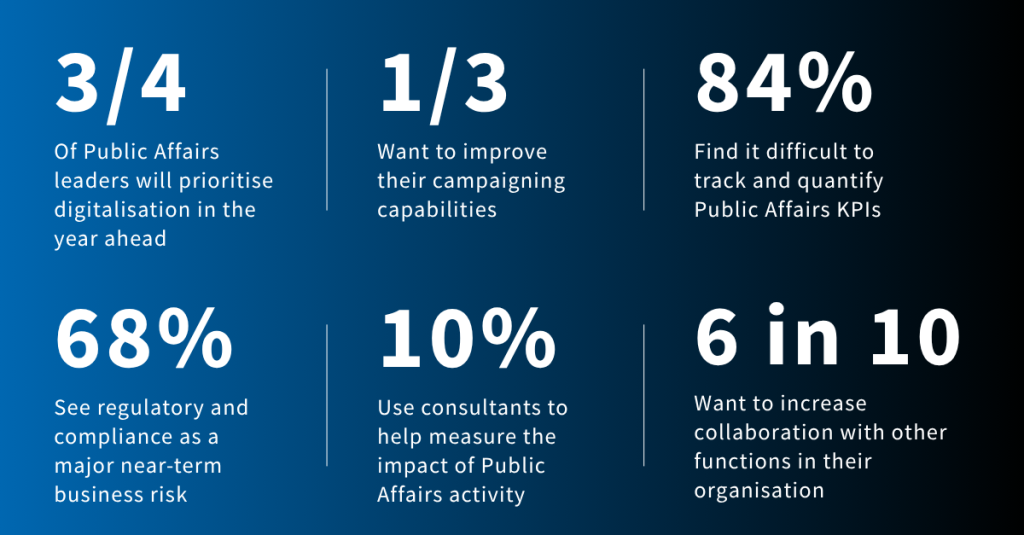
- The visibility of public affairs teams is growing within their businesses: More public affairs leaders report directly to CEOs or boards (51% in 2025 vs 42% in 2023), and fewer say their senior colleagues don’t understand what they do, 20% in 2025 compared to 40% a few years ago.
- However, demonstrating value remains tricky: 84% of public affairs teams still struggle to track and quantify their impact.
Market updates
- Democrats scored decisive victories across the United States on Tuesday, winning governorships in Virginia and New Jersey, the mayoralty of New York City, and several competitive contests in traditionally Republican states such as Mississippi and Georgia. Analysts said the breadth and margins of these wins reflect growing public unease with President Trump’s policies and political style. Yet the results also revealed enduring divisions within the Democratic Party—particularly between its moderate and progressive factions—a debate that is likely to intensify as the party looks ahead to 2026 and beyond.
- In California, Governor Gavin Newsom (D), widely regarded as a potential presidential contender, secured a significant victory with the passage of a statewide referendum granting his administration the power to redraw the state’s federal congressional districts. The measure, framed as a direct response to Republican-led redistricting efforts in states such as Texas and North Carolina, may inspire similar initiatives in other Democratic-led states.
Contact Jackson Dunn for a closer look at election results and potential implications or the national Midterm elections in 2026.
- But Did Senate Democrats Get the Message? The elections unfolded amid the longest government shutdown in U.S. history, as the Senate remained gridlocked over a funding bill centered on healthcare subsidies. The standoff resulted in widespread disruptions, including furloughs of federal employees and the suspension of essential services ranging from benefits processing to air traffic control. Despite the surge of electoral momentum, eight Senate Democrats broke ranks and joined Republicans in supporting an agreement to reopen the government and fund operations through January 30, 2026. The measure passed the Senate 60–40 and was approved by the House largely along party lines. President Trump signed the bill on Thursday, formally ending the shutdown but setting the stage for another potential fiscal showdown in the coming year
For more information about FTI’s Public Affairs services in the Americas, please contact [email protected].
- China’s Ministry of Commerce issued multiple public statements expressing concern over the Netherlands’ intervention in the Nexperia dispute and its resulting disruption to the global semiconductor supply chain, while the Commerce Minister has raised the issue in meetings with Dutch, German, and EU counterparts, cautioning against the broad politicization of national security reviews.
- Media coverage noted that the U.S. had raised security concerns about Nexperia before the Dutch government’s intervention. Following the Xi-Trump meeting, the U.S. stated that China would take measures to resume Nexperia’s chip exports to global markets – emphasizing how European handling of Chinese investments in strategic sectors increasingly intersects with broader U.S. technology and supply-chain concerns.
- Despite unresolved diplomatic tensions, Nexperia China resumed partial supply to European clients through targeted exemptions. European automakers confirmed renewed deliveries. The episode illustrates Beijing’s dual-track strategy: public opposition to what it perceives as unfair treatment, paired with pragmatic market adjustments to mitigate supply chain disruption.
For more information about FTI’s public affairs services in China, please contact [email protected].
- India’s health ministry has proposed new rules for regulating medical device software to align with global norms. A draft from the regulator for drugs and medical devices aims to address regulatory ambiguity around AI-driven, digital, and cloud/network-based software. The draft rules, open for public feedback up until November 20, require all medical device software to conform to standards from the Bureau of Indian Standards, or ISO or other standards to be notified by the ministry.
- The rules address regulatory gaps and introduce licensing, classification, and quality requirements. They distinguish standalone software from embedded systems, apply a four-tier risk classification, and mandate quality management systems for domestic and imported products. They require algorithmic change protocols, and post-market surveillance for updates to AI models. They may increase compliance burden on smaller suppliers and startups developing low risk software but are expected to reduce ambiguity for manufacturers and importers.
- Global medical device firms with software-driven devices or standalone software must anticipate additional regulatory compliance in India (licensing for software, QMS, algorithm change control, post-market surveillance); Indian manufacturers must adapt to the new licensing and obligations. With these rules, New Delhi aims to raise the bar for medical software compliance and align with European and US practices.
For more information about FTI’s Public Affairs services in India, please contact [email protected].
- The UK’s Prime Minister, Sir Keir Starmer, faced significant political turmoil this week after negative briefings against the Health Secretary, allegedly carried out by Starmer’s own advisers, backfired on 10 Downing Street. The situation has now escalated into a full-blown crisis, as Cabinet Ministers demand the Prime Minister fire the adviser responsible for the briefings, widely speculated to have been the Prime Minister’s Chief of Staff, Morgan McSweeney.
- The story first emerged on Tuesday when the political editor of the Guardian newspaper, Pippa Crerar, received “a number of” briefings from special advisers close to the Prime Minister warning that some of Starmer’s Cabinet Ministers, including Health Secretary Wes Streeting, were “on manoeuvres” and plotting to challenge Starmer for his premiership following this year’s Autumn Budget. The Budget, which will take place on November 26, is expected to break Labour’s manifesto commitment to not increase taxes on “working people”.
- The briefings, which were intended to warn “feral” Labour MPs of a potential bond market crisis if Starmer were to be replaced as Prime Minister, backfired spectacularly. Streeting, who was scheduled for the breakfast broadcast round the next morning, denied the allegations and urged Starmer to sack the aide responsible for the briefing. Starmer then publicly defended Streeting during Prime Minister’s Questions, where Opposition Leader Kemi Badenoch criticised a “toxic culture” in 10 Downing Street and accused the Prime Minister of having “lost control of his government and the trust of the British people”.
- At the time of writing, the issue remains unresolved, with media reports that pressure is growing on the Prime Minister to act decisively to demonstrate that he remains in control of not just his party, but his own advisers.
For more information about FTI’s Public Affairs services in the United Kingdom, please contact [email protected].
- In late October, the EU adopted its 19th sanctions package in a bid to further impact Russia’s revenue-generating industries and limit its ability to acquire tech needed on the battlefield.
Notable measures in the package are the (phased-in) ban on LNG imports, expansion of transaction bans against Russian and non-Russian banks, and measures looking to prevent circumvention, such as those against stablecoin A7A5, the shadow fleet, and Russian payment systems. - On the other side of the Atlantic, U.S. President Trump imposed sanctions on Russian oil giants Rosneft and Lukoil – together responsible for approximately. 50% of Russia’s crude oil production and export.
- The move spurred Lukoil to (as of writing) unsuccessfully sell its non-Russian business as a deal was blocked by the U.S.. In Europe, the move was generally welcomed – though Hungary quickly sought, and ultimately received, waivers from the U.S. to maintain energy supplies from Russia.
For more information about FTI’s Public Affairs services in the EU, please contact [email protected]
- During his speech at the COP 30 opening in Belém, President Lula argued that investing in climate solutions is far wiser than spending trillions on armed conflicts. His speech revealed both political intent and ideological contrast: he used the global stage to criticize “climate denialism” and indirectly challenge U.S. leadership after Donald Trump’s dismissal of the climate agenda.
- This moment underscores a shift in Brazil’s foreign policy, as Lula seeks to assert Global South protagonism and present environmental responsibility as an exercise of sovereignty. Although the tone in the multilateral forums has been confrontational, the Lula administration has been pragmatic, opting for a diplomatic approach on the issue of tariffs. Ongoing negotiations are expected to advance the negotiations.
- The aftermath of Rio’s deadly police operation, which killed 121 people, sparked a heated political and legislative response. The administration accelerated debate on its key anti- criminal factions bill, aiming to strengthen coordination between police forces and curb organized crime.
- However, the bill’s rapporteur’s revisions signal a strategic power play, potentially limiting federal autonomy and inviting international scrutiny. His version reclassified criminal groups under Brazil’s anti-terrorism law, a move critics say risks foreign interference and diplomatic fallout.
- Polls have shown that President Lula (PT) leads in all first- and second-round scenarios for the 2026 presidential election, increasing his advantage compared to previews polls. He also appears as the most recalled name by voters in the spontaneous survey. Among right-wing opponents, names such as Jair Bolsonaro (who is not eligible until 2030), Michelle Bolsonaro, Flávio Bolsonaro, and Tarcísio de Freitas show declines or remain behind Lula.
- The data indicates the right’s difficulty on consolidating a competitive candidate, reflecting internal divisions and a lack of political cohesion. Meanwhile, Lula maintains a stable position, benefiting both from national recognition and the absence of a unified opponent, strengthening his advantage heading into 2026.
For more information about FTI’s Public Affairs services in Brazil, please contact [email protected].
- In recent weeks, French politics has been dominated by debates over the 2026 budget, as the government seeks to tackle the country’s large public deficit. To secure passage of these crucial bills and maintain its hold on power, the administration has negotiated with left-wing parties. These compromises have come at the cost of key Macron-era reforms and have included controversial tax increases that have sparked widespread debate.
- The most notable concession has been the suspension of the 2023 pension reform, agreed with the Socialist Party, sparking strong opposition within government ranks. Controversial amendments to the Budget Bill, including higher taxes on digital services and multinational corporations, have also drawn criticism from politicians across the spectrum and raised concerns about potential retaliation from the United States.
- Further complicating matters, delays in reviewing these key legislative texts have increased the likelihood that the Budget may need to be passed by executive order, a move unprecedented in recent French political history. Such a measure would be widely perceived as undemocratic, heightening the risk of a no-confidence vote and government collapse.
For more information about FTI’s Public Affairs services in France, please contact [email protected].
- Last week revealed once again the internal instability of Australia’s Opposition, a Coalition of the centre-right Liberal and National parties. The junior partner, the Nationals, released their party position to drop the commitment to reach net zero carbon emissions by 2050, while the majority partner, the Liberals, are struggling to reach internal consensus on the issue.
- Immediately following the decision by the Nationals, national polling was released, revealing the Coalition’s primary vote had fallen four points to a record low of 24%. The national Newspoll, conducted in October, gave the governing Labor party a 57–43% two-party preferred lead over the Coalition.
- After a landslide defeat at the May federal election, the Coalition party has only worsened according to polls, with leadership changes, policy disagreements and internal resignations exposing the party’s current state of debility.
- With the Liberal Party yet to determine its position on net zero, the topic is another area in which the Coalition lacks unity. It is expected the Liberal Party will announce their position in the coming days.
- With the Opposition struggling with internal issues, it has been distracted from its core responsibilities – holding the government to account and offering the Australian public a viable alternative government.
For more information about FTI’s Financial Services Public Affairs support in Australia, please contact [email protected].
- As South Africa prepares to host the G20 Leaders’ Summit on 22–23 November 2025, President Cyril Ramaphosa’s administration has strategically positioned the country at the forefront of the global discourse on debt reform and inequality. Far from serving as a passive host, South Africa is asserting itself as an agenda-setter, leveraging its presidency to shape a reform-driven and inclusive economic narrative.
- Central to this effort is Ramaphosa’s call to link sovereign debt challenges to the persistent rise in global inequality. Ramaphosa has highlighted that excessive debt servicing costs continue to constrain fiscal space in developing economies, limiting their ability to invest in health, education, and infrastructure, all critical drivers of growth and stability. Under South Africa’s G20 leadership, the Presidency is championing reforms to the global financial architecture, including stronger mandates for multilateral development banks to integrate inequality reduction into their core operations.
- In anticipation of the summit, an Extraordinary Committee of Independent Experts, led by Nobel laureate Joseph Stiglitz, has presented a pivotal report framing inequality as a systemic risk to global prosperity. Its recommendations include the creation of an International Panel on Inequality (modelled on the Internal Panel on Climate Change), the implementation of national inequality-reduction strategies, and concrete measures to curb monopolistic practices and unsustainable debt pressures.
- By placing inequality and debt reform at the centre of the G20 agenda, South Africa is steering a critical shift, from discussion to action. The Johannesburg Summit presents a defining opportunity to translate global commitments into measurable outcomes that advance debt sustainability, strengthen fiscal resilience, and promote shared prosperity. The stakes are high, and South Africa is leading with purpose and conviction.
- Despite the anticipated absence of both US President Trump and China’s President Xi Jinping (expected to be represented by Premier Li Qiang), President Ramaphosa remains resolute that the G20 Summit will proceed successfully, underscoring South Africa’s leadership maturity and the continent’s growing global influence. Ramaphosa’s firm assertion that “boycott politics doesn’t work” and that the US absence is “their loss” reflects a confident, strategic posture, positioning South Africa as a credible convener of global dialogue and reinforcing Africa’s emergence as an indispensable voice in shaping the future of multilateral governance.
For more information about FTI’s Public Affairs services in South Africa, please contact [email protected].
- King Felipe VI and Chinese President Xi Jinping met in Beijing during the Spanish Royal State Visit, reaffirming the strong diplomatic and economic ties between the two nations. The visit, accompanied by a senior government and business delegation, included Economy Minister Carlos Cuerpo and Foreign Minister José Manuel Albares. President Xi described Spain–China relations as “an example of friendly coexistence between countries with different histories, cultures, and social systems.” The Royal couple’s programme, spanning Beijing and Chengdu, aimed to strengthen political dialogue and expand trade and investment cooperation.
- The official programme began with a business forum attended by Minister Cuerpo. China is Spain’s largest Asian market and second trading partner after Germany, and Cuerpo called relations with Beijing an “absolute priority,” while stressing the importance of “fair trade relations.” Within this framework, Spain and China reinforced their agri-food cooperation through the signing of three new protocols benefitting the pork and fisheries sectors.
- The visit fits within a broader pattern of increasing engagement between Madrid and Beijing. It follows three official trips to China by Prime Minister Pedro Sánchez since 2023 and reflects the growing presence of Chinese investment in Spain in recent years, notably in sectors such as automotive, technology, and renewable energy.
For more information about FTI Consulting’s Public Affairs services in Spain, please contact [email protected].
- Hong Kong will hold its Legislative Councils (LegCo) elections on 7 December, the second citywide poll under the revamped “patriots-only” electoral system introduced in 2021. All 90 seats will be contested across three constituencies: the 40-seat Election Committee Constituency (ECC), the 30-seat Functional Constituencies (FCs), and the 20-seat Geographical Constituencies (GCs).
- For these elections, Hong Kong authorities have signaled a continued focus on administrative efficiency, security compliance at polling stations, and streamlined ballot-counting arrangements. Local officials and community groups are also expected to undertake voter-engagement efforts, following the historically low turnout recorded in 2021. Turnout levels may serve as an indicator of broader public sentiment toward the updated governance framework. For the private sector, attention is likely to center on the policy priorities outlined by returning and incoming legislators.
- Key areas under discussion include economic diversification, cross-border integration, particularly vis-à-vis the Greater Bay Area, innovation and technology development, and adjustments to regulatory frameworks affecting data governance, professional services, and transport and logistics. Businesses are expected to monitor forthcoming committee appointments, as LegCo’s panel structure often shapes the pace of sector-specific policymaking.
For more information about FTI’s Public Affairs services in Hong Kong, please contact [email protected]
- The IV EU–CELAC Summit, hosted by Colombian President Gustavo Petro and European Council President António Costa in Santa Marta, concluded with 58 signatories instead of 60. Despite the participation of only nine heads of state, both hosts highlighted the achievement of a consensual resolution after extensive negotiations.
- Held amid tensions with the United States over its military presence in the Caribbean, the summit saw Venezuela withdraw completely and seven Latin American countries distance themselves from specific paragraphs related to gender, the 2030 Agenda, the Pact for the Future, and the Sustainable Development Goals. The next summit will take place in Brussels in 2027.
- The final declaration sets a 2025–2027 roadmap prioritizing trade, digitalization, energy transition, and joint security efforts. It reaffirms commitments to democracy, the UN system, and the Paris Agreement, while addressing financial reform, regional stability, and coordinated responses to global and environmental challenges.
For more information about FTI Consulting’s Public Affairs services in Colombia, please contact [email protected].
- The German government is accelerating work on its Germany Fund, aiming to mobilise €10 billion in federal capital to attract at least €100 billion in private investment. This is intended to strengthen the availability of growth and innovation capital for SMEs, scale-ups, and technology-intensive sectors. The initiative also responds to a long-standing problem: despite strong research and development, German start-ups often fail to raise sufficient domestic capital and move their innovations abroad.
- The Germany Fund is envisaged as an umbrella structure comprising around eight modules, covering areas such as infrastructure, raw materials, artificial intelligence, clean tech, deep tech, and a “technology booster” that combines fund investments with direct equity for scale-ups and first-of-its-kind industrial facilities. However, disagreement remains within the coalition over which instruments should fall under the fund and how ambitious the leverage target should be. Some officials advocate committing more state capital, while others insist on sticking to the €10 billion pledged in the coalition agreement.
- A central controversy concerns whether existing programmes should be counted toward the Germany Fund. Critics warn that relying on previously funded initiatives would amount to repackaging, arguing that the fund must deliver genuinely new financing for start-ups, scale-ups, and breakthrough innovation. The government aims to present a full concept before the end of the year.
For more information about FTI Consulting’s Public Affairs services in Germany, please contact [email protected].
Expert Analysis |
The Policy Pulse Podcast
In the latest episode of The Policy Pulse podcast, we explore how women’s health, safety, and rights are being addressed- as well as where critical gaps remain- especially across conflict zones, humanitarian settings, and health policy frameworks.
With gender increasingly recognised as a strategic lens in policymaking, this episode offers timely insights for professionals across the Public Affairs, Health and Security sectors.
‘Future of Digital Payments’ Event
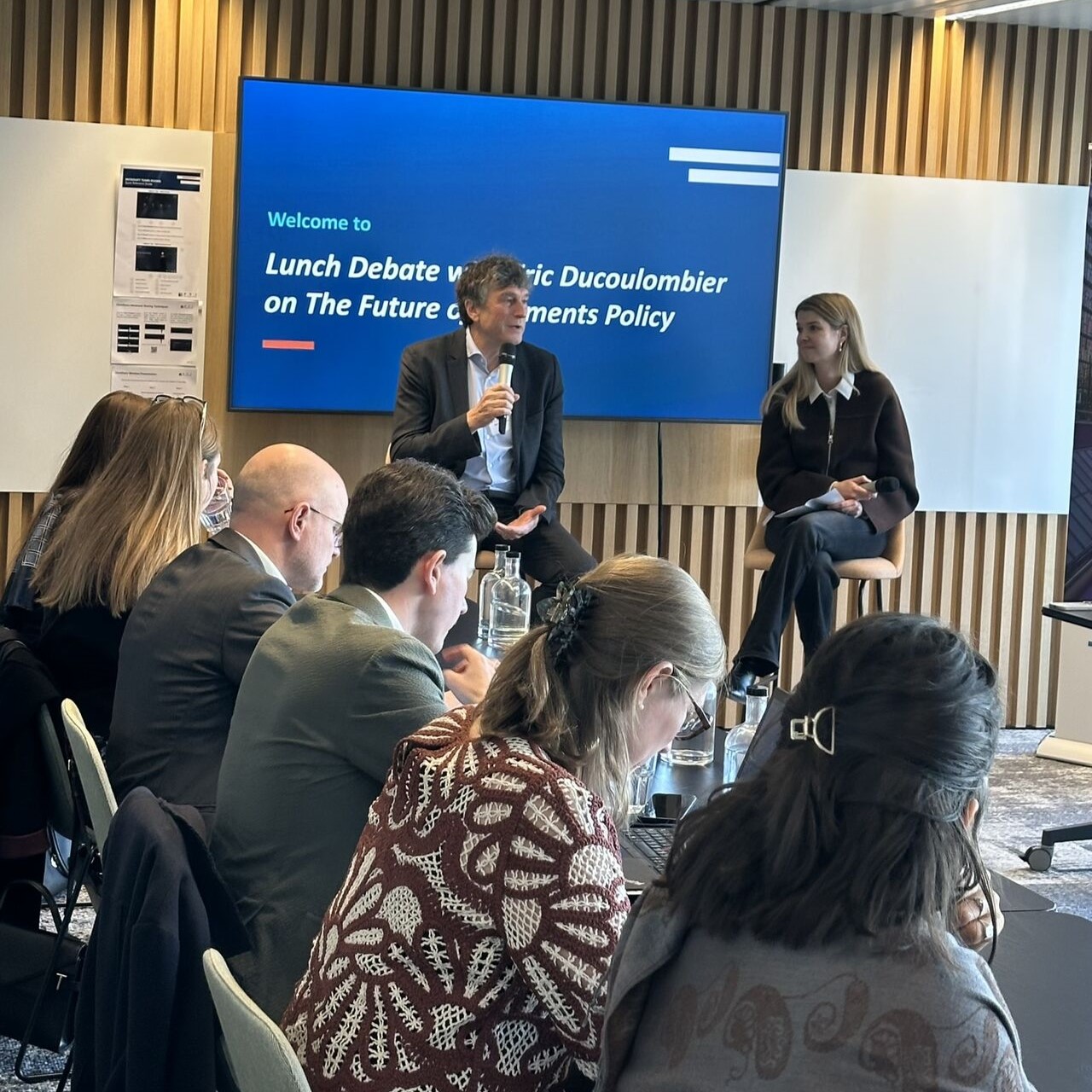
Last week, we had the privilege of bringing together leading industry representatives alongside stakeholders from the European Parliament and Member States’ Permanent Representations to the EU for an insightful discussion on the future of payments policy.
The conversation delved into the current status and the future implementation of the European payments policy, the Digital Euro project, and the growing prominence of stablecoins.
‘Big Bang of Defence Financing’ Event
Yesterday, the European Parliament hosted APRI’s “Big Bang of Defence Financing” breakfast, in collaboration with FTI Consulting, attended by 30+ Spanish Public Affairs professionals.
The event featured insights from Senior Director Marina Cubedo Vicén and Director Beatriz Cózar Murillo, for a discussion on how Spain could position its defence industry to seize new opportunities in the defence sector and stressed the need to prioritise European innovation over external dependencies.
Defence, Innovation, and Public Safety in the Technological Era
Last week our EMEA defence teams from Brussels and Madrid gathered for our landmark conference on ‘Defence, Innovation, and Public Safety in the Technological Era’, co-hosted with CEOE.
This dynamic event united top-tier policymakers, industry pioneers, and security specialists to delve into technology’s role in bolstering crisis preparedness, seamless inter-agency coordination, and rapid response mechanisms-ultimately fortifying Europe’s unified defence posture.
Upcoming Elections
- 16 November: General election (Chile)
- 18 November: Local elections (Denmark)
To be added to the distribution list for the Global PA Newswire, or for further information on the dedicated Public Affairs team at FTI, please contact [email protected]. |
The views expressed in this article are those of the author(s) and not necessarily the views of FTI Consulting, its management, its subsidiaries, its affiliates, or its other professionals.
©2025 FTI Consulting, Inc. All rights reserved. www.fticonsulting.com