Global Public Affairs Newswire – 12 December 2025

Welcome to a special ‘2025 in Review’ edition of the Global Public Affairs Newswire.
In this issue, FTI Consulting’s Public Affairs experts from key global markets break down the policy shifts, regulatory shake-ups and political twists that shaped global politics and markets this year. You’ll find insights from across the United States, United Kingdom, China, India, the European Union, Germany, Australia, France, Colombia, Brazil, South Africa, Ireland, and Hong Kong.
Please note that the next edition of the FTI Consulting Global Public Affairs Newswire will be published on Friday 9th January 2026. Happy Holidays and Warm Wishes for the New Year!
Market updates
- Over the past twelve months, President Trump’s return to the White House has produced a sweeping recalibration of U.S. policy and governance, reflecting a revived and more assertive version of his “America First” agenda. The administration has moved quickly across regulatory, legislative, and executive channels, often testing — and at times disregarding — long-standing institutional norms. These actions have reshaped relationships within Washington and raised new questions about the balance of power among the executive branch, Congress, and the federal bureaucracy.
- Internationally, the administration has relied heavily on economic coercion and personalized diplomacy. A rapid succession of tariff actions was designed to pressure key trading partners, narrow the trade deficit, and force NATO allies to commit greater resources to defense. The President has also taken an unusually direct role in navigating crises in Europe and the Middle East, personally engaging foreign leaders to drive negotiations. Latin America has emerged as a central focus: immigration policy has tightened further, and the administration has authorized targeted military operations against drug trafficking networks, signaling a more aggressive regional posture.
- Domestically, the passage of the expansive “One Big Beautiful Bill” advanced core pillars of the President’s platform. The law combined tax cuts, broad regulatory rollbacks, restructuring of the national healthcare system, and measures aimed at expanding domestic manufacturing. Meanwhile, the DOGE initiative resulted in the dismissal of thousands of career civil servants, reshaping the workforce and operational capacity of numerous federal agencies. The administration also deployed the National Guard in several cities to support crime-reduction efforts and directed ICE to intensify arrests of individuals suspected of being in the country illegally.
- Collectively, these steps represent a far-reaching interpretation of executive authority. They have triggered new legal challenges, forced Congress to reassess its institutional leverage, and underscored the volatile and fast-moving nature of policymaking in Washington during the administration’s first year back in office.
For more information about FTI’s Public Affairs services in the Americas, please contact [email protected].
- As the first full year of a Labour government since 2009 concludes, the party’s position in the polls has steadily deteriorated ahead of next year’s local and devolved elections, with potentially serious implications for Sir Keir Starmer’s premiership. After an unusually long and painful pre-Budget season, which damaged the Prime Minister’s standing with his own MPs, Labour will be banking on a better-than-expected result in May to keep the Starmer project viable into 2027.
- Electorally, Labour is now facing serious challenges from several directions at once. In its heartlands in the North of England and the Midlands, Nigel Farage’s Reform UK continues to dominate the conversation and is forecast to make sustained inroads at the expense of both Labour and the Conservatives. At the same time, Labour’s core vote in London and other urban centres is being eroded by Zack Polanski’s Green Party. The challenge for Labour lies in trying to shore up both sides of their electoral coalition: tacking right may stem losses to Reform but risks alienating those tempted by the Greens, and the inverse is equally true.
- While the outlook for Labour in England’s local elections is grim, it is arguably worse still for the Scottish and Welsh devolved contests, which pose the most serious threat to Starmer’s leadership. A poor result in May could see Labour lose control of the Welsh Parliament for the first time since 1999 and reverse the gains Scottish Labour had hoped to consolidate in Holyrood after last year’s General Election. In both cases, Labour’s woes are twofold: the same Reform UK insurgency that is challenging the party in England, and a resurgent nationalist vote in Wales and Scotland emboldened by the unpopularity of Starmer’s Westminster administration.
For more information about FTI’s Public Affairs services in the United Kingdom, please contact [email protected].
- Internally, China issued its latest Five-Year Plan to recalibrate growth toward “high-quality development”, prioritizing advanced manufacturing, technological self-reliance, industrial upgrading, and supply-chain security. This signals stronger industrial support, tighter links between innovation and security priorities, and incentives that will shape investment and operational choices across strategic sectors.
- Externally, China has held five rounds of economic and trade talks with the United States, spanning tariffs, export controls, tariff truces, fentanyl enforcement, and agriculture. Despite setbacks, the engagement – capped by the Xi-Trump meeting in South Korea – delivered modular agreements that added conditional stability while leaving core structural tensions unresolved.
Meanwhile, China’s tighter export controls on rare earths and related technologies reflect a shift from resource management to strategic leverage. - The move is widely interpreted as an effort to shape the terms of technological competition, prompting the U.S., Europe, and other major economies to confront the impact of resource asymmetries on industrial planning and technological positioning.
For more information about FTI’s public affairs services in China, please contact [email protected].
- For New Delhi, 2025 was a year of trade talks and shocks, and regional conflict: weaponization of tariffs by President Trump, a sudden conflict with Pakistan and U.S. claims of intervention, regime changes in Nepal and Bangladesh, drawn-out trade negotiations with the EU in the shadow of the Ukraine war, and India’s imports of Russian oil. All leading up to an intense November and December, with high-level visits from EU, USA and Russia.
- The geopolitical tightrope for India: balance trade with economic growth, a key electoral plank for PM Modi, while maintaining ‘strategic autonomy’ without visibly tilting towards USA or Russia. India scaled back Russian crude oil purchases under US pressure, signed a gas deal with the USA, and in December, welcomed trade teams from Washington and Brussels to seal respective deals, while PM Modi welcomed Russian president Putin in the nation’s capital.
- In 2026, New Delhi will aim to drive its AI leadership stake in the ground and host the AI Impact Summit in February, with a parallel focus on growing its fledgling semiconductor industry; close and execute trade deals, push further on energy security and ‘atmanirbhar’ or self-reliant strategic autonomy. Yet not very far in the background remains the threat of conflict with Pakistan, linked to the role of terror groups, such as in the November car explosion that killed 13 people in Delhi.
For more information about FTI’s Public Affairs services in India, please contact [email protected].
- Following the first year of the second 5-year mandate of President Ursula von der Leyen at the helm of the European Commission, two main focus areas have dominated:
- Enhancing the security of the EU and Ukraine; and
- Trying to improve the competitiveness of the European Union.
- On both fronts, there is progress has been made, yet it is clear that external and internal challenges are making more decisive steps complicated. The internal challenges are two-fold. One stems from a divided European Parliament where the “grand coalition” of the centre right and the centre left, and the Liberals and Greens, do not see eye to eye on the need and depth of regulatory simplification of the European legislative framework. The fact that the centre-right EPP group has, on a key simplification file, decided to vote with the alternative majority with the far right has further undermined trust between the parties that supported re-election von der Leyen, although it did mean that the first so-called omnibus package on reducing sustainability reporting requirements was agreed.
- The other stems from the political divisions within EU Member States, rendering national governments in the EU weaker and thereby hindering bold decision-making that is needed, on security and Ukraine, as well as on economic policy. Furthermore, there are also several major external challenges ranging from the Trump administration’s trade policy and uncertain commitment to NATO and support for Ukraine to the continued aggression of Russia and the strained relationship with China. Responding to these challenges would also require strong and unified action at the EU level, which is hampered by the internal challenges.
For more information about FTI’s Public Affairs services in the EU, please contact [email protected]
- Chancellor Election – Merz Secures the Top Job: On 06 May, Friedrich Merz (CDU) was elected Chancellor in a historic second round of voting, forming a coalition with the SPD, despite early tensions over ministerial appointments.
- €500-Billion Special Fund – the Largest Debt Package in Germany’s History: On 18 March, the Bundestag approved a €500-billion special fund to boost infrastructure and climate projects and additionally eased the debt brake for defense spending.
- Pension Reform – Securing the Present, Raising Future Questions: On 5 December, the Bundestag passed a controversial pension reform, narrowly avoiding a government crisis but raising concerns about long-term fiscal sustainability.
For more information about FTI Consulting’s Public Affairs services in Germany, please contact [email protected].
- Australia’s Federal election campaign was the key focus of the first half of 2025, which resulted in the centre left Australian Labor Party, securing a strong victory in the May poll, increasing its Parliamentary majority.
- Following the election, much was made by the government of its ‘Economic Reform Roundtable’, spruiked as a mechanism for building consensus on ways to improve Australia’s productivity, enhance economic resilience and strengthen budget sustainability. However, it resulted in limited tangible policy outcomes. Despite the Government’s political dominance, its policy agenda is decidedly cautious.
- The regulatory burden on Australian business continues to increase. This has extended to areas like scams, fraud, and misconduct; digital economy, fintech, crypto and payments; consumer protection and changes to merger laws; and the strengthening of enforcement and deterrence.
For more information about FTI’s Financial Services Public Affairs support in Australia, please contact [email protected].
- The year 2025 has seen France grapple with the consequences of the 2024 snap legislative elections. Called following the defeat of pro-Macron forces in the 2024 European elections, these elections resulted in a hung parliament split between three ideologically opposed blocs. This has made the passage of legislation difficult and successive governments fragile.
- This political instability has arrived at a particularly challenging time. Alongside the turmoil in parliament, France is facing a deepening budget crisis. Public debt reached a record €3.4 trillion ($4 trillion) in 2025, over 115% of GDP, while the deficit climbed to 5.4%. Major credit-rating agencies have since downgraded the country, which is also facing an excessive deficit procedure launched by the European Commission in July 2024.
- Reducing the deficit has been a priority of successive French governments in 2025, but the controversial fiscal measures required to do so have proven too contentious for a fragmented parliament. François Bayrou’s centrist government collapsed in September after tying its austerity package to a confidence vote, and Prime Minister Sébastien Lecornu has since struggled to secure compromises on the 2026 budget. Whether France will have an approved budget before the end of the year remains uncertain.
For more information about FTI’s Public Affairs services in France, please contact [email protected].
- 2025 marked the sharpest deterioration in U.S.–Colombia relations in more than a decade, driven by converging policy clashes, diplomatic missteps, and structural disagreements across trade, migration, security, and foreign policy. The cumulative effect was not a series of isolated disputes but a deeper erosion of trust that now shapes Washington’s assumptions about Colombia’s reliability as a partner.
- Trade, migration, and foreign policy frictions coalesced into a single rupture. Tariff disputes, renewed uncertainty around trade preferences, and U.S. frustration over deportations and the Darién migration flows heightened tensions. President Petro’s discourse at the UN, his positions on Gaza and NATO, and calls to suspend coal exports to Israel reinforced perceptions in Washington of a strategic drift toward a South–South alignment, weakening Colombia’s standing with traditional partners.
Security and diplomatic tensions further hardened mistrust and now shape the outlook for 2026. Disputes over extradition, drug policy, OFAC-listing controversies, and threats of decertification eroded cooperation. Public visa revocations and increasingly vocal criticism from Congress signaled Washington’s shift toward open pressure. - These strains are now influencing multilateral financing and raising electoral risk ahead of 2026. Colombia heads into elections amid polarization, security volatility, and heightened uncertainty—amplified by the fractured relationship with the Trump administration, whose tougher positions on drugs, migration, and trade reverberate across global markets and political cycles.
For more information about FTI Consulting’s Public Affairs services in Colombia, please contact [email protected].
- Trump’s tariff hike hit Brazilian exports as well as Justices. Brasília reacted with a strategy of commercial diversification, a WTO appeal and coordinated pressure from the private sectors, on both sides. The sustained effort paid off: Washington eased part of the tariffs and reopened agricultural markets, giving Lula political capital at home and greater credibility abroad.
- Former president Jair Bolsonaro was convicted for leading a plot to overturn the 2022 elections and sentenced to 27 years. After authorities flagged a potential escape plan, he was moved to a police facility. This unprecedented trial deepened polarization and sparked institutional clashes that will shape Brazil’s 2026 electoral landscape.
- Brazil has experienced recurring clashes among the Executive, Legislative, and Judiciary, fueled by polarization, disputes over constitutional limits, and competing pursuits for authority. These tensions are compounded by fiscal constraints and political fragmentation, complicating coalition-building and the pursuit of coherent policy, testing the country’s institutional resilience.
For more information about FTI’s Public Affairs services in Brazil, please contact [email protected].
- South Africa’s 2025 G20 Presidency concluded amid unprecedented diplomatic tensions with the United States, marking one of the most contentious periods in the country’s post democracy’s bilateral relations. What began as a promising opportunity for South Africa to showcase its leadership on the global economic stage quickly became overshadowed by escalating diplomatic incidents and trade relations disputes. The expulsion of South African Ambassador Ebrahim Rasool from Washington represented a dramatic low point, following months of deteriorating relations. However, the diplomatic rupture, had limited impact on South Africa’s ability to advance its G20 agenda focused on sustainable development, climate finance, and economic inclusion for the Global South, under the theme “Solidarity, Equality and Sustainability”.
- The tensions were further exacerbated by the proliferation of unsubstantiated narratives regarding South Africa’s domestic situation. Particularly damaging was the circulation of false claims about “white genocide” in South Africa, which gained traction in certain US political circles despite being repeatedly debunked by human rights organisations and fact-checkers. These narratives contributed to a climate of mistrust that ultimately led to the unprecedented boycott of several G20 ministerial meetings by senior US officials. The absence of high-level US representation undermined the legitimacy and continuity of key policy discussions and complicated consensus-building efforts on critical global economic issues.
- The diplomatic fallout culminated in South Africa’s exclusion from participation in planning meetings for the upcoming US G20 Presidency, breaking with the traditional troika model that includes the previous, current, and upcoming presidency nations. This exclusion not only disrupts the G20 continuity mechanisms but also signals a concerning departure from established multilateral norms.
For more information about FTI’s Public Affairs services in South Africa, please contact [email protected].
- 2025 saw Fine Gael secure a fourth consecutive term in Government, forming a coalition with Fianna Fáil and several Independent TDs. The new coalition entered government with a strong focus on addressing Ireland’s long-standing infrastructure challenges following the November 2024 election.
- Ireland found itself particularly exposed in a shifting geopolitical environment. Faced with tariffs and trade uncertainty, and keenly aware of the importance of US multinationals for the Irish economy, the Government worked to balance improving US relations while presenting a united front with its EU partners.
- As the EU led the response to tariffs, the Irish Government made efforts to tackle the domestic impact of trade and infrastructure challenges. New strategies focused on strengthening competitiveness and productivity, growing the semiconductor industry, and accelerating infrastructure delivery and housing supply.
For more information about FTI Consulting’s Public Affairs services in Ireland, please contact [email protected].
- Hong Kong concluded its 2025 Legislative Council (LegCo) elections on 7 December, marking the second full-term poll under the new electoral arrangements introduced in 2021. According to the city’s Electoral Affairs Commission, voting proceeded smoothly across all polling stations. While official turnout figures suggested that 1.32 million registered voters cast ballots yielding an overall turnout of 31.9% – slightly higher than 2021 elections – the elections marked the second-lowest turnout Hong Kong was handed over from the UK to China in 1997.
- With the elections now completed, LegCo will move into the post-poll transition phase. Chief Executive John Lee is expected to confirm the formal establishment of the new LegCo within the next 30 days followed by the swearing-in of lawmakers at the first council meeting. Committee and panel chairmanships—typically announced in the opening weeks of a new term—will help shape the legislative agenda around economic development, innovation and technology, housing, environmental policy, and cross-border cooperation vis-à-vis the Greater Bay Area.
- Observers expect greater emphasis on administrative efficiency, public-service modernization, and economic resilience measures amid a challenging external environment. Businesses will be monitoring how the new legislature prioritizes ongoing workstreams, including land and infrastructure approvals, digital regulation, professional-services reforms, and sector-specific compliance initiatives. Several large policy packages, already flagged by the government in 2024–25, are expected to advance once the new LegCo begins scrutiny.
For more information about FTI’s Public Affairs services in Hong Kong, please contact [email protected]
- Spain closes the year under a climate of entrenched political polarisation and institutional strain. The minority coalition government, dependent on a complex mix of left-wing and nationalist partners and now further weakened by Junts per Catalunya’s decision to withdraw its support, has faced persistent parliamentary deadlock. Further pressure on the Government has been added by judicial tensions, corruption investigations and inquiries affecting figures close to the Prime Minister.
- In the international arena, Spain’s geopolitical profile shifted noticeably this year, with Madrid strengthening its ties to China, adopting an assertive pro-Palestinian stance, and entering direct friction with the United States over defence spending within NATO. While formally aligned with EU priorities, Spain has pursued a pragmatic approach that seeks more diversified global relationships, at times distancing itself from its traditional partners, and positioning itself as a vocal leader on social causes with international impact.
- Looking ahead, Spain faces a dense electoral cycle, with several regional elections scheduled throughout the year and continued uncertainty over the approval of a national budget. The fragility of parliamentary arithmetic has revived speculation about potential early general elections, creating an unusually charged political context as parties prepare for overlapping regional and national contests.
For more information about FTI’s Public Affairs services in Spain, please contact [email protected]
Expert Analysis |
Boardroom Geopolitics: US-Asia-Europe Risk & Growth Outlook
FTI Consulting Spain and AmCham Spain recently organized a “Boardroom Geopolitics: US-Asia-Europe Risk & Growth Outlook” event, which brought together executives from major national and international companies to analyze the impact of geopolitics on business strategies for 2026.
The panel featured insights from representatives at The Dow Chemical Company, alongside FTI Consulting colleagues Mark McCall, Amrit Singh Deo and Carlos Ochoa Alonso.
2025 Global Public Affairs Survey
Our latest global Public Affairs report, “Risks and priorities in Public Affairs – 2025 versus 2023”, highlights how rapidly the landscape is evolving at a time when the Public Affairs function remains as critical as ever.
With market-leading experts across the globe, our Public Affairs teams help clients cut through complexity and stay a step ahead.
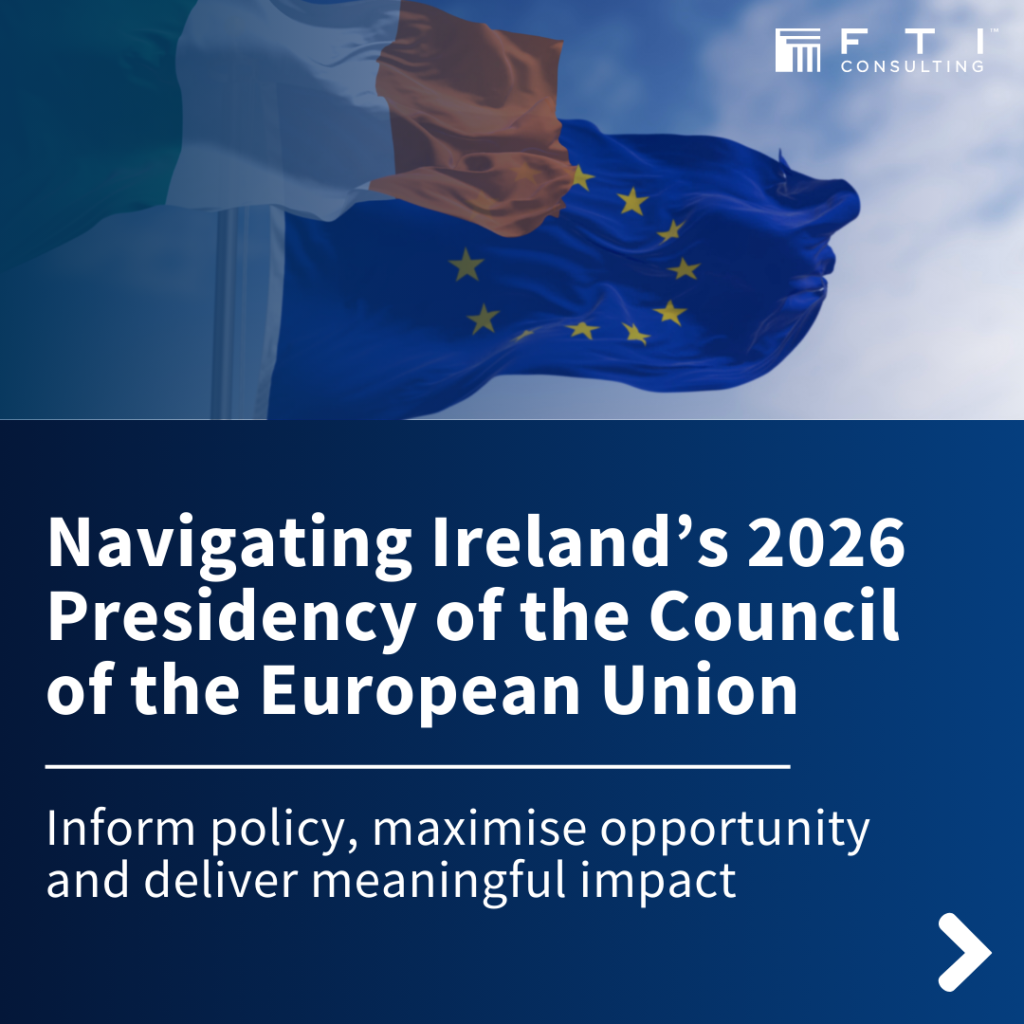
Ireland’s 8th Presidency of the Council of the EU
In July 2026, Ireland will assume the Presidency of the Council of the European Union (EU). For businesses operating in Ireland, the period leading up to Irish presidency represents an opportunity to engage and influence policies that will define Europe in the years ahead.
Click below to learn more about how your company can navigate opportunities and shape outcomes during Ireland’s EU Presidency.
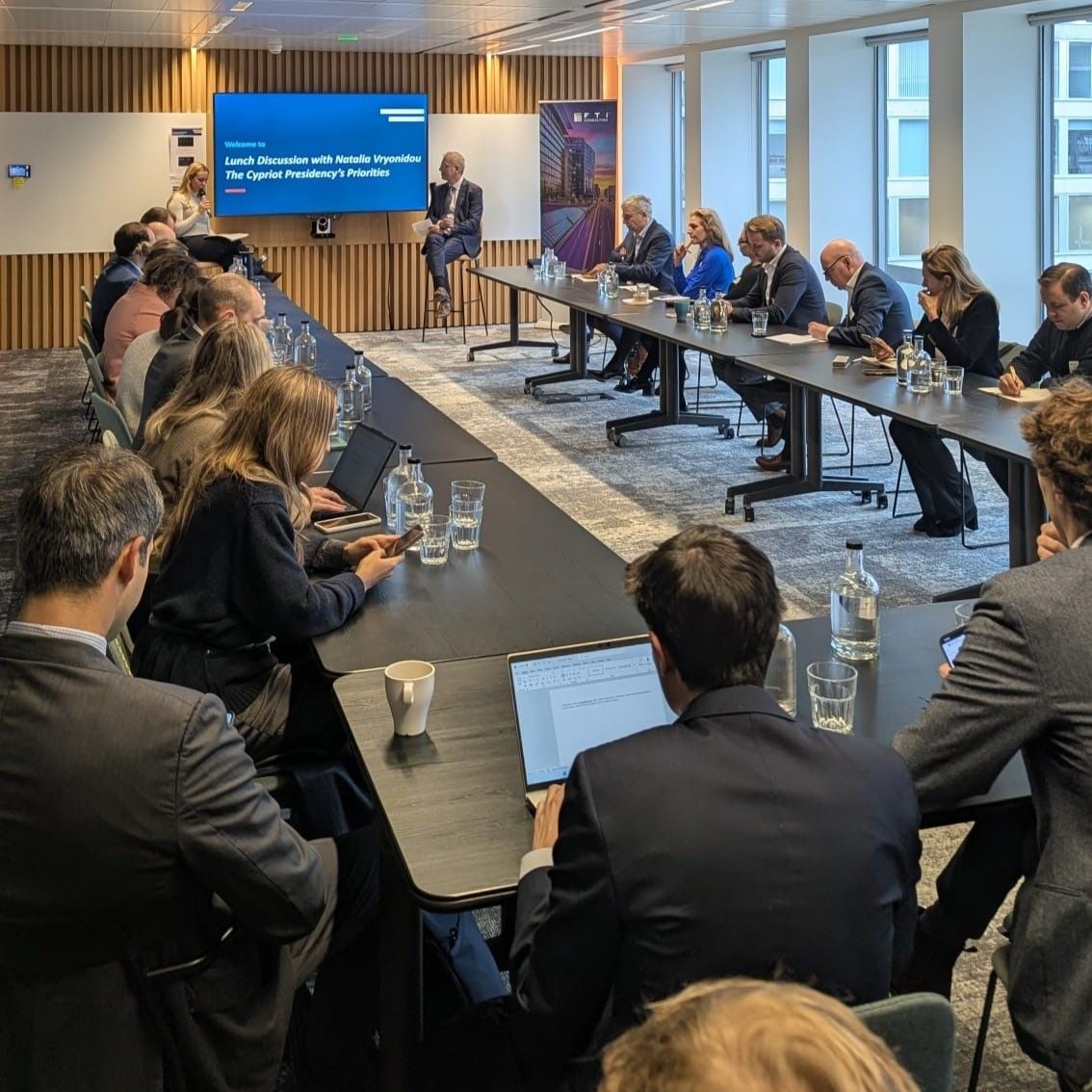
Cypriot EU Presidency Event
In the first half of 2026, Cyprus will assume the Presidency of the Council of the EU.
Against this backdrop, our team hosted leading industry representatives alongside the incoming Cypriot Presidency of the Council last week for an insightful discussion on the Presidency’s priorities and its objectives concerning the Savings and Investments Union with Natalia Vryonidou, Financial Services Attaché at the Cypriot Permanent Representation to the EU.
Upcoming Elections
- 14 December: Presidential elections (Chile)
- 28 December: Parliamentary elections (Myanmar)
- 15 January: General election (Uganda)
- 18 January: Presidential elections (Portugal)
- 1 February: General election (Costa Rica)
- 22 February: Parliamentary elections (Laos)
- 5 March: General election (Nepal)
- 8 March: Parliamentary elections (Colombia)
- 15 March: Legislative elections (Vietnam)
To be added to the distribution list for the Global PA Newswire, or for further information on the dedicated Public Affairs team at FTI, please contact [email protected]. |
The views expressed in this article are those of the author(s) and not necessarily the views of FTI Consulting, its management, its subsidiaries, its affiliates, or its other professionals.
©2025 FTI Consulting, Inc. All rights reserved. www.fticonsulting.com