ESG+ Newsletter – 3 July 2025
We start this week’s newsletter with confusion in the EU, over whether its anti-greenwashing legislation will or won’t proceed. At the same time, the EU will for the first time, formally allow the inclusion of carbon credits in environmental goals. We also look at the rise in lawsuits taking aim at climate action and policy initiatives and analyse whether the latest policy developments will impact renewables and ESG strategies.
This week’s poll
Will the threat of legal action stymie sustainability initiatives among companies and regulators?
- Yes
- No
- The opposite – lack of action opens up companies to legal action/litigation
Last week’s poll results
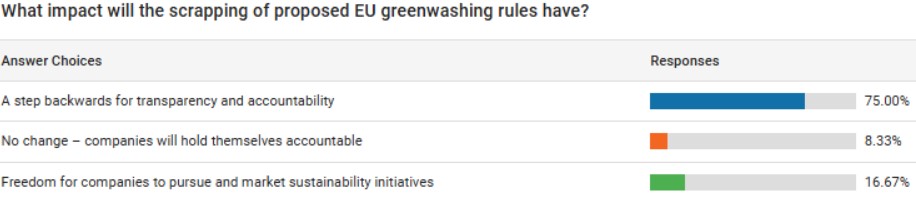
EU Commission reaffirms commitment to Green Claims Directive
While ESG+ itself reported on the EU Commission’s plans to abandon the Green Claims Directive last week, this week it appears that the Directive will not be withdrawn. ESG News reports on the EU Commission’s announcement that the law, aimed at combatting greenwashing, has not been shelved in its entirety. Following the confusion last week, a Commission spokesperson clarified that the Commission’s intention was only to withdraw the directive if microenterprises – businesses with less than 10 employees and a revenue below €2 million – fell under its scope, due to concerns about disproportionate administrative burdens. While the Commission seems firm that the Directive will remain in force if microenterprises are excluded from its scope, the confusion of the last week has brought significant debate around the law, potentially undermining its ultimate impact and negotiations around its approval.
Anti-climate action lawsuits grow under wider ESG pushback
As the pushback against ESG initiatives grows, the number of anti-climate lawsuits is on the rise. Sustainable Views reports that 60 out of the 226 climate lawsuits filed globally in 2024 challenge climate initiatives and plans to reduce emissions. These “non-climate-aligned” lawsuits frequently involve contesting a government’s power to implement climate policies, attacking private companies’ climate commitments through antitrust or fiduciary duty claims, or prosecuting climate activists under criminal law. Further, lawsuits known as “just transition” cases, are being enacted by communities or companies who feel that their rights or livelihoods are being negatively affected by climate action or clean energy projects, such as wind farms or large-scale solar installations, highlighting the importance of balancing stakeholder views when taking action to shift economies toward a more sustainable path. Other cases, known as “green vs green” lawsuits, pit climate mitigation efforts against other environmental concerns like biodiversity protection, illustrating the complex trade-offs involved in pursuing ambitious climate goals, but also how the tool of litigation can be used opportunistically to challenge businesses pursuing initiatives.
In the US, acting on a new executive order to “protect American energy from state overreach,” the federal government has targeted state-level climate initiatives, leading to an uptick in climate-related litigation. Across the globe, the bar continues to be raised for companies, with pressure coming not just from those demanding more action on sustainability, but also those willing to challenge businesses on a range of issues, through a range of media.
Carbon credits included in EU climate goals
The European Commission has proposed updating the EU’s 2040 climate target to allow, for the first time, carbon credits purchased from non-EU countries to count toward the bloc’s green goals. Reuters reports that the move comes in response to push back from several member states, including Italy, Poland, Germany, France and the Czech Republic, over the perceived lack of flexibility in the EU’s climate goals.
Under the proposal, member states could cover up to 3 percentage points of the bloc’s 90% carbon reduction target (from 1990s levels) by purchasing carbon credits from nations outside of the EU through a U.N. backed market, allowing countries to offset a portion of emissions rather than acting to reduce domestically driven carbon emissions. Supporters argue that carbon credit markets enable more environmentally advanced countries to invest in those less developed in this area, promoting a more unified global climate effort while balancing goals around economic security and development. Critics, however, contend that carbon credits can often overstate environmental benefits and risk allowing European industries to avoid cutting their own emissions.
The proposal comes ahead of COP30, set to take place this November in Brazil, where the EU is set to announce its 2035 climate plan, which underpins its ambition to become carbon neutral by 2025. Given the revision to allow for the inclusion of carbon offsets in the goals, debates over the efficacy of carbon credits are likely to remain at the forefront of discussions.
US policy shift clouds renewables outlook
After protracted negotiations, the U.S. Senate narrowly approved a sweeping budget bill, aspects of which directly target the clean energy provisions of the 2022 Inflation Reduction Act. Politico reports that while a punitive excise tax on wind and solar projects was successfully removed, and a “carve-out” was added for projects beginning within one year of the bill’s enactment, the legislation will enforce the phaseout of tax credits for other wind and solar projects not in service by the end of 2027.
While the bill encompasses action on a myriad of areas, clean energy tax credits emerged as a divisive issue during negotiations. While certain states, including those led by members of the President’s party, warned that removing these incentives could disrupt hundreds of gigawatts of planned solar and wind capacity, increase consumer energy costs, and slow power production amid the accelerating global AI race, others in the House of Representatives argue that greater cuts to clean energy were needed, the Financial Times reports. The bill has now returned to the House, with ongoing debates set to dictate the final version over the next 24 hours.
ESG strategies and communications reflect new political outlook
As evidence of the impact of policy developments, such as those ongoing in Congress, ESG Drive covers a recent report by The Conference Board that found 80% of large US and multinational companies have adjusted their ESG strategies in response to US policy shifts on climate, energy and ESG. Nearly three-quarters of ESG executives surveyed believed that the policy shifts would slow down corporate decarbonisation efforts in the US, with 82% thinking the domestic energy transition would lose momentum. The report, which surveyed 125 corporate sustainability and ESG executives, found that companies are refining their sustainability-related communications to focus on business impacts and expanding legal oversight of ESG. Notably, 65% of respondents reported experiencing backlash on their ESG efforts, primarily from advocacy groups and federal policymakers, with 90% expecting this backlash to persist or intensify over the next two years. Despite the reticence to focus on ESG, the underlying challenges that drove it to the top of the corporate agenda – climate change, inequality, precarious working conditions and supply chain risks, among others – have arguably become more acute. Alongside continued regulatory action to drive greater reporting on sustainability across jurisdictions, as set out in an FTI note earlier in the year, companies should ensure that – regardless of the noise – their risk management frameworks and strategy discussions reflect that they do not operate in isolation from the issues that originally brought ESG to the forefront.
ICYMI
- The Swiss government has paused revising its climate disclosure rules, delaying new company reporting requirements, including plans to meet Switzerland’s 2050 net-zero target, ESG Today reports.
- The Singapore Business Federation has called for a deadline extension on ISSB climate reporting for smaller listed firms, citing widespread unpreparedness. According to ESG News, only 4% of surveyed companies feel ready to meet the 2025 deadline, pointing to a lack of resources and adequate systems as key challenges.
- ICMA Principles have said that defence projects are “likely” to be ineligible for Green, Social, and Sustainability Bonds, despite Social Bonds’ role in aiding vulnerable populations in conflict zones.
| The views expressed in this article are those of the author(s) and not necessarily the views of FTI Consulting, its management, its subsidiaries, its affiliates, or its other professionals.
©2025 FTI Consulting, Inc. All rights reserved. www.fticonsulting.com |