Q2 2026 Health Insurance Payer-Provider Dispute Update
Coverage disruptions anticipated at the start of 2026, stemming from the implementation of the One Big Beautiful Bill Act (OBBBA) and the expiration of the Affordable Care Act’s (ACA) enhanced premium tax credits, are already beginning to affect the healthcare landscape. These policy changes have contributed to the financial pressures being felt across the healthcare ecosystem, affecting patients, payers, providers, and states alike.1,2,3,4
To address an estimated over $900 billion reduction in federal Medicaid funding over the next decade, states have taken action or are considering a range of fiscal measures, including budget cuts, tax and fee increases, restrictions on program eligibility and benefits, and higher cost sharing for eligible individuals. 5,6 At the same time, insurers are reporting cost pressures that have led to rate increases, premium adjustments, or reconsiderations of their participation in the ACA marketplace.7 Providers are facing growing pressures as well, with reimbursement uncertainty, rising uncompensated care, and workforce cost increases threatening the financial viability of hospitals, physician practices, and clinics.8,9 As the number of uninsured individuals rises and health plan enrollment shifts in response to the elimination of subsidies and rising premiums, average medical claims per person have increased, adding further cost pressure across the healthcare system.10,11
These dynamics are already producing measurable consequences. ACA sign-ups have declined by more than one million compared to 2025, according to CMS.12 This decline has coincided with rising costs for consumers.13 Hospitals and providers serving a higher concentration of patients covered by Medicaid and ACA marketplace plans have reported greater exposure to the financial effects of federal funding and policy changes, as they are confronted with the challenges of absorbing losses from a growing uninsured population and lower reimbursement rates.14 It is estimated that 400 hospitals across the country are at risk of closure, and more than 80 hospital units and departments have already closed in 2026.15 These changes have drawn increased attention from the public and policymakers alike, with healthcare access and affordability remaining a prominent and defining issue heading into the 2026 midterm elections.16
Taken together, these changes reflect deepening structural and long-term pressures across the healthcare industry. As coverage losses and financial pressures mount, payers and providers will continue to reassess their operational and contractual strategies, creating conditions well-suited to heightened disputes between the two.
Emerging Trends and Issues
Contract negotiations that result in disputes continue to draw attention from state and federal policymakers, regulators, and local officials. State legislators and regulators, including insurance commissioners and state attorneys general, have introduced proposals and guidance aimed at protecting consumers affected by disputes. These efforts have focused on improving transparency, expanding notification requirements for potential network disruptions, creating special enrollment periods for individuals and families impacted by disputes, and educating consumers about their rights – including how to file complaints, apply for continuity of care, and pursue appeals and grievances.17,18,19,20,21
The impact of the No Surprises Act (NSA) and its Independent Dispute Resolution (IDR) process on contract negotiations will be closely monitored by policymakers to identify trends that may lead to an increase in payer-provider disputes. The Congressional Budget Office (CBO) reported that 3.4 million IDR-related disputes were filed among payers and providers between 2022 and 2025, far exceeding the Centers for Medicare and Medicaid Services’ (CMS) projection of 22,000 disputes annually.22 While the NSA was intended to protect patients from surprise bills, we will continue to monitor how these trends influence negotiations between payers and providers.23
As the number of payer-provider disputes continues to rise and public scrutiny intensifies, we expect federal and state policymakers to continue pursuing policy options that protect consumers through new legislative and regulatory guardrails that could meaningfully impact the future dynamics of contract negotiations and disputes.
Q2 2026 Disputes – By the Numbers
For four years, FTI Consulting’s Healthcare Strategic Communications team has tracked and reported on payer-provider disputes through publicly reported news coverage and paid and earned media. Reaching agreements on key contract terms – including reimbursement, utilization management, care coordination, disease management, quality improvement, and performance metrics – has become increasingly challenging, affecting coverage for tens of millions of individuals and families across the United States.24
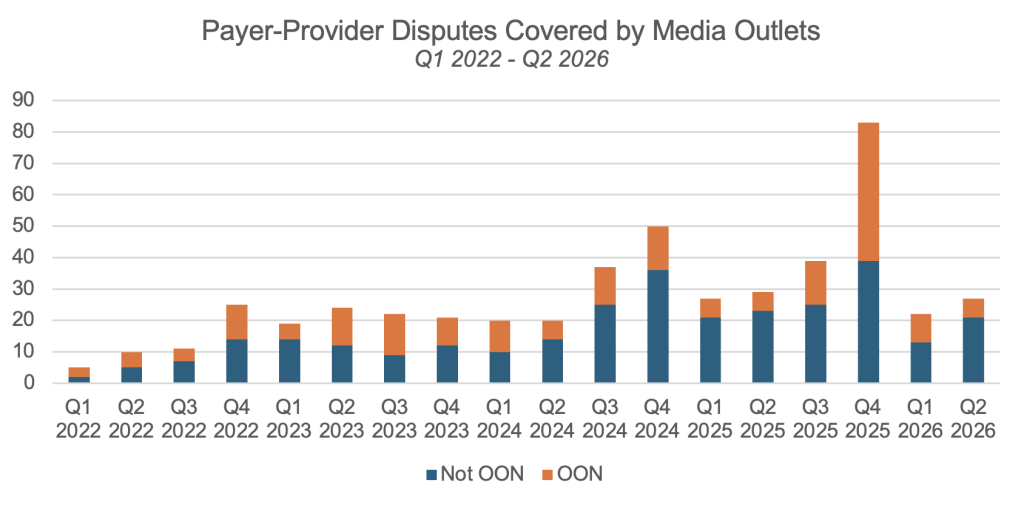
- In Q2 2026, traditional media outlets reported a total of 29 disputes. Of these disputes, 9 resulted in providers going out-of-network (OON), and 13 remain unresolved.
- 27.6% (8 out of 29) of disputes involved Medicare Advantage (MA) plans, 3 of which remained unresolved by the end of the quarter.
Q2 2026 Healthcare & Life Sciences Quarter in Review
Overall, 8 more disputes were reported in the second quarter of 2026 than in the previous quarter, reflecting a 38.1% increase. However, the total remained below the number of disputes reported in each quarter from Q2 through Q4 2025.
Disputes with University-Affiliated Providers Remain in View
Consistent with trends observed in the first quarter of 2026, university-affiliated providers continue to draw attention in disputes. During the second quarter, 37.9% (11 out of 29) of disputes involved a university-affiliated hospital or health system, compared to 61.9% (13 out of 21) in the previous quarter. While the share of disputes involving university-affiliated providers declined quarter over quarter, these organizations continue to cite escalating cost pressures and challenges associated with managing rising expenses as key drivers during negotiations.25,26
These challenges reflect broader financial pressures facing academic medical centers and research-focused healthcare systems. Ongoing funding constraints from federal agencies, including the National Institutes of Health (NIH), continue to affect how university-affiliated hospitals and health systems manage operating costs and sustain clinical operations.27
Looking Ahead
As the effects of the OBBBA and the expiration of the ACA’s enhanced premium tax credits continue to unfold, the financial pressures facing payers, providers, and states are likely to intensify. With ACA enrollment projected to decline by more than one million individuals, relative to 2025 levels, an estimated 400 hospitals at risk of closure, and federal Medicaid funding reductions straining state budgets, the underlying conditions driving payer-provider disputes show no signs of easing.28, 29
University-affiliated providers, already confronting the effects of constrained federal research funding, remain a notable presence in these disputes and will continue to warrant close attention. At the same time, the volume of IDR filings under the No Surprises Act – far exceeding original projections – signals that the dispute resolution landscape will remain under significant strain.
State and federal policymakers are responding with increased regulatory scrutiny and consumer protection efforts. With healthcare affordability emerging as a defining issue in the midterm election cycle, legislative and regulatory activity is expected to accelerate through the end of 2026 and into 2027.30
FTI Consulting will continue to monitor these developments and assess their impact on the evolving payer-provider landscape in the second half of 2026.
Indya Adam and Bianca Chiu, both Strategic Communications interns at FTI Consulting, contributed to this article.
Research Methodology:
FTI Consulting searched multiple news databases for articles regarding negotiations over reimbursement rates between provider organizations and insurance companies. Those negotiations that were publicly reported by a news outlet on or after April 1, 2026, were counted for the quarter in which they were reported. Negotiations that were resolved or failed to reach an agreement in one quarter but were first reported in another quarter were counted for the quarter in which they became public. When a provider decided to no longer accept any MA plans, FTI Consulting counted that decision as a single dispute upon notification of the decision to remove all MA plans from the respective provider network.
References
[1] Levinson, Zachary, Neuman, Tricia and Godwin, Jamie, “What are the Implications of the 2025 Budget Reconciliation Bill for Hospitals?” KFF (June 12, 2025). https://www.kff.org/medicaid/what-are-the-implications-of-the-2025-budget-reconciliation-bill-for-hospitals/.
[2] “What Health Care Provisions of the One Big Beautiful Bill Act Mean for States,” National Academy for State Health Policy (July 8, 2025). https://nashp.org/what-health-care-provisions-of-the-one-big-beautiful-bill-act-mean-for-states/.
[3] Hut, Nick, “Health insurers tell Congress their operations aren’t the cause of high healthcare costs,” Healthcare Financial Management Association (Jan. 23, 2026), https://www.hfma.org/payment-reimbursement-and-managed-care/health-insurers-tell-congress-their-operations-arent-driving-high-healthcare-costs/.
[4] Ortaliza, Jared et al., “How Will the One Big Beautiful Bill Act Affect the ACA, Medicaid, and the Uninsured Rate?” KFF (June 18, 2025), https://www.kff.org/affordable-care-act/how-will-the-2025-budget-reconciliation-affect-the-aca-medicaid-and-the-uninsured-rate/.
[5] Williams, Elizabeth, Burns, Alice, and Rudowitz Robin, “How Has Projected Medicaid Spending and Enrollment Changed Since Passage of the 2025 Reconciliation Law?,” KFF (July 1, 2026), https://www.kff.org/medicaid/how-has-projected-medicaid-spending-and-enrollment-changed-since-passage-of-the-2025-reconciliation-law/.
[6] “Diana, Amaya, Pillai, Akash, and Rudowitz, Robin, “A Closer Look at California’s Plans to Implement Work Requirements While Facing Major Budget Shortfalls Amid Cuts in Federal Medicaid Funding,” KFF (Apr. 6, 2026),https://www.kff.org/medicaid/a-closer-look-at-californias-plans-to-implement-work-requirements-while-facing-major-budget-shortfalls-amid-cuts-in-federal-medicaid-funding/.
[7] Querolo, Nic, ”States face tough budget decisions as Medicaid cuts mount,” Modern Healthcare (June 11, 2026). https://www.modernhealthcare.com/politics-regulation/mh-states-budget-medicaid-cuts-hr-1/.
[8] “Costs of Caring: Challenges Facing America’s Hospitals as They Care for Patients in 2026,” American Hospital Association (Mar. 2026), https://www.aha.org/costsofcaring.
[9] Blavin, Fredric, and Simpson, Michael, “Changes in Health Care Spending and Uncompensated Care under Enhanced Tax Credit Expiration for Marketplace Coverage,” Urban Institute (Sept. 25, 2025). https://www.urban.org/research/publication/changes-health-care-spending-and-uncompensated-care-under-enhanced-tax-credit.
[10] Ortaliza, Jared et al. “Tracking Insurer Participation Changes in the ACA Marketplaces in 2027,” KFF (June 29, 2026), https://www.kff.org/affordable-care-act/tracking-insurer-participation-changes-in-the-aca-marketplaces-in-2027/.
[11] Cox, Cynthia, “ACA Marketplace Enrollment Is Down By 3 Million After Big Jump in Premium Payments,” KFF (June 29, 2026), https://www.kff.org/quick-insights/aca-marketplace-enrollment-is-down-by-3-million-after-big-jump-in-premium-payments/.
[12] “Marketplace 2026 Open Enrollment Period Report: National Snapshot,” Centers for Medicare & Medicaid Services (Jan. 28, 2026), https://www.cms.gov/newsroom/fact-sheets/marketplace-2026-open-enrollment-period-report-national-snapshot-2.
[13] Spears, Rachel, “Affordable Care Act Insurers Want More Premium Increases as Enrollment Sags,” KFF (July 8, 2026). https://kffhealthnews.org/insurance/priced-out-obamacare-affordable-care-act-aca-premium-increases-peterson-kff
[14] Levinson et al., supra note i.
[15] Weixel, Nathaniel and Choi, Joseph, “Protect Our Care highlights adverse effects of GOP cuts on hospitals,” The Hill (June 16, 2026), https://thehill.com/newsletters/healthcare/5927221-protect-our-care-tracks-hospital-cuts/.
[16] Schumacher, Shannon, et al., “KFF Health Tracking Poll: Health Care Costs, Expiring ACA Tax Credits, and the 2026 Midterms,” KFF (Jan. 29, 2026), https://www.kff.org/public-opinion/kff-health-tracking-poll-health-care-costs-expiring-aca-tax-credits-and-the-2026-midterms/.
[17] Sofastaii, Mallory, “Maryland bill aims to protect patients caught in hospital-insurance contract disputes,” WMAR News (Feb. 26, 2026). https://www.wmar2news.com/matterformallory/maryland-bill-aims-to-protect-patients-caught-in-hospital-insurance-contract-disputes.
[18] “Attorney General Neronha offers guidance to those affected by UnitedHealthcare and Brown University Health’s health insurance contract negotiation,” State of Rhode Island Attorney General Peter F. Neronha (June 9, 2026), https://riag.ri.gov/press-releases/attorney-general-neronha-offers-guidance-those-affected-unitedhealthcare-and-brown.
[19] “Provider network and health insurer contract negotiations,” Office of the Insurance Commissioner, Washington State (Accessed June 2026), https://www.insurance.wa.gov/insurance-resources/health-insurance/how-health-insurance-works/provider-network-and-health-insurer-contract-negotiations.
[20] “Health Billing & Insurance Complaints,” Attorney General of Maryland (Accessed June 2026), https://oag.maryland.gov/i-need-to/Pages/health-billing-insurance-complaints.aspx.
[21] “Health Care and Insurance,” New York State Attorney General (Accessed June 2026), https://ag.ny.gov/resources/individuals/health-care-insurance.
[22] Hale, Jessica, Hayford, Tamara and Pelech, Daria, “A Call for New Research on the No Surprises Act,” Congressional Budget Office (June 15, 2026), https://www.cbo.gov/publication/62491.
[23] “No Surprises Act Overview of Key Consumer Protections,” Centers for Medicare & Medicaid Services (rev. Nov. 2023), https://www.cms.gov/files/document/nsa-keyprotections.pdf.
[24] Hudson, Caroline, “Provider, payer contract disputes are heating up,” Modern Healthcare (May 29, 2024), http://www.modernhealthcare.com/providers/health-plan-negotiations-inflation-claims-denials/.
[25] Dyrda, Laura, “Financial pressures mount for academic medical centers,” Becker’s Hospital Review (Dec. 3, 2025). https://www.beckershospitalreview.com/academic-medical-center/financial-pressures-mount-for-academic-medical-centers/.
[26] Boyle, Patrick, “Hospitals make painful choices as federal cutbacks add to economic headwinds,” AAMC (Aug. 7, 2025), https://www.aamc.org/news/hospitals-make-painful-choices-federal-cutbacks-add-economic-headwinds.
[27] “The impact of federal actions on academic medicine and the U.S. health care system,” AAMC (June 11, 2025), https://www.aamc.org/about-us/aamc-leads/impact-federal-actions-academic-medicine-and-us-health-care-system.
[28] Centers for Medicare & Medicaid Services, supra note xiii.
[29] Weixel, Nathaniel and Choi, Joseph, supra note xv.
[30] Bogen, Julie, “Axios Live: Health care affordability emerges as a defining issue,” Axios (June 26, 2026), https://www.axios.com/2026/06/26/axios-live-health-care-affordability-emerges-as-a-defining-issue.