Renewable energy faces policy-driven headwinds in Q1 2026
According to ESG Dive, the US renewable energy manufacturing sector experienced significant disruption in the first quarter of 2026, with an Environmental Defence Fund (EDF) report recording a net loss of approximately 5,900 jobs and cancelled investments amounting to $1.4 billion. These challenges are tied to evolving US federal policy changes affecting electric vehicles, renewable energy incentives, and emissions regulations. For instance, the US EPA rescinded the 2009 Greenhouse Gas Endangerment Finding earlier this year, repealing tailpipe emissions standards for vehicles, inherently placing downward pressure on EV sales. Additional recent changes have included the elimination of several tax incentives related to clean vehicles, renewable energy, alternative fuels, and energy-efficient commercial buildings. Despite these insurmountable headwinds, clean energy investment remained net positive in Q1 2026. In parallel, a recently proposed merger between energy giants Dominion Energy and NextEra Energy further highlights continued momentum in the renewable energy sector, with the companies stating the transaction would create the world’s largest renewables and battery storage company, accelerating the development and deployment of clean energy. Overall, the EDF report highlights how policy and geopolitical shifts are increasingly influencing renewable energy investment, with Q2 2026 expected to provide further clarity on the sector’s trajectory.
EU Sustainable Finance negotiations raise debate over energy producers’ scope 3 emissions
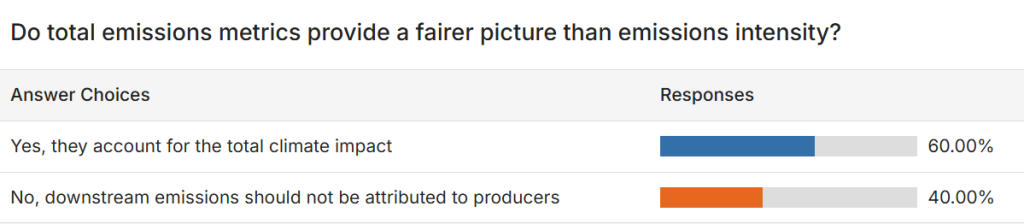
The European Commission has proposed that climate and sustainable funds be banned from investing in oil and gas companies that are expanding production under amendments to the Sustainable Finance Disclosure Regulation (SFDR). This has led to disagreements across the EU over whether to keep fossil fuels out of climate and transition funds. France has proposed that such funds should be free to invest in companies that generate revenue from the exploration, extraction and refining of hard coal, and oil and gas, provided that emissions reduction strategies for scope 1 and 2 are in place and that finance is available for positive environmental impact. Critically, the proposal wouldn’t include scope 3 emissions, which could account for up to 90% of energy producers’ emissions. The new SFDR rules are expected to be ready by the end of 2026.
TISFD draft released two years after launch
The Taskforce on Inequality and Social-related Financial Disclosures (TISFD) has released the first draft of its framework, nearly two years after the initiative launched, Responsible Investor reports. The framework aims to improve transparency and disclosure on people-related issues, extending to systems-level risks of inequality, giving it a broader scope than comparable initiatives such as the International Sustainability Standards Board’s (ISSB) human capital project, which focuses solely on workforce-related risks. Modelled on the structure of the Task Force on Climate-related Financial Disclosures, the TISFD framework is built around four pillars: governance, strategy, impact and risk management, and metrics and targets. It was developed in close collaboration with standard-setters including the ISSB, EFRAG, and the Global Reporting Initiative, drawing on more than 2,000 requirements and 300 unique metrics from existing standards.
TISFD Executive Director Simon Rawson emphasised that the framework is designed to be interoperable with existing disclosure standards, addressing earlier investor concerns about further fragmentation in the reporting landscape. He noted that the framework provides companies with “a scientific language” to discuss socially-related financial issues in the boardroom, particularly in a politically sensitive climate. The draft is open for public consultation until the end of July, followed by pilot testing and further development, with a final version expected in 2027.
Leadership succession planning remains a top priority for French businesses
New research reported by L’Agefi highlights 2025 as a year of significant leadership transition for French companies in the large and mid-cap SBF 120 index. Nearly one in five changed their CEO last year, including six among the larger CAC 40 companies. This accelerated pace of change underlines the need for boards to prepare effectively for leadership transition. Leadership succession is now a permanent governance priority for French businesses. Effective preparation often depends on the strength of the relationship between the board and the incumbent leader. Where a CEO has a particularly dominant leadership style, succession planning can become more challenging. Yet despite the importance of the topic and related risks, stakeholders continue to find limited disclosure on succession processes in annual reports. With a CEO turnover rate of 19% in 2025, France sits above the continental European average of 13%. While almost two thirds of last year’s transitions were planned, the remaining 35% were unplanned, reinforcing the need for boards to be ready for unexpected departures.
Boards also made greater use of external recruitment in 2025. Across the SBF 120, 61% of appointments came from outside the organisation, compared with 45% previously. In the CAC 40, however, the figure was 17%, down from 31%. External appointments may point to gaps in succession planning, but they can also reflect a deliberate effort to secure leaders with the capabilities needed to drive restructuring, transformation, international expansion or strategic renewal. In France and beyond, robust succession planning for both anticipated and unforeseen departures, supported by clear communication with external stakeholders, remains essential. It is critical not only for limiting business risk, but also for maintaining stakeholder confidence.
ICYMI
- Texas, Nebraska, Iowa, and West Virginia sued proxy advisor ISS, alleging its ESG and DEI-related guidance violates consumer protection laws, in the latest escalation of US anti-ESG scrutiny targeting proxy advisory firms, ESG Today reports.
- Singapore and the World Bank launched a new programme to strengthen high-integrity carbon markets and improve access to climate finance, ESG News reports .