ESG+ Newsletter – 27 March 2025
As Spring arrives in the Northern hemisphere, this week we look at ongoing shifts in regulation in the US, the potential for upside over the long-term in the ongoing tariff war and efforts to continue to soften the reporting burden for companies from CDP and EFRAG. We also summarise research from Reuters and Natixis, which analyse climate action and diversity in Japan, and the impact of AI on investments, respectively.
From an FTI viewpoint, yesterday we hosted our second annual governance event in Paris, with a summary below.
This week’s poll
Would you be more likely to give your money to an ESG focused asset manager or fund?
- More likely
- Less likely
- No difference
- I would only want to focus on returns
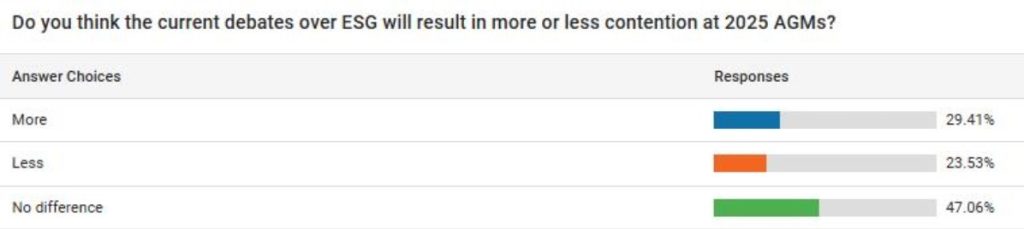
Last week’s poll results
SEC pushes back another rule, the Names Rule
The SEC has extended the compliance deadlines for its updated “Names Rule“, ESG Dive has reported, giving investment companies an additional six months to align their funds’ investment strategies with their advertised purposes. The new deadlines are June 11, 2026, for companies with over $1 billion in assets and December 11, 2026, for those with less. Originally, large funds were required to comply by December 2025.
The updated rule, initially adopted in 2023, mandates that funds with thematic names, like “ESG” or “sustainability,” invest at least 80% of their assets in line with those objectives. It also introduces enhanced disclosure requirements for fund prospectuses. The SEC’s extension aims to give companies more time to develop and test their compliance systems and avoid additional operational costs. Acting SEC Chair Mark Uyeda has expressed that the agency may consider further extensions for other recently adopted rules if challenges arise. He emphasised the importance of giving firms sufficient time to implement new regulations in an orderly manner. Uyeda also pointed out that the SEC should assess whether “changed circumstances” might justify pausing the implementation of certain rules. He stressed that the Commission’s focus should be on creating effective and cost-efficient regulations, while also ensuring that the SEC stays within its statutory authority. Uyeda’s comments, and recent delay around the SEC Climate Rule, reflect a broader push for careful consideration of how new rules impact businesses and an overall trend toward lighter regulation in the US.
Discussing governance trends in Paris
On Wednesday, FTI Consulting organised its second governance event in Paris, featuring a distinguished panel that provided deep and diverse perspectives on key trends expected to shape French shareholder meetings in 2025 and the broader governance landscape. The panel included Agnès Touraine – Chair of the Board of Rexel, Cédric Lavérie – Head of French Research at ISS, David Chekroun – Professor of Law at ESCP Business School and Edouard Dubois – Head of Proxy Voting at Amundi. A common theme throughout the discussions was the attractiveness of the Paris financial market and the competitiveness of French companies. The first topic covered was the new French attractiveness law, which facilitates the use of multiple voting shares, eases the issuance of capital at a discount to market price and enables virtual Board and shareholder meetings. The panel then examined executive remuneration levels and practices, their impact on competitiveness, and how they are reviewed by proxy advisors and investors. The event concluded with a discussion of the EU Corporate Sustainability Reporting Directive (CSRD) and Omnibus proposals – designed to enhance the competitiveness of European companies – as well as the influence of US-driven anti-ESG movements on investor and corporate practices. While the event discussions were framed around French AGMs, they dealt with broader topics across European markets, emphasising the importance of clear communication in explaining governance and remuneration changes in a dynamic environment.
CDP and EFRAG release mapping to align climate disclosures
CDP and the European Financial Reporting Advisory Group (EFRAG) have introduced a mapping tool aligning CDP’s questions with the EU’s ESRS E1 climate standard, as reported by ESG Today. This initiative aims to simplify reporting for companies subject to both the CDP platform and the Corporate Sustainability Reporting Directive (CSRD). CDP facilitates global environmental disclosure, with over 23,000 companies reporting in 2023—representing 66% of global market capitalisation. EFRAG, tasked by the European Commission, developed the European Sustainability Reporting Standards (ESRS), adopted in 2023, to regulate sustainability disclosures under CSRD. Despite the scope of the ESRS being under review as part of the EU’s Omnibus legislation, the mapping tool follows a 2023 agreement to enhance alignment between CDP and ESRS. Key areas of interoperability include climate transition plans, mitigation targets, emissions reporting, and internal carbon pricing. CDP emphasised that the initiative reduces reporting complexity while providing businesses with richer climate data. EFRAG highlighted the resource’s role in fostering efficiency and avoiding redundant disclosures. CDP and EFRAG plan to continue strengthening interoperability, ensuring streamlined climate reporting for companies navigating both frameworks.
The collaboration marks a further step toward harmonised sustainability reporting, aiming to reduce duplication and helping businesses focus on actionable climate strategies rather than administrative burdens.
Tariffs may bring hope for Canada’s green sectors
While the climate policy pushback and ongoing trade war between Canada and the US has been viewed as damaging to both economies, Bloomberg suggests the rift may offer longer-term green opportunities in Canada. The green industry is bracing for more US levies on aluminum and steel, posing near-term threats to exports of Canadian critical minerals, notably low carbon aluminum, and power grid equipment which underpin US electrification efforts. Down the line however, Canada’s clean industries could reap the benefits of this trade war, particularly in electric vehicle (EV), aluminum and steel markets. As the supply chain for EVs currently crosses more borders than the cheaper traditional gasoline-burning vehicles, the impact of tariffs may be reduced. While still a junior market, Canada hopes to build a sophisticated, domestic ecosystem for the production of electric cars and batteries, leveraging the country’s supply of critical metals and minerals as well as its abundant clean power. Beyond EVs, aluminum is also a key component in solar panels, wind turbines and power grid components. With the US importing most of its aluminum from Canada, constituting 90% of Canada’s aluminum production, the imposition of tariffs is likely to be painful in the short-term. However, over time, the higher import prices could motivate Canada to mine, refine and use more of its own critical minerals, boosting the efficiency of the homegrown EV and clean-energy industry.
Fund selectors look to AI and private markets for asset growth
A survey conducted by Natixis Investment Management and covered by Portfolio Adviser Future, has found that wealth managers are increasingly utlising AI and private assets to grow their assets under management. The 2025 Natixis Investment Managers Wealth Industry Survey polled the views of 520 fund selectors across 20 countries, finding increasing AI adoption among wealth managers to improve internal investment processes, business operations and client servicing, with 58% confirming their firm implemented AI into investment processes. Meeting client demand for unlisted assets was marked as a ‘critical factor’ for almost half of wealth managers, underpinning ongoing challenges for public companies in terms of attractiveness. According to the survey, 79% of participants also expect the technology to accelerate earnings growth for the next 10 years. Moving forwards, almost three quarters of fund selectors suggested they were optimistic about market prospects, confident that they can harness potential disruptors to unlock new opportunities, while remaining wary of new geopolitical conflicts which was listed as the top economic concern.
Japan stays committed to diversity and decarbonisation
A recent Reuters survey has revealed that 77% of Japanese companies remain committed to promoting workplace diversity and decarbonisation, despite changes in US policies. While U.S. corporations have scaled back their diversity and decarbonisation efforts, Japan continues to prioritize these initiatives as essential for employee retention and addressing labour shortages due to its ageing population. The survey also shows that 84% of companies will maintain their decarbonisation strategies, citing the importance of energy security and emissions reduction. Japan’s approach highlights a thoughtful balance of global priorities with its own unique challenges, ensuring long-term resilience and progress.
ICYMI
- ISS is preparing a ‘sustainability bond rating’ that will help investors analyse the sustainability impact and risks of labelled bonds, Environmental Finance reports.
- The SAF industry is falling short of its 2030 targets with production not ramping up quickly enough, Boston Consulting Group found in a report published on Thursday.
| The views expressed in this article are those of the author(s) and not necessarily the views of FTI Consulting, its management, its subsidiaries, its affiliates, or its other professionals.
©2024 FTI Consulting, Inc. All rights reserved. www.fticonsulting.com |