ESG+ Newsletter – 16 April 2026
In this week’s newsletter, we ask whether the expectations on boards, including around ESG, might be impeding effective governance. We also look at two updates from the EU – around the latest potential changes to ESRS and the seminal deforestation regulation. Elsewhere, a survey of companies within the G7 points to challenges around marrying progress on climate with communicating on the same. Finally, with geopolitical events pushing energy prices up globally, we analyse the experience of different nations and the impact of the diversification of energy systems.
This week’s poll
|
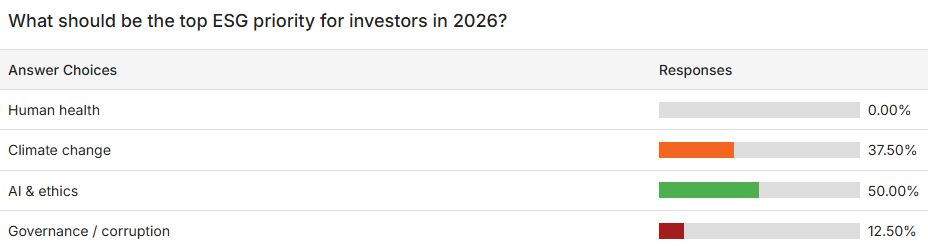
Last week’s poll
Asking more from boards may not be in shareholders’ best interests
A new ECGI working paper suggests that the expansion of board responsibilities over the past two decades may not necessarily be in shareholders’ best interests. Regulators have increasingly required boards to oversee compliance across areas such as anti-money laundering, cyber security and climate and sustainability risks. While there are governance benefits to elevating these issues to board level, expectations have grown faster than board capacity. The paper notes that board size and meeting frequency have remained relatively fixed.
This has led to what the authors describe as “board overload”. Drawing on interviews with directors and insights from decision-making literature, the paper highlights two key effects. At the individual level, excessive demands lead to information fatigue, meaning that even conscientious directors are more likely to rely on heuristics and devote less time to engaging with unfamiliar issues. At the collective level, it can skew agenda-setting, with boards underinvesting in long-term strategy and risk oversight.
Beyond regulation, we note that expectations from investors and other stakeholders have also expanded, from climate risk to biodiversity, from cyber security to artificial intelligence, and more recently to geopolitical risk. The cumulative effect is a steadily widening remit for boards.
The paper argues that regulators should reconsider the current approach. Rather than mandating board involvement in an ever-growing list of issues, the focus should shift towards defining desired outcomes, while allowing companies flexibility over how responsibilities are allocated internally. That argument echoes other recent calls for a more flexible approach to corporate governance (such as from the UK’s FRC) focused on long-term shareholder value creation.
European Commission considers ESRS revamp
The European Commission is considering alterations to the European Sustainability Reporting Standards (ESRS) to officially align with global standards set by the International Sustainability Standards Board (ISSB), according to Responsible Investor. Where the ESRS requires reporting on a double materiality basis, i.e., that companies disclose on sustainability issues that have impacts on the environment and society, as well as those that are financially material to the reporting company, ISSB only mandates the latter. As such, the Commission is debating stricter separation between factors that are considered financially material and those that influence materiality in sustainability reports . The latest debate comes on the back of extensive revisions of the ESRS in December, and a draft of the framework is anticipated within the next week. If approved, EU companies covered by CRSD will automatically comply with ISSB without additional reporting, so long as “impact information” is presented in a way that does not “obscure” or overshadow financially material disclosures. The ISSB has consistently pushed the EU to use its global standards as a “starting point”, which could then be “topped up” with impact-material disclosures to comply with EU requirements, but has not received official backing as of yet. However, critics have raised concerns that the amendment could further complicate double materiality assessments, as sustainability statements may require redrafting, increasing auditing costs and undermining a double materiality-focused approach that was popular among significant cohorts of investors and stakeholders.
EUDR simplification could jeopardise current corporate progress
On the subject of EU regulation, the simplification of the European Union Deforestation Regulation presents an important opportunity for policymakers to recognise the progress companies have already made in preparing for its implementation, Reuters reports. Although the regulation is not yet fully in force, it is already influencing corporate behaviour. According to the Forest 500, which tracks the 500 most influential companies linked to commodity-driven deforestation, 14% have cited the EUDR as a driver for actions to reduce their environmental impact. Of these, 19% have demonstrated tangible progress in 2025. More broadly, over two-thirds of the companies have expressed intention to address deforestation, though progress remains limited. Meanwhile, one-third of companies are considered to be lagging, lacking any commitments to prevent deforestation or ecosystem conversion. Most interestingly, despite concerns of a wider ESG rollback, only 14 companies have reduced their ambition since 2024. This reinforces the importance of the EUDR as a regulatory tool, highlighting that voluntary action alone is insufficient. Policymakers now face a critical choice. Support forward-looking companies and scientific evidence, or yield to narrow lobbying interests.
Net-Zero Commitment Gap: businesses balancing action and communication
A British Standards Institution survey of over 7,000 business leaders across G7 countries reveals a significant gap between climate ambitions and action. The research suggests that, overall, businesses remain committed in their focus. In fact, despite scepticism in some quarters, four in five (78%) say economic growth and net zero can happen together. Similarly, three in four business leaders (76%) say net zero will help grow the economy, create jobs, and strengthen energy security. And whilst 74% see greater risks in inaction, companies are retreating from public commitments. Sixty-one percent have altered how they communicate net-zero goals due to political climate scepticism, and 33% have re-evaluated their targets.
Despite 81% expressing concern about future climate costs, only half expect emissions reductions in the next year. Investment remains limited: just 21% have procured renewable energy, 20% completed climate adaptation planning, and only 38% plan increased net-zero investment—while 25% anticipate cuts.
This disconnect persists despite 83% claiming commitment to national net zero targets. The survey suggests businesses increasingly frame decarbonization through a “resilience prism” rather than explicit climate action, reflecting the politicisation of environmental goals while maintaining underlying recognition of climate risks.
Global energy shock exposes energy security limits
According to Inside Climate News, a geopolitical shock stemming from the US-Israeli conflict with Iran, leading to disruptions in the Strait of Hormuz, has exposed how energy security is repeatedly tested by disturbances in global supply. Despite record oil and gas production, the United States is structurally tied to global oil markets, meaning shocks quickly translate into domestic price volatility. Fuel prices are rising sharply as supply chains tighten amid persisting traffic through the Strait of Hormuz. Over the past month, US households have reportedly paid collectively $8.4 billion more for gasoline compared to prices before the conflict began, according to a report by Democrats on Congress’ Joint Economic Committee. During shocks, nations may rely on readily available and abundant fossil fuels, such as China which currently burns coal for electricity. However, prior energy diversification, including China’s continued investment in electric vehicles and renewables, do provide meaningful resilience against fossil fuel disruptions, displacing an estimated 1.7 million Chinese barrels of oil per day. Regardless of widespread clean energy alternatives, which have been rolled back under the current US administration, the US faces a clear vulnerability: heavy reliance on globally traded fossil fuels leaves the nation exposed to price volatility and supply chain disruptions. Energy security is shaped by exposure to global shocks, underscoring the mutuality of fossil fuel systems and the energy transition in strengthening resilience.
ICYMI
- Global standards bodies International Organization for Standardization and Greenhouse Gas Protocol have formed a joint working group, to develop a harmonised product-level emissions accounting standard, aiming to reduce fragmentation and simplify reporting, ESG Today reports.
- Japan’s greenhouse gas emissions fell below one billion tons for the first time since 2013. According to ESG News, this marks a symbolic threshold even as policymakers warn that progress remains uneven.
| The views expressed in this article are those of the author(s) and not necessarily the views of FTI Consulting, its management, its subsidiaries, its affiliates, or its other professionals.
©2026 FTI Consulting, Inc. All rights reserved. www.fticonsulting.com |