ESG+ Newsletter – 15 May 2025
This week we cover a recent study which claims that the financial system lacks incentives to support sustainability, which risks major market repricing as the realities of the climate crisis transpire. We also look at the latest developments in ESG-related regulations in the EU and US, including the implications of Trump administration policies on energy security and financial regulation.
This week’s poll
Are investors at risk of substantial market disruption due to a lack of consideration of climate- and nature-related risks?
- Yes
- No
- Investors are already considering these risks
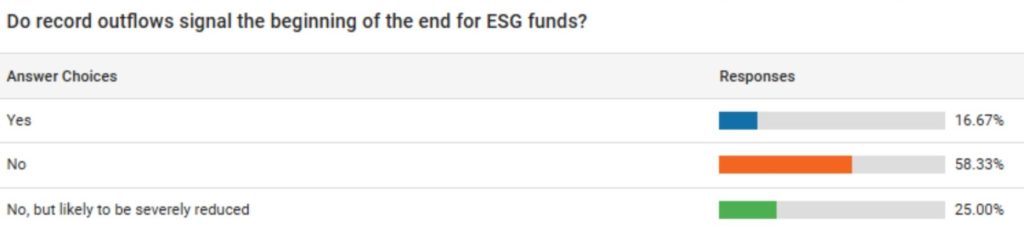
Last week’s poll results
Risk of major market repricing as ESG sentiment shifts
Investors are exposed to a substantial risk of disruptive market repricing once sentiment begins to reflect the physical realities of climate and nature-related risks, according to a new study by the Cambridge Institute for Sustainability Leadership. Currently, the financial system lacks the right incentives to support sustainable investment. There are no capital charges on environmentally harmful activities, as the existing capital framework is not built to shield the broader economy from climate and biodiversity-related risks. As a result, investors have little motivation to divest from environmentally damaging assets as long as they continue to deliver short-term returns. Climate-negative nature-degrading investments often appear more profitable than sustainable alternatives as the full environmental cost of economic activity is not reflected in market pricing.
This directs capital toward short-term gains at the expense of long-term stability. Despite these systemic flaws, a transition is already underway in certain sectors. The growing green economy could offer opportunities worth up to $10.3 trillion. Thus, finance must adapt, not only to avoid sudden market corrections, but also to seize the wide-ranging opportunities that the transition to a more sustainable economy presents.
NBIM urges EU to align sustainability standards with ISSB for greater consistency
Norway’s trillion-dollar sovereign wealth fund, Norges Bank Investment Management (NBIM), has urged the EU to align its European Sustainability Reporting Standards (ESRS) more closely with the International Sustainability Standards Board (ISSB) and Sustainability Accounting Standards Board (SASB) frameworks, as reported by Responsible Investor. In its response to a public consultation by the European Financial Reporting Advisory Group (EFRAG), NBIM highlighted the need for “identical terminology and metrics” where the frameworks address the same topics. NBIM emphasised that streamlining the ESRS could reduce the reporting burden for companies, enhance comparability, and support a consistent global baseline. It noted that the current ESRS structure, with its granular and overlapping requirements, creates unnecessary complexity, especially in areas like climate change and workforce metrics. The fund also called for a balanced approach, ensuring qualitative disclosures remain alongside streamlined quantitative metrics, to provide context for investors. It further recommended consolidating redundant requirements and enhancing engagement with report users to improve the practical value of the standards.
As global standards converge, further alignment could drive meaningful simplification, enhancing transparency and reducing costs for businesses while providing clearer data for investors.
US States challenge federal suspension of wind energy projects in coordinated legal push
A recent lawsuit filed by 18 US states against the Trump administration underscores a significant clash between federal directives and state-led initiatives in relation to clean energy and climate. Led by New York AG, Letitia James, the suit challenges a presidential memorandum issued on Trump’s first day in office, which indefinitely halted all federal approvals for wind energy projects. ESG Today reports that by halting federal approvals for wind energy projects, the administration not only disrupts ongoing developments, but inherently challenges the autonomy of states striving to meet renewable energy goals and to combat climate change. This legal confrontation points out the inconsistency between halting wind energy development and the administration’s declaration of a national energy emergency and subsequent intent to expand domestic energy production. Further, it highlights the broader tension between national energy policies favouring fossil fuels and state commitments to sustainable energy solutions, raising critical questions about the future of America’s energy landscape and environmental responsibility.
US pushes world financial regulators to backtrack
Top officials at US financial watchdogs are calling on the Basel Committee on Banking Supervision, the world’s financial standard-setters, to downgrade their flagship climate risk project according to the Financial Times. The Basel Committee originally established a high level task force in 2020 to examine climate change risks to the financial system, and since its inception has produced a number of reports, including proposals to establish a global framework for banks to disclose climate risks and a set of principles for banks and their supervisors to tackle threats from global warming. However, amidst a trend of pushback against environmental policy since President Trump took office, the four US regulators on the Basel committee, the Federal Reserve Bank, the New York Fed, the Office of the Comptroller of the Currency and the Federal Deposit Insurance Corporation, have announced their intention to downgrade the taskforce to a working group. The proposal to restructure the Basel Committee’s task force was discussed at a meeting of the world’s top central bank governors and financial supervisors on Monday this week, with some, likely Europe-based, bankers and regulators defending the taskforce. The threat of dissolution from the US marks a further widening the gap between North America and Europe on climate regulation, with the European Central Bank and the Bank of England conversely calling for banks to step up their efforts to address climate change.
NGFS unveils short-term climate scenarios to assess economic risks
The Network for Greening the Financial System (NGFS) has developed its first set of short-term climate scenarios, aimed at helping financial institutions, policymakers, and investors understand the economic impacts of climate events and transition policies by 2030. The freely available tool models four climate shock scenarios, highlighting both physical and transition-related risks with detailed sectoral and macroeconomic insights. It is expected that the dataset will be used for climate stress testing and risk assessments, helping institutions inform decisions in areas like investment, regulation, risk management and monetary policy. The results highlight that delayed climate action will lead to higher future economic damage, reinforcing the urgency of climate preparedness.
ICYMI
- House Republicans released a draft bill to extend President Donald Trump’s tax cuts, which would overhaul Biden’s climate law and clean energy tax credits for electric vehicles and solar, Bloomberg reports.
- German Chancellor Friedrich Merz has publicly urged the European Union to cancel its Corporate Sustainability Due Diligence Directive, which, according to ESG News, signals a potential reversal in Europe’s approach to ESG regulation.
| The views expressed in this article are those of the author(s) and not necessarily the views of FTI Consulting, its management, its subsidiaries, its affiliates, or its other professionals.
©2025 FTI Consulting, Inc. All rights reserved. www.fticonsulting.com |