ESG+ Newsletter – 13 February 2025
Your weekly source of ESG and sustainability news includes the latest developments on DEI, regulatory developments in the US and EU, growing adoption of TNFD reporting and a view on sustainability investing through the eyes of value rather than politics.
This week’s poll
As the focus on DEI ramps up globally, we ask whether the recent pressure on DEI will impact your approach to reporting in 2025?
Plans to reduce focus on DEI in reporting
Plans to increase focus on DEI in reporting
No changes planned
Last week’s poll results
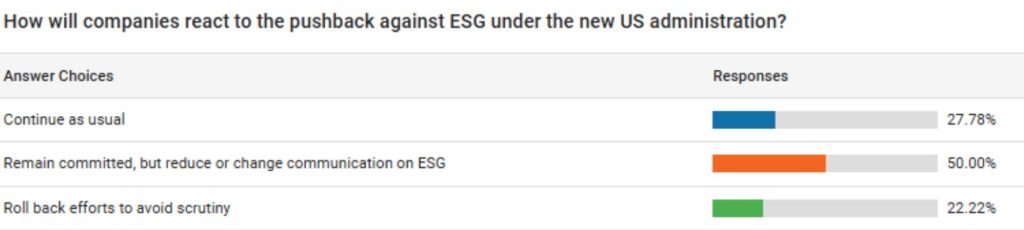
The rapidly evolving DEI landscape
The impact of a change in administration in the US continues to reverberate across the US. Following a Supreme Court ruling in 2023, diversity had come under pressure, with action ramping up significantly in 2025. US companies have scaled back DEI initiatives and diversity policies, while certain notable investors have altered expectations on board diversity targets in their engagement and voting guidelines. Additionally, the world’s most influential proxy advisor, ISS, issued a statement that it will no longer consider diversity factors when providing voting recommendations regarding the election of directors at US companies. In a statement published earlier this week, ISS cited President Trump’s Executive Order on DEI policy as the basis for this decision, noting that US companies will evolve their views on DEI based on “evolving market practice and governmental activity.” ISS new guidelines will only apply to recommendations published on or after 25 February, bringing about the potential for unusual discrepancies between recommendations before and after that date. While the pushback on DEI has almost exclusively been limited to the US, we have seen scrutiny on sustainability regulations start to impact action in the EU. Over the coming months, as a majority of AGMs are held, companies should take steps to understand the evolving expectations of differing shareholders on their register, as well as testing reporting against broader stakeholder expectations.
Acting SEC Chair questions need for climate disclosure Rule
As ESG Today reports, Mark Uyeda, Acting SEC Chairman, announced a postponement of legal proceedings against the SEC’s new climate disclosure rule, calling it “deeply flawed” and potentially harmful to the economy. Uyeda, appointed after former Chair Gary Gensler’s resignation following a change in administration, opposes the rule arguing that existing disclosure rules suffice and that the new rule exceeded the SEC’s mandate. The rule, adopted in March 2024, would mandate public companies disclose climate risks, financial impacts of extreme weather, and in some cases, greenhouse gas emissions.
The rule faced immediate legal challenges, including lawsuits from Republican state attorney generals and the U.S. Chamber of Commerce. In April, the SEC paused implementation while defending the rule in court, arguing it provides essential investment information. However, Uyeda has now ordered staff to inform the court of the Commission’s changed stance, signalling a potential shift in policy. As with the EU, the future of sustainability reporting in the US remains uncertain, with significant political and legal headwinds upending previous momentum towards regulation of disclosure.
Sustainable investment is about cash, not politics
Business Green reports this week that sustainable investing will remain unphased by the changing political landscape in the US. Yes, key asset managers have left the Net-Zero Banking Alliance but investors still have the appetite for sustainable initiatives, and the regulatory architecture for green investing appears to have held strong. The structure of many tier one and two asset managers includes sustainability teams, as well as strict client mandates which entail sustainability requirements in investment policies.
ESG pushback has come at a time of wider industry dissatisfaction with the state of sustainability regulations for asset managers. In 2024, the SEC reviewed over 20 new climate disclosure rules, and in Europe, the CRSD and CSDDD have caused a level of frustration due to the complexity of reporting and due diligence. In response, the European Commission has announced it will look at regulatory simplifications, set to be announced before the end of Q1.
While the term ESG may face some pushback, ultimately, money talks. Sustainable investment, investor sentiment and asset owner demand will continue to drive investment in ESG funds, even if the naming or branding changes. As an example, 85% of clean energy investments from Biden’s Inflation Reduction Act have come in Republican-led states, highlighting the impact of economic incentives for sustainability and the potential challenges for those seeking to overhaul them.
EU omnibus may shift toward ISSB approach
The International Sustainability Standards Board (ISSB) has advocated for aligning the Corporate Sustainability Reporting Directive (CSRD) with its own sustainability reporting standard, according to Responsible Investor. The European Commission is expected to heavily water down the CSRD and Corporate Sustainability Due Diligence Directive (CSDDD) as part of its upcoming Omnibus package. The article suggests that the double materiality aspect of CSRD may be at risk and that there may be a re-focus on single (financial) materiality instead, in line with ISSB standards. The call for alignment is motivated by an opportunity for the EU to “reduce reporting burdens, ensuring efficiency and comparability” for global companies by further aligning with global disclosures, as set out by Sustainable Views. The ISSB has also suggested streamlining climate reporting for CSRD, allowing companies to use the board’s climate standard as a “starting point”.
TNFD adoption continues to grow
While DEI and ESG in general remain the subject of stakeholder and political backlash, green shoots of adoption continue to grow in relation to the Taskforce on Nature-related Financial Disclosures (TNFD), reports Environmental Finance. 526 organisations have now committed to reporting against the framework, an increase from 502 in October. Among them are 84 global investors, including 19 insurers, reflecting a growing recognition of nature-related risks and opportunities in financial decision-making. According to a recent presentation to the International Sustainability Standards Board, investors are increasingly engaging with portfolio companies on biodiversity, setting specific targets, and integrating nature into risk assessments. Major asset managers are among those actively pushing for stronger nature-related commitments. Engagement initiatives like Nature Action 100 and the PRI’s Spring initiative on nature further highlight the momentum behind sustainable investing. The TNFD noted that many investors are now looking beyond compliance, leveraging nature-positive strategies to enhance both financial performance and environmental outcomes. With growing investor interest and corporate action, the TNFD framework is positioning itself as a key tool in aligning financial markets with global biodiversity goals.
ICYMI
Salesforce announced the launch of the AI Energy Score, a benchmarking tool aimed at enabling AI developers and users to evaluate, identify, and compare the energy consumption of AI models, ESG today reports.
Chinese EV giant BYD is in talks with European automakers to form a carbon credit pool. According to ESG News, this will allow companies with lower EV sales to buy emissions credits and reduce their overall CO2 averages.
| The views expressed in this article are those of the author(s) and not necessarily the views of FTI Consulting, its management, its subsidiaries, its affiliates, or its other professionals.
©2024 FTI Consulting, Inc. All rights reserved. www.fticonsulting.com |