ESG+ Newsletter – 11 September 2025
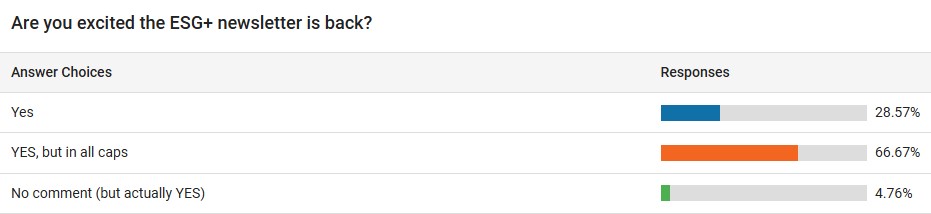
We open this week’s ESG+ with a review of FTI’s annual state of the activism market in the US. We then turn our attention to developments across the ‘E’ landscape, including the alignment of global climate reporting standards for greenhouse gas emissions; the finance industry’s split across the Atlantic on ESG, and governments increasing green financing issuances. We also look at US climate scientists’ pushback against a Trump Administration report that downplayed climate risks, as well as progress on California’s Climate-Related Financial Risk Disclosures Act. First, our weekly poll.
This week’s poll
|
This week’s poll
FTI Consulting releases 4th Annual Shareholder Activism Report
This report highlights key trends from latest US proxy season including the rise of new activist funds, challenges in winning board seats, and the influence of proxy advisors. It finds a decade-high 70% of settlements reached before activists disclose positions, with post-disclosure resolutions averaging 46 days – well below th#e pre-universal proxy average of 71. Activists are also more successful in settlements than contests, with 58% of settlements securing two or more board seats versus 38% in proxy battles. As the activism landscape continues to evolve with new market entrants, organisations must remain vigilant on emerging trends and develop robust defence strategies to navigate potential activist situations effectively.
Alignment on carbon accounting rules aims to simplify climate reporting
A long-standing criticism of ESG reporting is the broad range of existing reporting frameworks. Fragmented standards have caused confusion for both investors and companies, hindering effective implementation. Earlier this week, there was a significant development in global climate reporting standards for greenhouse gas emissions with the International Organization for Standardisation (ISO) and the Greenhouse Gas (GHG) Protocol planning to harmonise their measuring and reporting. The partnership aims to create a unified standard with aligned terminology, measurement, and reporting. Under the agreement, ISO and the GHG Protocol will merge their leading GHG standards into harmonised, co-branded international standards. Aligning ISO standards with the widely adopted GHG Protocol could drive global adoption of a single carbon accounting framework. In 2023, 97% of S&P 500 companies that reported to the Carbon Disclosure Project used the GHG Protocol, making it one of the most widely used carbon accounting standards globally. ISO standards, meanwhile, are recognised internationally by both corporations and governments. This partnership could establish a global ‘common language’ for carbon accounting, simplifying adoption and building trust among businesses, regulators, and investors.
Dutch pension fund leads shift toward climate-aligned investing
Last week, it was reported that Dutch pension fund PFZW has ended its investment mandate with BlackRock, citing concerns over the firm’s voting record on sustainability issues, with particular reference to its failure to consider climate risks effectively. The decision has cost BlackRock a mandate that was valued at $14.5 billion at the end of March. PFZW also withdrew its mandate from AQR Capital Management, worth $4.7 billion, as part of a wider shift toward a new strategy where financial performance, risk and sustainability are weighted equally. These withdrawals are somewhat unsurprising as, in the Netherlands, pressure has been mounting on pension funds to end mandates with investment firms that fail to align with long-term sustainability goals. Dutch nonprofit Fossil Free Netherlands played a pivotal role by driving the Break with BlackRock initiative. Another Dutch pension fund, PME, with a $5 billion BlackRock mandate, has said it will review its position by year end after criticising the firm in May for not distancing itself from Donald Trump’s anti-climate rhetoric.
This pushback against anti-sustainability policies and investment in Europe comes as ESG investing faces headwinds in the US. In 2024, $20 billion was pulled from ESG funds, up from $13 billion in 2023, highlighting the widening divide between US and EU investors on the integration of ESG priorities into their investment decisions.
Governments lead green financing push as corporates retreat
Amid the global slowdown in corporate issuance of green bonds, governments are turning to the market to support their green transitions. ESG Today reported that Denmark is set to become the first country to issue a sovereign bond under the European Green Bond (EuGB) ‘gold standard’, with plans to raise up to DKK 10 billion ($1.6 billion) through a new 10-year issuance. The EuGB framework, which came into effect in late 2024, is designed to ensure credibility and transparency, requiring issuers to direct all proceeds into projects aligned with the EU Taxonomy. Denmark’s bond will support energy transition, sustainable transport, land-use change and nature restoration. This follows similar moves elsewhere. The Monetary Authority of Singapore (MAS), the central bank and financial regulator of Singapore, is raising over $500 million which will be invested in green and sustainable infrastructure opportunities in Southeast and South Asia. In April, China launched its first global green sovereign bond, 6 billion yuan ($825 million) was raised across three- and five- year maturities. The bond aligns with China’s Sovereign Green Bond Framework, which prioritises green and sustainable projects, supporting its goals to peak emissions by 2030 and reach carbon neutrality by 2060.
US climate scientists demand correction of DOE Climate Report
The Times Magazine has reported that more than 85 leading scientists from across the globe have issued a sharp rebuttal to a recent US Department of Energy (DOE) report that downplays the threat of climate change. The DOE’s July review argued that the impact of greenhouse gas emissions is exaggerated and poses limited economic risk – a conclusion scientists say relies on cherry-picked data and flawed interpretations. In response, 85 leading scientists released a 500-page analysis highlighting errors such as misquoted data, misinterpreted concepts and omitted risks like rising temperatures’ impact on agriculture. This comes as President Trump’s second term has seen expanded oil and gas production, blocked state climate laws and efforts to phase out FEMA, even as climate disasters grow more frequent. According to Columbia University’s Climate Backtracker, Trump’s second term has added 200 rollbacks on top of 125 environmental reversals in his first.
California releases guidance for Year 1 Climate-Related Risk Reports
The California Air Resources Board (CARB) has released a checklist to guide companies preparing reports under the Climate-Related Financial Risk Disclosures Act (SB 261). While California, led by Democrats, advances ambitious climate legislation, many Republican-led states are moving in the opposite direction by echoing the Trump administration’s rollback of environmental protections and promotion of fossil fuel use. According to ESG Today, SB 261 applies to companies with revenues over $500 million that conduct business in California. The first report is due 1 January 2026, and will be published on CARB’s public docket, with reporting required every two years thereafter. Companies may use various frameworks, such as TCFD or IFRS S2, to meet disclosure requirements.
ICYMI
- The HKMA has launched a public consultation on the Phase 2A prototype of the Hong Kong Taxonomy for Sustainable Finance. This initiative provides clear definitions of green and sustainable activities to support capital flows and mitigate greenwashing risks.
- The US Office of the Comptroller of the Currency issued guidance to stop banks from ‘debanking’ customers on political or religious grounds, with Comptroller Jonathan Gould saying the move seeks to prevent “weaponisation” of the financial system and ensure fair treatment.
- The US solar industry could install 27% less solar capacity between 2026 and 2030 due to Trump’s rollback of clean energy subsidies, according to a new industry report. The Solar Energy Industries Association warned the policies are stifling investment, raising costs, and threatening grid reliability.
| The views expressed in this article are those of the author(s) and not necessarily the views of FTI Consulting, its management, its subsidiaries, its affiliates, or its other professionals.
©2025 FTI Consulting, Inc. All rights reserved. www.fticonsulting.com |