ESG+ Newsletter – 10 April 2025
In this week’s edition, we open with a review of how UK companies are looking to increase executive pay. We also look at how US pension funds tighten AI oversight, the increasing role of general counsels and greenwashing risks in biodiversity credits. The newsletter also details the continued evolution of sustainability reporting, looking at the European Commission urging EFRAG to align with the ISSB and a new global partnerships aimed at boosting nature-related financial disclosures.
This week’s poll
Will the current market turbulence be a net positive or negative for ESG strategies over the long-term?
- Positive
- Negative
- No difference
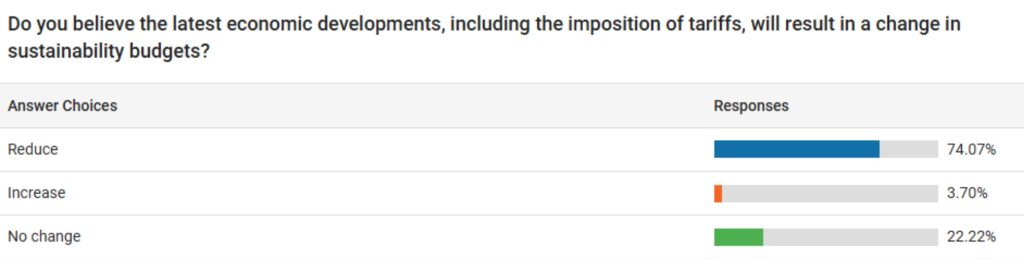
Last week’s poll results
UK companies seeking to align executive pay with US practices
An increasing number of FTSE 100 companies are looking to raise executive pay in response to global competition, particularly from the US, according to the Financial Times, which points to an increase in the number of companies seeking shareholder approval for new pay policies Specifically, 13 companies are proposing significant changes, such as increased incentive levels and more innovative pay structures that combine performance-related and restricted shares, with10 companies reviewing and submitting new pay policies ahead of the standard three-year review cycle. While UK boards have traditionally faced shareholder resistance on pay, a shift in tone has emerged. The Investment Association’s updated Principles of Remuneration, released last October, signalled greater flexibility for higher pay and US-style pay structures, if accompanied by strong shareholder engagement and a compelling rationale. However, companies’ transatlantic ambitions may be dampened by current geopolitical tensions creating uncertainty—such as UK CEOs relocating to the US or UK companies listing overseas—which may lead to increased scrutiny of any urgent revisions to pay policies and the need to compete with US stile pay arrangements.
US pension funds strengthen AI governance voting policies on director accountability
This week, Responsible Investor highlighted that three major US pension funds have adjusted their voting policies to hold directors accountable for poor AI oversight. These changes reflect growing concerns over the need for effective management of artificial intelligence technologies within corporate governance. San Francisco’s $33 billion Employee Retirement System amended its policy to vote against directors when evidence shows that “insufficient AI oversight and/or management has resulted in material harm to shareholders”. Similarly, Vermont’s $7 billion pension fund has updated its proxy voting policy to include the option to review the election of directors responsible for AI oversight on a case-by-case basis. Directors may be held accountable if shareholders are deemed materially impacted by inadequate AI management or oversight. Interestingly, even Republican-leaning states are joining the movement. Florida’s State Board of Administration (SBA), which manages a portfolio of $257 billion, has implemented one of the most progressive policies in this space. Unlike San Francisco’s policy, which generally refrains from voting on AI-related director oversight, Florida’s SBA may oppose board members responsible for AI governance if “there is evidence of failure to establish proper risk guidelines, review management proposals and establish board-level expertise” in AI. While the total AUM detailed above is relatively small for now, it marks a trend toward the increased expectations for robust oversight of AI from a growing number of investors.
With the number of AI-related proposals being submitted at AGMs also rising, boards are set to face scrutiny over their ability to effectively oversee AI initiatives. Our research underscores this trend, revealing that only 15% of the Dow Jones 30 largest companies disclose board oversight of AI, while 23% of companies in the Stoxx Europe 50 provide similar disclosures.
The role of GCs in times of polarisation
In today’s polarised political and social climate, companies are under increasing pressure from all stakeholders to act — often amid conflicting demands. As Diversity, Equity, and Inclusion (DEI) and Environmental, Social, and Governance (ESG) initiatives are being re-evaluated, organisations must ensure these programmes are aligned with their broader business and communications strategies. As our own research at FTI Consulting points out, the modern General Counsel (GC) plays a pivotal role in guiding companies through this environment of uncertainty and polarisation. Firstly, GCs must possess a deep understanding of their business, including existing commitments and past communications related to DEI and ESG efforts. This insight helps identify potential vulnerabilities and areas of reputational risk. Secondly, GCs must understand the company’s stakeholders. When managing potentially divisive issues, the GC must consider the varied perspectives of employees, customers, investors, and regulators to shape a cohesive strategy and communication approach. Thirdly, the GC must be well-versed in the organisation’s overall business strategy. This enables them to assess whether the company’s actions align with long-term goals, ensuring that responses to social issues are thoughtful, strategic, and substantiated—rather than reactionary gestures aimed solely at preserving reputation. Ultimately, GCs should ground their decisions in the company’s core values, taking a pragmatic approach to determine which actions and initiatives genuinely support the business strategy and stakeholder trust.
Trump administration targets state climate laws
This week Reuters reported that President Donald Trump issued an executive order aimed at blocking state laws that target climate change and reduce the use of fossil fuels. This move aligns with Trump’s efforts to boost domestic energy production and oppose policies, mostly led by Democratic states, aimed at reducing carbon emissions. The order directs the US Attorney General to identify and block state laws addressing climate change, environmental justice, and carbon emissions. Trump specifically mentioned laws in New York and Vermont that fine fossil fuel companies, and California’s cap-and-trade policy as examples. The Democratic governors of New York and New Mexico, who co-chair the U.S. Climate Alliance, opposed the order, emphasizing that states’ rights to address climate change would not be undermined. The American Petroleum Institute supported the executive order, arguing that it would hold states accountable for penalizing U.S. energy producers.
This executive order reflects the ongoing political divide over climate change and energy policy in the U.S., and the trend of climate policy rollbacks. While Democratic states push for stronger climate action, the Trump administration is driving towards upholding fossil fuel production and limiting state regulations. This tension highlights the broader polarization in American politics, where climate policy has become a major point of contention, shaping future political debates and policies.
Biodiversity credits pose greenwashing risk, warns former PRI executive
A former Principles for Responsible Investment (PRI) executive has warned that biodiversity credits could pose a greenwashing risk due to difficulties in measuring their true impact. In an Environmental Finance article, Rose Easton outlined that the lack of consistent metrics to quantify biodiversity improvements and doubts around the permanence of conservation outcomes make these credits hard to verify. These challenges mean that biodiversity credits may fall short of their promise to drive real environmental change and instead risk becoming more of a marketing tool. Despite this, momentum around nature investing is expected to grow, with 2025 seen as a potential turning point. Initiatives focused on nature-related lobbying and transforming sectors like food and agriculture are helping drive investor interest. However, major barriers remain. Nature-focused investment vehicles are still limited, often too small or illiquid to attract large-scale investment. Many of these structures are in early stages of development, and investors currently tend to view biodiversity more as a risk management issue than a direct investment opportunity. Although awareness of the biodiversity funding gap is increasing, it has yet to translate into widespread, scalable financial solutions.
European Commission advises EFRAG to consider alignment with ISSB
As EFRAG searches for a new chair for its Sustainability Reporting Board (SRB)—the group responsible for setting EFRAG’s strategic direction—the European Commission has encouraged alignment with the International Sustainability Standards Board (ISSB), a global standard setter for corporate governance. EFRAG serves as a technical adviser to the European Commission’s Directorate-General for Financial Stability, Financial Services and Capital Markets Union (DG FISMA), with a focus on financial and sustainability reporting. Following the release of the Commission’s sustainability Omnibus proposal in February 2025—which amended the Corporate Sustainability Reporting Directive (CSRD), notably by reducing the number of mandatory ESRS datapoints—the new SRB chair will be tasked with revising the standards to enable the Commission to adopt them in “the most effective and efficient way.” According to Responsible Investor, the European Commission stated that projects within EFRAG’s research agenda should collaborate with international sustainability reporting standard setters, including the ISSB. The Commission also noted that EFRAG’s research has the potential to advance the global sustainability reporting debate.
Collaborative partnerships facilitate nature-related financial disclosures for capital markets
The IFRS Foundation and the Taskforce on Nature-related Financial Disclosures (TNFD) have formalised a partnership to support nature-related financial disclosures for capital markets, ESG Today reports. Launched in 2021 following the success of the Task Force on Climate-related Financial Disclosures (TCFD), the TNFD helps organisations report and act on nature-related risks. Since its inception, over 1,700 organisations have joined the initiative, and more than 520 companies and financial institutions have committed to beginning nature-related corporate reporting. The IFRS Foundation’s International Sustainability Standards Board (ISSB), also launched in 2021, develops IFRS Sustainability Disclosure Standards to provide investors with information on companies’ sustainability risks and opportunities. The new agreement allows the ISSB and TNFD to share research, knowledge, and technical expertise—informing both the ISSB’s Biodiversity, Ecosystems, and Ecosystem Services (BEES) initiative and the nature-related dimensions of its work to enhance industry-focused SASB standards.
ICYMI
- According to research from Barclays, about $9 billion was withdrawn from ESG equity funds last month, the most in a year, with US and global funds seeing intensified selling since February, Bloomberg reports.
- The French SIF and Transparency France have published a guide to help investors assess companies’ commitment against corruption.
- China’s EV boom is causing economic disparities, with cities reliant on foreign carmakers like Guangzhou falling behind cities with popular domestic brands like BYD, according to Bloomberg.
| The views expressed in this article are those of the author(s) and not necessarily the views of FTI Consulting, its management, its subsidiaries, its affiliates, or its other professionals.
©2025 FTI Consulting, Inc. All rights reserved. www.fticonsulting.com |