With growing public attention on artificial intelligence (AI), the implementation of the EU AI Act and heightened investor scrutiny, companies face increasing pressure to disclose their AI activities. This research explores how leading European companies are reporting on AI, with a particular focus on their governance practices. Strong AI governance is essential due to the potential risks associated with the technology and the critical decisions leadership must make regarding its use. How AI is governed will have a lasting impact on a company’s future direction and success.
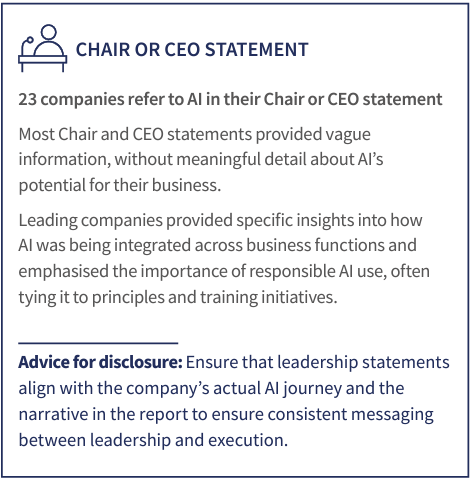
We analysed the Annual and Sustainability reports of the 50 European companies from the STOXX Europe 50 Index, classifying their AI disclosures based on 10 categories, ranging from the existence and content of an AI policy, to concrete use cases and mentions of the topic in Chair and CEO statements. Some of the categories are broken down into sub-categories to provide further information on the kind of disclosure.
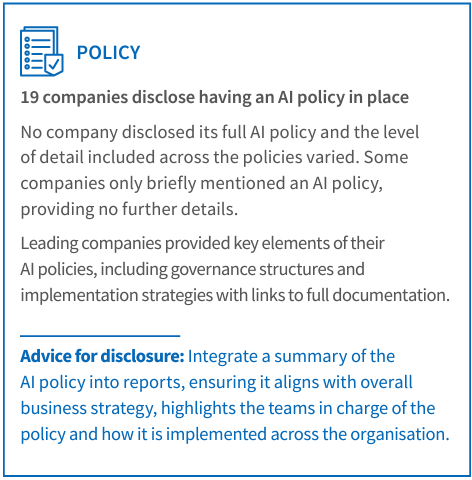
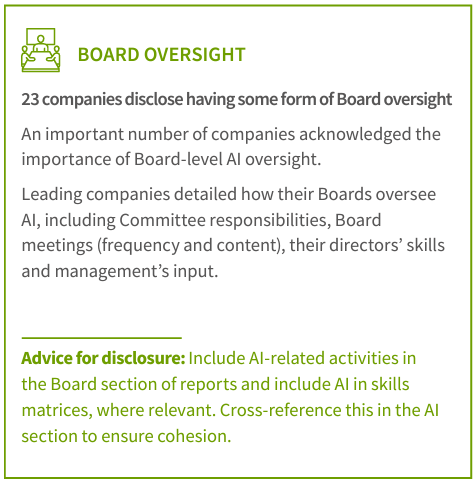
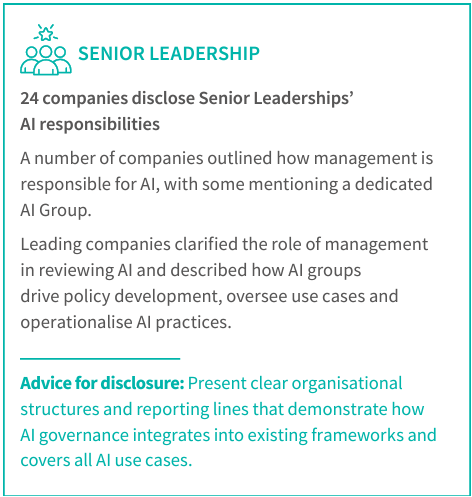
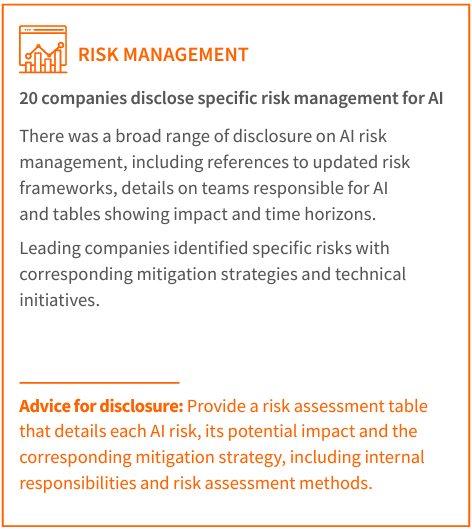
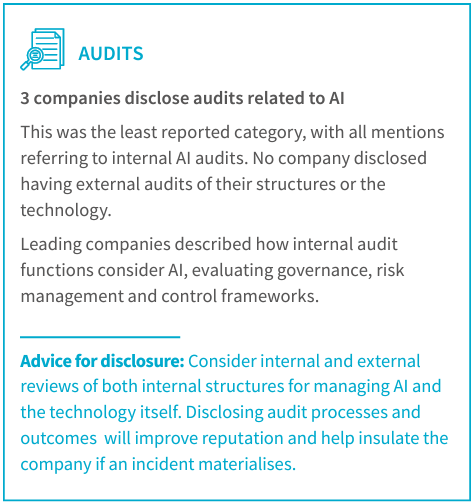
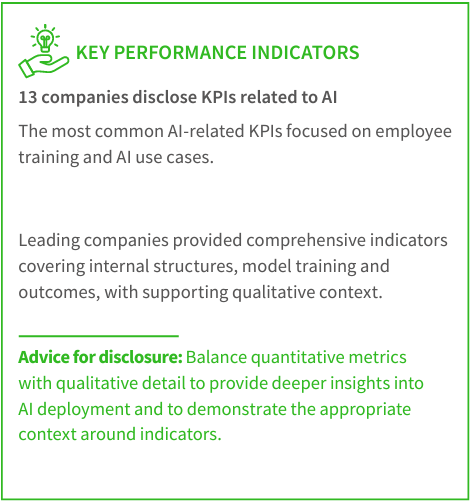
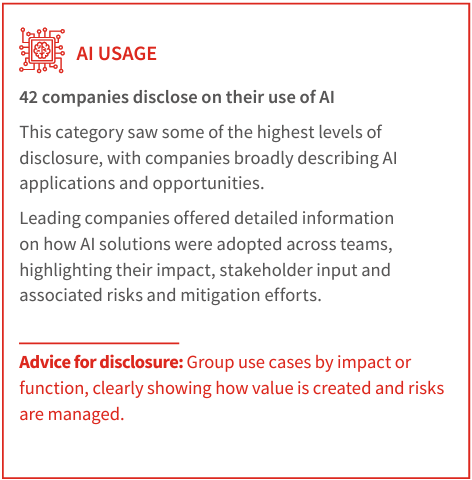
Many companies report on AI strategy and use cases, whereas critical areas such as AI policy, oversight mechanisms, risk management, audits and key performance indicators (KPIs)showed lower disclosure rates. We also noted some variation in disclosures per sector, with those exposed to the greatest amount of risk providing the most comprehensive disclosures.
Our analysis revealed varying levels of disclosure , with eight leading companies reporting on at least eight out of the 10 identified categories.
2024 Top 'Disclosers'
Allianz, AstraZeneca, Deutsche Telekom, GSK, Mercedes-Benz, Prosus, RELX, Zurich Insurance
For each category, the report highlights the various disclosure practices observed, provides examples of best practice and key takeaways. Priority areas, based on public disclosure, include strengthening Board and management oversight, establishing key performance metrics, expanding audit practices and providing detailed context on AI’s implementation.
This analysis provides valuable insights and guidance for companies seeking to enhance their AI disclosure and to demonstrate the effectiveness of their governance frameworks. It also illuminates Europe’s largest companies’ approach towards AI corporate governance. Companies that can effectively communicate their strategic approach to AI innovation and how they manage risks will be better positioned to maintain stakeholder confidence.
At the end of the report, we provide 10 recommendations and advice for disclosure.
About Trinity Business School The triple-accredited Trinity Business School strives to embed environmental, social, and governance (ESG) solutions into all of its activities to tackle urgent societal issues. The School is committed to a strategy of “Transforming Business for Good” and works with students and various stakeholders in building an inclusive and sustainable economy for all.The School’s Corporate Governance Lab delivers innovative and collaborative projects in the areas of corporate governance and business ethics. With a focus on the ‘G’ of ESG, the Lab undertakes cutting-edge interdisciplinary and practitioner-oriented research, engagement, and innovation projects in collaboration with industry, policy-makers, and researchers.
Researchers:Danielle Farrelly (FTI Consulting), Johana Sierra (Post-Doctoral Researcher, Universidad de Barcelona; Visiting Research Assistant, Trinity Corporate Governance Lab)
We use cookies on our website to give you the most relevant experience by remembering your preferences and repeat visits. By clicking “Accept All”, you consent to the use of ALL the cookies. However, you may visit "Cookie Settings" to provide a controlled consent.
This website uses cookies to improve your experience while you navigate through the website. Out of these cookies, the cookies that are categorized as necessary are stored on your browser as they are essential for the working of basic functionalities of the website. We also use third-party cookies that help us analyze and understand how you use this website. These cookies will be stored in your browser only with your consent. You also have the option to opt-out of these cookies. But opting out of some of these cookies may have an effect on your browsing experience.
Necessary cookies are absolutely essential for the website to function properly. These cookies ensure basic functionalities and security features of the website, anonymously.
Cookie
Duration
Description
cookielawinfo-checkbox-analytics
11 months
This cookie is set by GDPR Cookie Consent plugin. The cookie is used to store the user consent for the cookies in the category "Analytics".
cookielawinfo-checkbox-functional
11 months
The cookie is set by GDPR cookie consent to record the user consent for the cookies in the category "Functional".
cookielawinfo-checkbox-necessary
11 months
This cookie is set by GDPR Cookie Consent plugin. The cookies is used to store the user consent for the cookies in the category "Necessary".
cookielawinfo-checkbox-others
11 months
This cookie is set by GDPR Cookie Consent plugin. The cookie is used to store the user consent for the cookies in the category "Other.
cookielawinfo-checkbox-performance
11 months
This cookie is set by GDPR Cookie Consent plugin. The cookie is used to store the user consent for the cookies in the category "Performance".
viewed_cookie_policy
11 months
The cookie is set by the GDPR Cookie Consent plugin and is used to store whether or not user has consented to the use of cookies. It does not store any personal data.
Functional cookies help to perform certain functionalities like sharing the content of the website on social media platforms, collect feedbacks, and other third-party features.
Performance cookies are used to understand and analyze the key performance indexes of the website which helps in delivering a better user experience for the visitors.
Analytical cookies are used to understand how visitors interact with the website. These cookies help provide information on metrics the number of visitors, bounce rate, traffic source, etc.
Advertisement cookies are used to provide visitors with relevant ads and marketing campaigns. These cookies track visitors across websites and collect information to provide customized ads.