Decoding AI Disclosure 2025
Download a PDF of this articleHow Europe’s largest companies report on Artificial Intelligence
A joint report by FTI Consulting, Trinity College Dublin and Mason Hayes & Curran
2025 Top 'Disclosers'
GSK, HSBC Holdings, L'Oreal, National Grid, Prosus, SAP, Schneider Electric, Siemens, UBS Group, Unilever, Zurich Insurance Group
Executive Summary
We are pleased to launch our second “Decoding AI Disclosure” report which assesses AI-related disclosures by Europe’s 50 largest companies. In this report, we outline practice and progress for these companies and compare them to the findings from our inaugural report, published in November 2024. While two years of data are insufficient to establish fundamental trends, notable changes have emerged since last year. In 2024, most companies placed an emphasis on detailing their AI strategies and use cases, while disclosure on critical governance aspects such as AI policies, oversight mechanisms, risk management, audits, and key performance indicators (KPIs) remained limited.
From the 2025 review, it is clear companies are providing significantly more information on their governance frameworks, including policies, board oversight, training, risk management, and KPIs. As a result, the previous gap between high-level AI strategy disclosure and detailed governance reporting is beginning to narrow.
Similar to the 2024 report, our research examined annual, sustainability and integrated reports of the 50 companies in the STOXX Europe 50 Index. We established a framework for our 2024 analysis which we have again used as the basis for our 2025 analysis and which looks at 10 thematic categories:
| Category | What evidence we were looking for |
|---|---|
| Policy | Established AI policy or set of principles in relation to AI. |
| Board Oversight | AI-related board responsibilities and board committees, as well as evidence that AI was discussed during board or committee meetings, and evidence of AI skills at board level. |
| Senior Leadership | Any person in a senior leadership position whose role included AI tasks or responsibilities. |
| Knowledge Development | AI-related training or industry collaboration (excluding collaboration arising from customer or supplier relationships). |
| Audits | Direct mentions of internal or external audits specifically related to AI systems or their use. |
| Strategy | General disclosure that referenced AI-related risks, opportunities, objectives or principles. Recognition was given to vague statements but that will change in the future. |
| Risk Management | Detailed information on AI-related risks, existence of frameworks, safeguards, risk matrices, etc. |
| Key Performance Indicators (KPIs) | Quantifiable numbers or proportions associated with AI. |
| AI Usage | Concrete AI use cases. Disclosure of initiatives under development did not qualify. |
| Chair or CEO Statement | Any reference to AI in either the Chair or CEO statement (location-specific). |
Strategy remains the category with the highest frequency of disclosure; however, these results are tempered by the range of potential disclosures for strategy, and the relatively low bar set under this disclosure point. In some cases a piece of disclosure on AI strategy might be relatively weak (“AI is on our agenda, it is a strategic issue”) and not backed up by additional information disclosed in other categories, such as Policy, Senior Leadership and KPIs, where there are greater changes in company practice needed to satisfy the disclosure requirements.
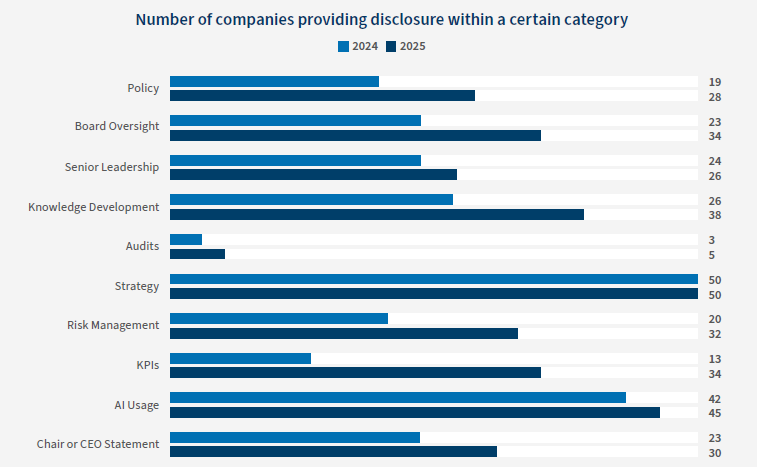
The most significant improvement is in the category of KPIs. Reporting on KPIs increased by 162% (from 13 companies in 2024 to 34 companies in 2025). As of 2025, more than two thirds of companies have recognised the importance of measurement. Simultaneously, the increase in the integration of KPIs is an indication of growing sophistication of AI strategies and reporting, with companies more comfortable determining what measures should be tracked and, ultimately, improved.
Reporting on Policy, Board Oversight, Knowledge Development and Risk Management all increased by about 50%:
- The number of companies mentioning the existence of an AI policy increased from 19 to 28;
- The number of companies disclosing proof of AI oversight at board level increased from 23 to 34;
- The number of companies discussing knowledge
development initiatives increased from 26 to 38; and - The number of companies describing elements of their processes to manage AI-related risks increased from 20 to 32.
From a governance perspective, it is encouraging to see that more than two-thirds of companies now report having established board-level oversight of AI, including examples such as the creation of AI-focused board committees and evidence of AI-related discussions at board and committee meetings. We also identified anecdotal evidence of companies updating their board skills matrices to reflect AI competencies, linking executive remuneration to AI-related strategic objectives, and integrating the management of AI risks into their existing risk management frameworks.
Finally, the weakest category remains Audits. As companies come to terms with regulatory requirements as well as management and governance of new technology, it is understandable that it will take
some time for audit methods to be developed and implemented, much like the eventual development of external assurance for sustainability data.
The overall results are summarised in the figure below.
About Trinity Business School
The triple-accredited Trinity Business School strives to embed environmental, social, and governance (ESG) solutions into all of its
activities to tackle urgent societal issues. The School is committed to a strategy of “Transforming Business for Good” and works with students and various stakeholders in building an inclusive and sustainable economy for all. The School’s Corporate Governance Lab delivers innovative and collaborative projects in the areas of corporate governance and business ethics. With a focus on the ‘G’ of ESG, the Lab undertakes cutting-edge interdisciplinary and practitioner-oriented research, engagement, and innovation projects in collaboration with industry, policy-makers, and researchers.
About Mason Hayes & Curran
Mason Hayes & Curran LLP is a leading Irish law firm with offices in Dublin, London, New York and San Francisco. The firm provides
legal services to domestic and international clients across key sectors including technology, financial services, energy, healthcare
and real estate. Its practice areas cover corporate, dispute resolution, employment, regulatory and intellectual property, among
others. Known for combining technical expertise with a practical, business-focused approach, Mason Hayes & Curran advises
clients ranging from multinational corporations to public bodies and emerging companies. The firm is recognised for its strong
cross-border capability and commitment to client-focused legal solutions.
Lead Authors:
Arnaud Cavé (FTI Consulting)
Daniel Malan (Trinity Corporate Governance Lab)
Niamh O’Brien (FTI Consulting)
Alberto Sinatra (Visiting Research Assistant, Trinity Corporate Governance Lab)
Researchers:
Alberto Sinatra (Visiting Research Assistant, Trinity Corporate Governance Lab)
Pearse Woods (Mason Hayes & Curran)