Q1 2026 Health Insurance Payer-Provider Dispute Update
The first quarter of 2026 was marked by uncertainty surrounding the preservation of health insurance coverage for millions of individuals and families across the country. Implementation of the One Big Beautiful Bill Act (“OBBBA”) continued alongside the expiration of the Affordable Care Act’s (ACA) Enhanced Premium Tax Credits, leading to substantially higher individual and commercial marketplace premiums and out-of-pocket cost sharing. These changes are estimated to force more than one million Americans out of the insurance marketplace, tightening margins for both payers and providers, which we expect will lead to increased tensions on both sides.1
The healthcare industry continues to grapple with the cumulative reduction in federal and state Medicaid funding, rising inflation and market volatility, and the introduction of more comprehensive fraud, waste, and abuse measures at the federal and state levels. This confluence of pressures sustains uncertainty for payers and providers as both adjust their operational, policy, and regulatory strategies, directly affecting the accessibility and affordability of care for countless individuals nationwide.
Cost Pressures Continue to Dominate the Healthcare Industry
As payer and provider contract negotiations continue, adjustments to the political, policy, and economic uncertainties shape what each party considers fair contract terms and adequate reimbursement for the care and services. Negotiations are driven by distinct pressures on both sides. Providers face rising operating costs, fluctuating labor supply, and increasingly expensive infrastructure investments.2 Payers confront rising cost pressures, ongoing eligibility compliance requirements, and structural shifts in utilization driven by federal and state policy changes.3
These dynamics are likely to persist throughout 2026 as states finalize their fiscal year 2027 budgets, which will need to account for implementation costs related to the administrative policy requirements in OBBBA – specifically, work requirements for Medicaid eligibility and more frequent eligibility redeterminations.4
For four years, FTI Consulting’s Healthcare Strategic Communications team has tracked and reported on payer-provider disputes through publicly reported news coverage and paid and earned media. Reaching agreements on key contract terms – such as reimbursement, utilization management, care coordination, disease management, quality improvement, and performance metrics – has become increasingly challenging, affecting coverage for tens of millions of individuals and families across the United States.5 Contract negotiations that result in disputes continue to draw attention from state and federal policymakers, regulators, and local government officials, with growing visibility and coverage across traditional and social media outlets and the public.6
What we found: Among all quarterly updates since 2022, Q1 2026 reported…
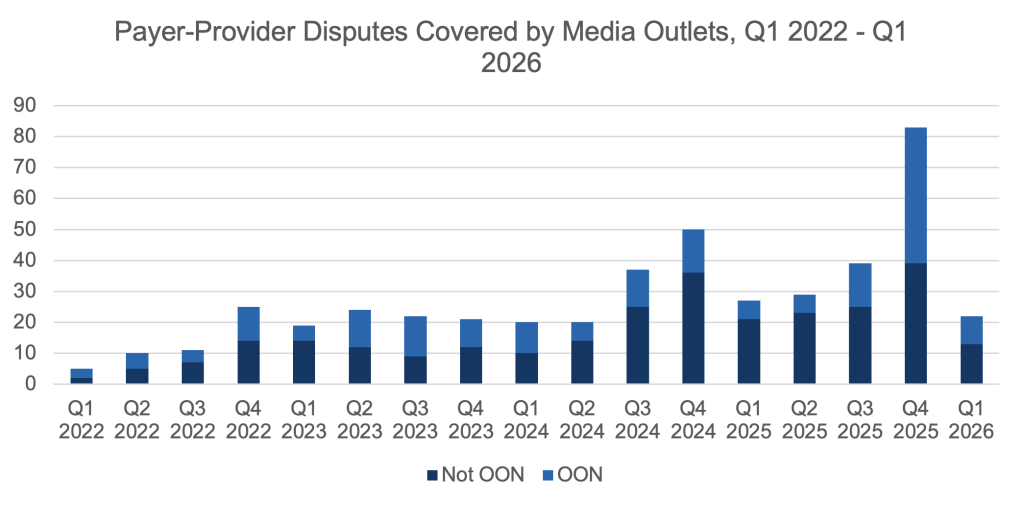
- In Q1 2026, there were a total of 22 disputes reported in traditional media outlets, 6 of which remain unresolved.
- 40% (9 out of 22) of total disputes involved Medicare Advantage (MA) plans, 3 of which went unresolved by the end of the first quarter of 2026.
- The last quarter of 2025 included the highest number of publicly reported disputes (83) since we began tracking in 2022.
Q4 2025 Healthcare & Life Sciences Quarter in Review
The first quarter of 2026 reported fewer disputes than any quarter in 2025, reflecting the typical seasonal low observed at the start of plan years when fewer contracts face out‑of‑network deadlines. While overall dispute volume followed established patterns, the composition differed: MA plans accounted for only 40% of disputes in Q1 2026, compared with a historical quarterly average of over 55% in prior first quarters.
Universities Feel Cost Containment Pressures
As in recent years, disputes between large university-based health systems and payers in Q1 2026 continue to draw heightened attention, as they jeopardize countless individuals’ access to primary and specialty care providers, as well as rural healthcare providers. Both payers and providers involved in the disputes tracked cite mounting cost pressures, and the scale and visibility of university‑based health systems amplify media coverage and patient scrutiny. This aligns with broader patterns among non-federal hospitals: 18% experienced at least one public payer dispute between June 2021 and May 2025, and 8% went out of network with a payer during that period.7
As large, university-based systems face compounding cost pressures, many are also likely to be experiencing funding losses from cuts to the National Institutes of Health (NIH) and other federal research, program, and healthcare funding last year.8 NIH funding previously enabled these institutions to expand their service offering, including specialized, rural, and primary care at a time when healthcare organizations are having to grapple with the implications of vertical integration.9,10 Now, some of these systems must confront difficult decisions to offset lost NIH and other federal funding while also navigating ongoing regulatory uncertainty stemming from OBBBA implementation and subsequent Medicaid cuts. FTI Consulting will continue monitoring whether these conflicts signal a broader trend that could limit coverage and access, particularly for specialty and rural care.
Looking Ahead
As 2026 continues, we expect more disputes to arise due to payer and provider cost-containment concerns, driven by regulatory uncertainty and increased scrutiny at the state and federal levels of payer and provider financing. Market-dominant health systems and payers can continue to expect increased media attention as more patients are directly or indirectly affected by changing cost structures for payers and providers resulting from recent policy changes. With the upcoming 2026 midterm elections, the conversation around healthcare remains top of mind for voters, shaping the policies that will influence payers and providers for years to come.11 FTI Consulting will continue to monitor key developments related to OBBBA implementation, state budget finalization, state Rural Health Transformation Program projects, and Congress and the Administration’s healthcare reforms.
Research Methodology:
FTI Consulting searched multiple news databases for articles regarding negotiations over reimbursement rates between provider organizations and insurance companies. Those negotiations that were publicly reported by a news outlet on or after January 1, 2026 were counted for the quarter in which they were reported. Negotiations that were resolved or failed to reach an agreement in one quarter but were first reported in another quarter were counted for the quarter in which they became public. When a provider decided to no longer accept any MA plans, FTI Consulting counted that decision as a single dispute upon notification of the decision to remove all MA plans from the respective provider network.
References
[1] Cotter, Lynne, et al., “Eight Trends Shaping 2026 Healthcare Costs,” Peterson-KFF (March 17, 2026), https://www.healthsystemtracker.org/chart-collection/eight-trends-shaping-2026-healthcare-costs/#Average%20monthly%20health%20insurance%20premiums,%20by%20market%20segment,%202010-2024.
[2] Hut, Nick, “Hospital-insurer contract disputes could intensify as cost pressures persist,” HFMA (January 12, 2026), https://www.hfma.org/payment-reimbursement-and-managed-care/hospital-insurer-contract-disputes-cost-pressures/.
[3] Ibid.
[4] Cotter, supra note i.
[5] Hudson, Caroline, “Provider, payer contract disputes are heating up,” Modern Healthcare (May 29, 2024), https://www.modernhealthcare.com/providers/health-plan-negotiations-inflation-claims-denials/#:~:text=Contract%20negotiations%20are%20growing%20more,from%20the%20COVID%2D19%20pandemic.&text=Providers%20are%20facing%20higher%20costs,agreeing%20on%20how%20much%20higher.%E2%80%9D.
[6] Emerson, Jakob, “Payers, providers diverge on why No Surprises costs are climbing,” Becker’s Payer Issues (October 13, 2025), https://www.beckerspayer.com/payer/payers-providers-diverge-on-why-no-surprises-costs-are-climbing/.
[7] Sable-Smith, Bram, “When Hospitals and Insurers Fight, Patients Get Caught in the Middle,” KFF Health News (September 2, 2025), https://kffhealthnews.org/news/article/hospitals-insurers-contract-dispute-patients-coverage-in-limbo/.
[8] Faiman, Beth, “The Impact of Federal Funding Cuts on Research, Practice, and Patient Care,” National Library of Medicine (July 1, 2025), https://pmc.ncbi.nlm.nih.gov/articles/PMC12322968/
[9] “The impact of federal actions on academic medicine and the U.S. health care system,” AAMC (June 11, 2025), https://www.aamc.org/about-us/aamc-leads/impact-federal-actions-academic-medicine-and-us-health-care-system.
[10] Dimitri, Carl, “Vertical integration is shaping the future of U.S. health care,” Brown University School of Public Health (September 16, 2024), https://sph.brown.edu/news/2024-09-16/vertical-integration-health-care#:~:text=By%20Carl%20Dimitri,a%20vertically%20integrated%20medical%20system.
[11] “Health Care Costs Tops the Public’s Economic Worries as the Runup to the Midterms Begins; Independent Voters Are More Likely to Trust Democrats than Republicans on the Issue,” KFF (January 29, 2026), http://kff.org/public-opinion/health-care-costs-tops-the-publics-economic-worries-as-the-runup-to-the-midterms-begins-independent-voters-are-more-likely-to-trust-democrats-than-republicans-on-the-issue/.