Global Public Affairs Newswire – 7 February 2025

Welcome to the latest instalment of FTI Consulting’s fortnightly Global Public Affairs Newswire.
This week, we bring you updates from FTI Public Affairs teams across the world’s major markets, including the United States, the European Union, China, the United Kingdom, India, France, Brazil, Spain, South Africa, Germany, and Colombia. This week’s update also brings readers market insights from FTI Public Affairs experts from around the world, explaining what these updates mean for your business.
Market updates
Over the last weeks, President Trump has announced his intention to levy tariffs on three of the largest U.S. trading partners: Canada, Mexico, and China. Beyond threatening imminent tariffs on specific countries or larger global tariffs on all imports, President Trump has also hinted at select tariffs in specific sectors, including pharmaceuticals, semiconductors, and steel, as part of his administration’s broader efforts to bring back U.S. domestic manufacturing and supply chains.
In fact, President Trump recently suggested that the administration plans to implement tariffs on chips and pharmaceuticals “in the very near future,” stating that “[t]he only way to get out of this is to build your plant – if you want to stop paying taxes or tariffs, build here in America.”
Ripping off the band–AID?
In addition to reshaping U.S. trade agreements, the Trump Administration is signaling its intention to dismantle the U.S. Agency for International Development (USAID). Founded by President Kennedy in 1961, USAID is an independent agency within the government responsible for the distribution of civilian foreign assistance. With a budget of nearly $50 billion and more than 10,000 staff, USAID has long been criticized by Republicans who claim it has lost sight of its core mission and has become an overly politicized vehicle for funding of non-essential projects. Responsibility for the functions of USAID have temporarily been given to Secretary of State Marco Rubio.
For more information about FTI’s Public Affairs services in the Americas, please contact [email protected].
At the end of January, the European Commission published its Communication on “A Competitiveness Compass for the EU.” The document emphasises that Europe must renew and strengthen its competitive edge. Designed to prevent Europe from lagging behind global powerhouses such as the US and China, the plan is built on three pillars identified in the Draghi report: closing the innovation gap, decarbonisation, and reducing dependencies. To bridge the innovation gap, the Compass priorities cutting red tape and enhancing the global competitiveness of European businesses. A key initiative in this area is the Omnibus Simplification Package, expected on 26 February, which targets sustainability reporting.
Furthermore, the Compass stresses the importance of ensuring that economic growth benefits all, including small businesses and workers. This involves keeping markets open, preventing monopolies, and fostering resilience by securing supply chains, reducing reliance on foreign powers for critical resources, and preparing for economic shocks. The EU must work to decrease its dependencies while enhancing its own security and maintaining prosperous trade partnerships. Regarding decarbonisation, and particularly the green and digital transitions, the Compass aims to propel Europe towards a sustainable future by investing in clean technology, AI, and digital infrastructure, while avoiding excessive regulation that could stifle industry.
For businesses, this is crucial. A stronger, more competitive Europe means better access to funding, clearer regulations, and a business-friendly environment that attracts investment. Companies need stable policies and innovation support to thrive in a world where geopolitical tensions, technological disruptions, and climate challenges are ever-present. If the EU succeeds, businesses will have the tools to scale, trade, and adapt – rather than being hampered by uncertainty and bureaucracy.
For more information about FTI’s Financial Services Public Affairs support in Brussels, please contact [email protected]
On 4 February, China announced its decision to counter U.S.’s 10% tariffs on all Chinese goods with a retaliatory 15% import levy on LNG and coal as well as a 10% duty on crude oil, agricultural equipment and automobiles with large displacement. In addition, a joint statement from China’s Commerce Ministry and the General Administration of Customs said China would impose export controls on niche metals which include tungsten, tellurium, bismuth, molybdenum and indium, citing national security concerns.
LNG and coal: The United States is the world’s largest LNG exporter, and Beijing has targeted American LNG via tariffs before during Trump’s first presidency. The U.S. supplied 6% of China’s LNG and 3% of Chinese thermal and coking coal imports in 2024. The numbers are likely to drop due to the tariffs, while Chinese importers may turn to alternative suppliers.
Oil, agricultural equipment and automobile: Similarly, Chinese oil buyers may shift to Middle East exporters as a result of crude oil duty. Meanwhile, the tariff list mainly contains agricultural machines rather than crops, this might buffer Sino-U.S. trade friction if the bilateral relations warm after President Xi and Trump’s potential call. Big-engine sedans and a small number of trucks from the U.S. are also under the influence of China’s import tariffs.
Critical metals: As the main producer of the restricted critical materials, China is able to wield its leverages, putting export controls on the niche metals that are used in the electronics, automotive, energy and defense industries. China has a track record of banning gallium, germanium and antimony as a countermeasure of Biden administration’s escalated chip curb, although the materials under export control this time have impacted the consumer goods.
For more information about FTI’s Public Affairs services in China, please contact [email protected]
Britain’s Chancellor of the Exchequer, Rachel Reeves, delivered a highly-anticipated speech on 29 January, designed to shift perceptions of her economic agenda and to give confidence to the markets by underlining the government’s commitment to growth. In a marked change in tone, while warning that achieving its goal would not come “without a fight”, she argued that low growth is not Britain’s “destiny”. Reeves’ announcements were designed to highlight how serious the government is about stimulating economic growth – and also how concerned it is that growth has so far alluded them.
To that end, Reeves announced a number of policy measures to signify the government’s aggressive pursuit of growth, including the most significant reform to Britain’s planning system in a generation, support for a third runway at Heathrow Airport, and renewed ambitions for the Oxford-Cambridge growth corridor, which ministers hope to transform into Britain’s version of Silicon Valley. These announcements were crafted to reset the narrative following sustained criticism from businesses in the wake of the Autumn Budget, which saw business confidence fall to its lowest in two years and consumer confidence fall to pre-pandemic levels. Addressing this, Reeves was notably optimistic in her language and upbeat in her delivery, arguing that Britain is at the forefront of some of the most “exciting developments in the world”, from artificial intelligence to life sciences.
Elsewhere, much attention in British economic circles was paid this week to President Trump’s comments on transatlantic trade. While Trump argued that Britain had been “way out of line”, he argued that the EU had been “really out of line” and labelled its trade relationship with the US an “atrocity”. The more conciliatory tone struck towards Britain will have calmed some fears in Westminster, but the government will nonetheless remain vigilant as the new US president continues to institute his “America First” economic agenda. Meanwhile, the British Prime Minister, Sir Keir Starmer, travelled to Brussels this week in an attempt to deepen European ties on defence and security as part of a potential post-Brexit reset. However, President Trump’s comments loomed large, and in response to questions on the issue of transatlantic relations, Sir Keir stated that Britain was “not choosing between the US and the EU”.
For more information about FTI’s Public Affairs services in the United Kingdom, please contact [email protected]
India announced its annual Union Budget for fiscal 2025-26 on 1 February, the first full Budget of PM Modi’s third term, amid slowing growth and jobs.
The budget brought in tax relief aimed at tackling discontent among the middle class, but scaled back on capital spend and infrastructure.
A vocal segment of middle-class voters cheered the tax breaks. Analysts pointed out that the total tax giveaway of 0.2% of the GDP may not do as much for consumption as hoped, as many might use the additional “money in their pockets” to pre-pay rising debt instead.
Tech got a boost, with a focus on AI and cybersecurity. India’s IT Ministry got a 48% boost in its budget allocation, reaching $3B. A big chunk ($235M) is for the IndiaAI Mission, which will fund deep-tech AI startups and provide access to GPU infrastructure for AI. However, many pointed to the enormous gaps in AI capability compared with China, which has been shown in a recent global study to be ahead of the US in 57 of 64 critical technologies that shape strategic power, and much further ahead of India.
Some economists were disappointed by the absence of growth boosters, and by the low budgetary provisions for large national missions.
A USD 2.3B ‘Nuclear Energy Mission’ will aim to help build five or more Small Modular Reactors 2033, a step toward a goal of developing 100 GW of nuclear energy by 2047, but there’s no actual budgetary outlay for those SMRs for fiscal 2025-26.
The National Green Hydrogen Mission (launched in 2023 with $2.3B mission outlay till 2030) got a tiny $61M, leaving over 95% of the outlay untouched. Green hydrogen has seen initial optimism fade, due to several factors including Trump’s re-election and focus on fossil fuels.
Amitabh Kant, an influential government voice and former CEO of the Center’s think-tank NITI Aayog, said the budget would pave the way for India’s transformation from $4T to a $30T economy by 2047 (the 100th anniversary of independent India) with sustained growth at 8-9%.
For more information about FTI’s Public Affairs services in India, please contact [email protected]
Prime Minister François Bayrou successfully passed the 2025 Budget and Social Security Financing bills on 5 February after invoking special constitutional powers, allowing them to be adopted without a parliamentary vote. This controversial move gave the opposition the right to propose a no-confidence motion. The far-left group France Unbowed (LFI) seized the opportunity to topple the government and tabled a no-confidence motion supported by the Communists and the Greens.
The previous administration, led by Michel Barnier, collapsed in December when the far-right National Rally (RN) joined forces with the left-wing alliance to vote it down. Though Bayrou lacks a majority in the National Assembly, both the Socialists and RN abstained this time around from voting down the government, citing the “national interest” and the urgency of passing a budget. Bayrou’s budget, which softened spending cuts compared to Barnier’s proposal, also made it more acceptable for both parties to let it pass. However, political tensions remain high. The Socialists plan to introduce another no-confidence motion next week, following Bayrou’s controversial remarks about migrants “flooding” France.
The passage of these budget bills is likely to be of relief to investors and financial markets, which have been shaken by political instability since the National Assembly was dissolved in June 2024. It will also ease pressure on President Macron, who has faced persistent calls to resign but insists he will serve his full term until 2027. Moreover, it enables France to stay on course to reduce its budget deficit—the highest in Europe—back to 3% by 2029. The government now has a window of opportunity to focus on other legislative projects paused by the political crisis, including the economic simplification bill, although its success will depend on its ability to build compromises with the Assembly’s numerous groups. Moreover, this window could close quickly as political uncertainty looms. Indeed, with June 2025 approaching —the earliest Macron can call new legislative elections—pressure to bring down the government is expected to intensify.
For more information about FTI’s Public Affairs services in France, please contact [email protected]
As Brazil’s National Congress returns from recess, President Luiz Inácio Lula da Silva faces a defining challenge: balancing the immediate demands of governance with the need to craft a distinct political identity for 2026. Negotiating with Congress is crucial to maintaining governability in Brazil, but the stakes are even higher this time around as doing so risks diluting the Workers’ Party’s brand at a time when Lula needs to solidify public support for reelection.
The new congressional leadership, with central-aligned Hugo Motta in the Chamber of Deputies and Davi Alcolumbre in the Senate, has signaled a focus on fiscal responsibility and parliamentary amendments. Lula has responded by promoting institutional harmony, assuring lawmakers that major proposals will be debated before reaching Congress. However, outside the halls of power, his administration faces growing political and economic headwinds.
Public dissatisfaction is rising, with negative assessments increasing from 31% in December to 37%, including declines in approval in Lula’s traditional strongholds. The administration’s attempt to reset its narrative—through a new head of presidential communications and strategic delays in cabinet changes—has been overshadowed by inflation concerns, uncertainty over fuel and food prices, and continued hikes in the benchmark interest rate (Selic) to 13.25%.
Internationally, diplomatic tensions with the U.S. have emerged following the deportation of 88 Brazilians in shackles. While the government condemned the incident as “degrading,” Itamaraty has sought to de-escalate tensions. Yet, Lula’s warning that he would impose retaliatory tariffs if Donald Trump were to target Brazilian exports signals a more assertive stance.
February’s congressional committee negotiations will help determine the administration’s legislative path, but the broader dilemma remains: Lula’s political skill will likely ensure stability, yet the challenge of shaping a compelling vision for 2026 looms large. With mounting crises demanding his attention, the window for defining a winning political message may be narrowing.
For more information about FTI’s Public Affairs services in Brazil, please contact [email protected]
The Spanish government faces a legislative impasse after the rejection of the Decreto Ómnibus in the Congress of Deputies last week. This extensive set of measures, intended to address economic, transport, and social security issues, failed to pass due to a lack of parliamentary support. As a result, some provisions—including adjustments to regional financing, changes to income tax (IRPF), and aid for energy-intensive industries—have been left out and will be debated separately at a later date. Given this gridlock, the Council of Ministers had to approve a revised version of the decree with a more limited scope.
This setback highlights the government’s struggle to pass legislation due to its fragile parliamentary arithmetic. Without an absolute majority, Prime Minister Pedro Sánchez’s administration is forced to negotiate with multiple factions to secure votes. The rejection of the original Decreto Ómnibus was largely due to opposition from the main opposition party, conservative People’s Party (PP), and the Catalan pro-independence party Junts, making clear the challenges of coalition governance. Left-wing parties like Sumar and Podemos have pushed for a revised decree, but the government has opted for a more cautious approach, citing the need for more time to resolve the political deadlock.
While some economic measures are delayed, the debate over tax policies, regional funding, and industrial support remains open. In the broader context, the government’s difficulty in securing legislative backing raises concerns about the effectiveness of the coalition in implementing its policy agenda and the political stability in the country, ultimately raising concerns about legal uncertainty and the lack of predictability for investors.
For more information about FTI’s Public Affairs services in Spain, please contact [email protected].
South Africa finds itself at odds with the Trump administration over its land reform agenda. On Sunday night, former US President Donald Trump used his Truth social media platform to accuse South Africa of “confiscating land and treating certain classes of people very badly”—a reference to the Expropriation Act signed into law by President Cyril Ramaphosa in January. Trump has since threatened to suspend all future US funding to South Africa pending a full investigation.
The South African government has publicly refuted these claims, asserting that it is not confiscating private land. However, conflicting statements from senior officials risk exacerbating tensions. While the Presidency has called for engagement with its US counterparts, Minister of Mineral and Petroleum Resources Gwede Mantashe has taken a more confrontational stance, suggesting that African nations withhold critical minerals from the US if necessary.
Although South Africa does not receive substantial aid from the US beyond the President’s Emergency Plan for AIDS Relief (PEPFAR), its strategic relationship with Washington remains pivotal. Recent friction—stemming from South Africa’s close ties with China and Russia—has already led to calls for a reassessment of US-South Africa relations. With the African Growth and Opportunity Act (AGOA) up for review, South Africa faces heightened uncertainty regarding its continued preferential trade access to the US market.
As South Africa navigates this evolving geopolitical landscape, US multinational corporations operating in the country – many of which rely on South Africa as a gateway to the broader African market – must proactively assess their public policy and government affairs strategies. Strengthening engagement with key stakeholders is now more critical than ever.
For more information about FTI’s Public Affairs services in South Africa, please contact [email protected]
“As the election date approaches, the intensity of campaigns rises. Last week’s debate on migration has sparked significant controversy across media, civil society, and within the parties themselves. Meanwhile, as we turn our focus to energy policy, one thing is evident: While the issue may not be dominating the current election discourse, it will undoubtedly take center stage in the upcoming legislative period. Soaring electricity prices burden the economy, a delay in infrastructure development threatens the energy transition, and international power struggles position the sector as a key battleground. Enjoy the read! Please read our full Germany Votes update here.”
President Donald Trump’s deportation policy triggered a diplomatic and commercial crisis between the United States and Colombia, making it the first country to face sanctions for challenging the new immigration strategy. On January 26th, President Gustavo Petro refused to allow planes carrying deported illegal migrants to land, citing a lack of dignity guarantees. In response, Washington imposed tariffs of up to 50% on Colombian goods and suspended visa issuance. Petro countered with the threat of reciprocal tariffs at 25%.
Faced with an imminent trade crisis, both governments negotiated an agreement the same day, preventing the implementation of tariffs and restoring visa services by January 31st. Colombia agreed to accept deportees without restrictions, including on U.S. military aircraft, while also deploying its own planes to repatriate citizens. The White House hailed the agreement as a victory, while Bogotá framed it as a ‘balanced’ resolution.
This episode highlighted the fragility of bilateral relations, where Colombia is highly dependable of trade, financial aid, military support and intelligence. As the third-largest U.S. trade partner in Latin America, Colombia heavily depends on its economic ties with Washington, strengthened by a free trade agreement in place since 2012 and the creation of over 9,000 jobs through U.S. companies operating in Colombia. In 2024, 53.6% of remittances received in Colombia came from the U.S., underscoring the economic interdependence between both nations.
Amid escalating trade disputes in North America, this episode raises questions about the future of Colombia’s foreign policy and its ability to balance autonomy with its strategic relationship with Washington.
For more information about FTI’s Public Affairs services in Colombia, please contact [email protected]
Expert Analysis |
FTI Consulting Webinar: Navigating Tariff Uncertainty
Join us for a timely webinar exploring the multifaceted impacts of proposed tariffs on your business.
This cross-functional discussion will bring together experts in customs, tax, supply chain, and government affairs to provide valuable insights and actionable strategies.
The first session in our two-part series will help your business navigate the complexities of the current tariff environment – and thrive in the face of uncertainty.
Tariff: ‘The most beautiful word in the dictionary’
When President Trump did not follow through on his election pledge to impose tariffs on US trade partners on “day one”, there was a sense of hope that the President’s threats had been political bluster.
That optimism was put to rest on 1 February, when Trump imposed 25% tariffs on most imports from Canada and Mexico, as well as tariffs on 10% of products from China.
As governments from Beijing to Brussels scramble to adapt to announced or anticipated tariffs, FTI Consulting’s UK Public Affairs trade experts assess the possible tariff threat facing the UK and how the government may respond.
Navigating the French Agri-Food Sector: High Expectations, Conflicting Aspirations
The 2025 French Agricultural Fair will be taking place in a tense political climate, driven by significant unrest within the farming community, ongoing legislative gridlock, a new government and a new geopolitical landscape.
Our government relations and regulatory affairs experts Renaud Dutreil, Louison Lérein and Dana Batal have identified 10 key trends in the French Agri-Food Sector to help businesses navigate this uncertain environment.
Attract Capital, Not Controversy: How to Do ESG Right in the Current Landscape
As the ESG landscape continues to evolve, companies must navigate the current environment carefully, especially given recent developments.
Our colleagues Alanna Fishman, Bryan Armstrong and Lukas Kay share insights on how companies can strategically focus ESG programs on risk mitigation and value creation in a constantly evolving environment immersed in political and market volatility.
Irish Lobbying Act
Companies involved in lobbying activities in Ireland now face additional reporting requirements due to the extension of the Lobbying Act to cover over 60 additional official bodies.
Our experts in Dublin outline the criteria of the Lobbying Act, and emphasise the need for companies to understand their new obligations to mitigate the risk of penalties and potential reputational damage.
The College of Europe
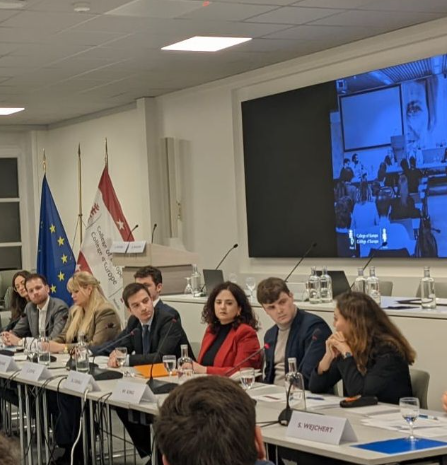
Last week, our expert Samuel Wejchert spoke to students at the College of Europe in Bruges about working in public affairs at FTI Consulting.
He also had the opportunity to raise awareness about the InclusivEU scholarship, a diversity and inclusion initiative spearheaded by the EU offices of FTI Consulting, BCW, and Dentons Global Advisors, in partnership with the College of Europe. It seeks to improve social and cultural mobility in higher education and contribute to the diversification of the future talent pipeline in public affairs in Brussels.
Upcoming Conferences, Elections and Webinars
- 09 February: General election (Ecuador)
- 09 February: Parliamentary election (Kosovo)
- 09 February: General election (Liechtenstein)
- 23 February: Federal election (Germany)
- 27 February: Regional election (Ontario, Canada)
- 04 March: General election (Micronesia)
- 08 March: Regional election (Western Australia, Australia)
- 23 March: Snap regional election (Madeira, Portugal)
To be added to the distribution list for the Global PA Newswire, or for further information on the dedicated Public Affairs team at FTI, please contact [email protected]. |
The views expressed in this article are those of the author(s) and not necessarily the views of FTI Consulting, its management, its subsidiaries, its affiliates, or its other professionals.
©2025 FTI Consulting, Inc. All rights reserved. www.fticonsulting.com