ESG+ Newsletter – 30 October 2025
|
This week’s poll
|
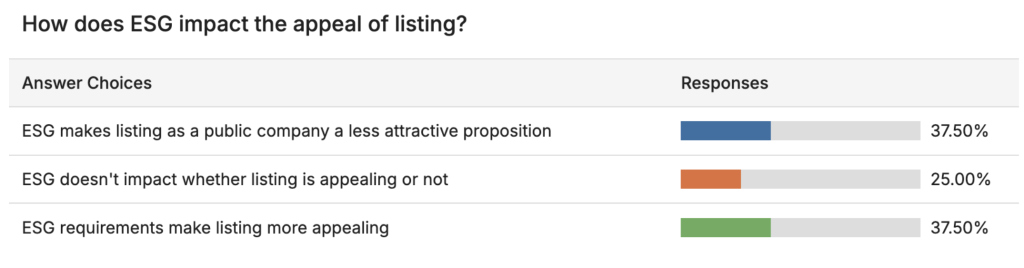
Last week’s poll results
European Parliament rejects Omnibus package amid continued pressure to weaken sustainability rules
ESG News reports that European lawmakers voted 318 to 309 to reject the Omnibus simplification package, which aimed to ease sustainability reporting and due diligence rules for large companies. The decision delays clarity on future reporting requirements and extends uncertainty for firms preparing for CSRD and CSDDD compliance. The rejection sends the proposal back to Parliament’s committees, halting talks with the Council and Commission. The deal, brokered by the European People’s Party (EPP) with Socialists and Democrats (S&D) and Renew Europe, sought to preserve key simplifications without further weakening sustainability rules but collapsed after internal divisions emerged during the vote. Lawmakers must now draft a new position before another plenary vote on 13 November 2025. Until a final agreement is reached, companies remain uncertain about reporting thresholds and due diligence scope. As reported by Reuters, the vote also follows pressure from the US and Qatar to further relax corporate sustainability rules to protect liquefied natural gas trade. In an open letter to EU leaders, Qatar’s energy minister Saad al-Kaabi and US Energy Secretary Chris Wright warned the rules threaten the “affordability and reliability of critical energy” across Europe. Similar views have emerged within the EU, with German Chancellor Friedrich Merz and French President Emmanuel Macron calling for the requirements to be scrapped entirely. |
NZAM proposes weakening signatory requirements in updated commitment statement
Following a series of high profile exits earlier this year, the Net Zero Asset Managers Initiative (NZAM) paused activities in January and launched a six month review. As reported by Responsible Investor, an updated commitment statement was shared with investors yesterday. The update significantly reduces the commitment required to become a member, focusing on a 2°C rather than 1.5°C pathway and making the commitment less specific by removing commitments to Net Zero by 2050 and allocations of AUM to low carbon investments. Notably, these updates were made to ease members’ concerns around fiduciary duties and competition law, with a note adding that the commitment only be undertaken “where consistent with our fiduciary duties and, where applicable, client mandates, fund investment objectives and other legal obligations”. The updates have already been criticised for weakening NZAM’s ambitions, however it remains to be seen whether these changes are enough to save the ailing initiative.
FCA plans to make short sellers anonymous in UK
In an attempt to stimulate market activity by reducing burdens for capital market participants, Bloomberg reports that the UK securities regulator, the Financial Conduct Authority (FCA), has proposed ending the public disclosure of short seller identities. Short sellers borrow securities to sell them in the hope they will be able to buy them back at a lower price later. The UK, France and Germany are among the few markets where individual short positions above a certain threshold are made public. Currently, individual firms with net short positions of at least 0.5% of shares outstanding in UK-listed companies are publicly disclosed, however the FCA is considering combining and anonymising short positions above a 0.2% reporting threshold. From a governance perspective, the proposed updates represent a tradeoff between reduced transparency and market efficiency. The regulator is seeking comments on the proposed rules by 16th December 2025. |
Nature Action 100 hails progress in nature-related corporate engagement
According to Environmental Finance, Nature Action 100 (NA100) is seeing ‘remarkable progress’. NA100 is a coalition of investors committed to supporting action on biodiversity loss by targeting engagement with the 100 companies with the greatest impact on nature. Investors manage around $30 trillion in assets and include BNP Paribas, Allianz Global Investors and Amundi. Releasing its first progress report this week, NA100 hailed notable progress in direct engagements. According to the report, since NA100’s launch in September 2023, 49 companies have made a plan to address nature-related issues. Investors noted that companies were increasingly “recognising the importance of acting and developing plans to address nature-related issues”. While to some this progress may feel like baby steps, a recognition of the criticality of nature in supporting the economy and clear engagement from investors are important first steps in driving meaningful change. |
China targets decarbonisation in five-year plan
The New York Times reports that China’s 15th Five-Year Plan (2026–2030) makes sustainability and social resilience central to modernization. Environmentally, it fast-tracks a “Beautiful China” green transition, expanding renewables, new-type energy storage, smart grids, and zero-carbon industrial parks, while strengthening carbon accounting, product carbon footprints, and the national carbon market. Financial and procurement tools will support the development of green projects. Socially, the Plan expands healthcare, childcare, eldercare, education, and rural services, and strengthens income and employment measures, creating sustained demand for public-service delivery and workforce upskilling. For businesses, this means commercial opportunities in low-carbon and social sectors and rising expectations for robust environmental and social compliance. |
ICYMI
- Responsible Investor reports that a £3.1 trillion investor group led by the Local Authority Pension Forum and CCLA has written to chairs of the FTSE100 firms asking them to provide a Say on Climate vote at least once every three years.
- Google and NextEra Energy have agreed to restart Iowa’s Duane Arnold nuclear plant, which according to ESG Today amounts to a 25-year deal with Google set to power the plant’s cloud and AI infrastructure while exploring new nuclear projects in the U.S.
- As highlighted by Reuters, Norway’s $2 trillion wealth fund is stepping up pressure on its 8,500 portfolio companies to reach netzero emissions by 2050, increasing scrutiny of climate lobbying, reserving the right to file shareholder proposals, and prioritising engagement over divestment.
| The views expressed in this article are those of the author(s) and not necessarily the views of FTI Consulting, its management, its subsidiaries, its affiliates, or its other professionals.
©2025 FTI Consulting, Inc. All rights reserved. www.fticonsulting.com |