ESG+ Newsletter – 30 April 2026
In this week’s newsletter, we explore growing pushback from multinationals against stricter carbon accounting rules, as companies call for more flexibility to support practical climate action. We also examine the quiet decline of DEI commitments, with fewer firms setting and disclosing diversity targets. Elsewhere, we look at controversy surrounding changes to the SBTi’s net-zero framework and consider what increased flexibility means for the pace of decarbonisation. Finally, we assess the rise of AI tools in the boardroom and the impact of CSRD-aligned reporting, as sustainability disclosures become more standardised, data-driven, and central to corporate governance. |
This week’s poll
Will AI improve decision-making at the board level?
|
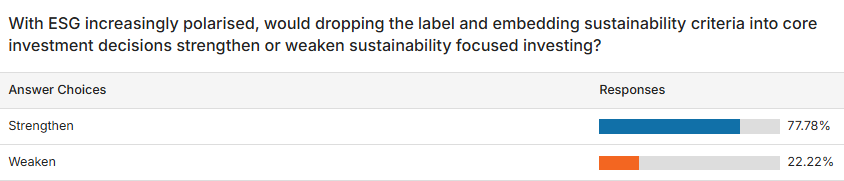
Last week’s poll
Major multinationals seek flexibility in GHG Protocol updates
A coalition of over 60 multinational companies is calling for more flexibility under the Greenhouse Gas Protocol’s new requirements for measuring corporate carbon footprints. According to the companies’ joint statement released last week, the Protocol’s “revised guidance must encourage more clean energy procurement and enable more impactful corporate action, not unintentionally discourage it.” Companies caution that more stringent emissions accounting rules could increase the underlying costs of climate action due to the high likelihood of implementation challenges, especially in regions where renewable energy infrastructure and grid alignment capabilities are still developing. The pushback comes as climate disclosure requirements are expanding and becoming more standardised across jurisdictions, with a recent trend toward alignment with the ISSB’s global standards. While organisations continue to support climate transparency, there is growing dialogue around reporting requirements balancing comparability with operational feasibility. Pushback from globally recognised firms highlights how ESG disclosures are becoming more nuanced, and often contested, as stakeholders seek both more rigorous data and reporting systems that remain standardisable and practical across diverse sectors and global markets.
DEI initiatives slip down corporate agenda
A recent report from the Thomson Reuters Foundation has found that companies are quietly reducing DEI disclosure and removing associated targets, according to Reuters. The report studied publicly available information on the workforce policies of nearly 3,000 global companies and included longer-term information voluntarily disclosed by more than 140 companies since 2020. The Thomson Reuters Foundation found that whilst DEI targets were common for gender, they were rare for ethnicity and disability. 53% of companies in the dataset publicly reported any form of DEI targets, and of these, most were on gender, with only 8% of companies setting ethnicity targets and 5% setting disability targets. Less than half of all companies set time-bound DEI targets, and only 21% had a KPI related to DEI. Regarding disclosure, only 26% of companies reported any workforce-level ethnicity breakdown, dropping to 16% for ethnicity breakdown at board level. The report disproved the link between DEI incentives and improved outcomes. Take the financial industry, for example, despite being the sector with the strongest adoption of DEI incentives, the finance industry reported the widest median gender pay gap of 11 different economic sectors. Reuters notes Trump’s crack down on diversity efforts nationwide, particularly targeting universities, major corporations and non-profits, which likely explains the decline in corporate DEI targets and disclosure. |
SBTi accused of a significant and silent change to the net-zero framework
The Science Based Targets initiative (SBTi) amended its corporate net zero standard last week amidst controversy, Responsible Investor reports. Previously, the body set 2030 as the benchmark year for companies to halve corporate emissions and achieve medium-term targets. Companies were previously required to reduce scope 1 and 2 by at least 42% by 2030 irrespective of when targets were approved. Now the 2030 deadline is removed, companies are being asked to set their own target year subject to a minimum emission reduction requirement of 4.2% per year.
An SBTi spokesperson explained, ”the motivation was to ensure emissions reductions are distributed over time for companies with different starting points. It ensures reductions are spread more consistently across the full pathway to 2025 rather than overly concentrated in a shorter near-term window for companies setting targets later.”
Critics are calling this a substantive revision, not a non- substantive revision as described by the SBTi, and make the case that emissions made earlier on will have a greater overall net impact on climate change. SBTi are also being challenged to explain how this change accelerates decarbonisation. Some welcomed the change insisting that flexibility is needed. SBTi say they will be communicating more widely in the coming weeks.
The rise of AI tools to support corporate boards
A new article from the Financial Times suggests artificial intelligence (AI) tools are increasingly being deployed to support corporate boards, though legal barriers still prevent AI from assuming full director responsibilities. Diligent launched its “AI Board Member” last week, offering directors specialist perspectives from various personas, including long-term or activist investors and experts on cybersecurity or geopolitics. Other tools already help directors and company secretaries manage and analyse board papers, prepare for and minute board meetings within a secure system. Experimental research found that AI outperformed humans on decision quality and evidence use but struggled with interpersonal and cultural governance aspects. This raises the question as to whether one or more votes could be given to robot directors. However, legal experts confirm that—currently in the UK—AI cannot hold fiduciary duties or voting rights.
Two weeks ago in ESG+, we discussed the risks linked to regulators and investors asking boards to oversee a growing list of areas from climate and sustainability to technology and geopolitics, with recent research suggesting excessive demands may lead to information fatigue amongst directors, who become more likely to rely on heuristics and devote less time to engaging with unfamiliar issues. AI companions for board members could provide valuable support in meeting these increasing expectations. However, a notable risk emerges if multiple directors rely on the same AI source to inform their thinking on complex unfamiliar issues, potentially amplifying groupthink rather than enhancing independent judgment. As with many other AI applications, robust guardrails will prove essential to ensure these tools strengthen rather than undermine board effectiveness.
CSRD-aligned reporting is transforming sustainability disclosures
The European Union’s Corporate Sustainability Reporting Directive (CSRD) is reshaping how companies report on ESG topics, even before the regulation reaches full implementation, ESG News reports. An analysis of more than 1,100 filings shows that reports are becoming 30% longer on average, more structured, and more closely aligned with financial disclosures. In addition, mandatory requirements such as standardised metrics and third-party assurance are driving greater consistency and comparability. Enabling investors to benchmark ESG performance more effectively across firms and sectors.
At the same time, increased standardisation is limiting companies’ ability to communicate tailored sustainability narratives, prompting many to publish separate, more story-driven reports alongside their CSRD disclosures. The transition is also improving data quality, with companies restating historical metrics and adopting more robust data collection and verification processes. Looking ahead, the introduction of requirements to make underlying data machine-readable once the European Commission finalises a digital taxonomy is expected to enhance analysis and automation. This will further embed sustainability reporting as a core, compliance-driven component of corporate governance and financial reporting.
ICYMI
- The Greenhouse Gas Protocol announced Tuesday that Boston Consulting Group executive Tim Mohin will become the organisation’s first chief executive officer, ESG Dive reports.
- Ireland signed energy agreements with Spain and the UK, putting interconnection and regional cooperation at the core of its long-term strategy, in an effort to strengthen its role in Europe’s energy transition.
| The views expressed in this article are those of the author(s) and not necessarily the views of FTI Consulting, its management, its subsidiaries, its affiliates, or its other professionals.
©2026 FTI Consulting, Inc. All rights reserved. www.fticonsulting.com |