ESG+ Newsletter – 23 January 2025
A bumper edition of ESG+ for our readers this week, as the global political environment continues to loom large over the ESG landscape. We begin by looking at the push by some in the EU to roll back some reporting burdens to safeguard the bloc’s competitiveness. We review President Trump’s executive orders that intend to remove climate related funding and prioritise fossil fuel related industries. We also look at a shift away from ESG and towards economic growth at Davos; how the politicisation of ESG in the US is impacting EU asset managers; and review ISS’ annual global ESG outlook report. But first, our weekly poll.
This week’s poll
Do you believe that increased use of AI will have a net positive or negative impact on the sustainability of companies?
- Positive
- Negative
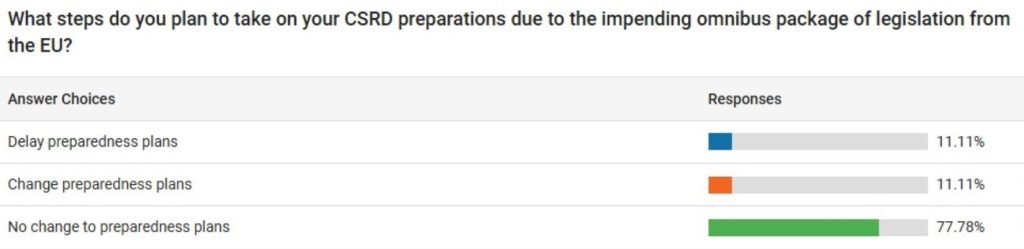
Last week’s poll results
EPP pushes deregulation amid calls to preserve EU sustainability standards
The European People’s Party (EPP) has called for ESG initiatives to return to market-driven solutions, criticising regulatory overreach for stifling innovation and harming SMEs. At a meeting in Berlin last week, the EPP argued that, while ESG principles initially gained traction through market innovation and investor demand, regulatory bodies have since imposed burdensome rules that stifle competitiveness and hurt SMEs. The EPP advocates a two-year pause on new climate and sustainability laws and proposes limiting the application of existing rules to companies with over 1,000 employees. They also demand simplified reporting requirements to cut inefficiencies, signalling a broader call for a recalibration of ESG policy away from bureaucracy. While the EPP sees deregulation as essential for fostering growth, a coalition of major corporations has warned against weakening sustainability rules. They have expressed concerns that the European Commission’s upcoming ‘omnibus’ package – intended to streamline reporting and compliance – could undermine the CSRD and CSDDD, with the potential for others to use the omnibus process as a way to re-open and renegotiate the legislation. The coalition emphasised that significant resources have already been invested by companies to comply with the new requirements and urged the Commission to uphold legal certainty and refrain from reopening settled legislation.
As the European Commission prepares updates to its sustainability regulations, the debate between those for reduced reporting burdens to foster economic growth and advocates for robust ESG standards will likely continue. Inevitably, the EU will have to strike a balance between sustainability, economic growth, and competitiveness.
New administration already disrupting environmental efforts made by President Biden
The inauguration of President Donald Trump has already severely shifted environmental initiatives enacted by the Biden administration. Since being sworn into office, President Trump has issued numerous executive orders that intend to expand drilling, remove climate related funding, including:
- An order to stop spending set by Biden’s Climate law;
- An order to open US waters, which were recently shut down through a Biden executive order, for oil drilling;
- Withdrawal of the US from the Paris Climate Accord; and,
- Federal Reserve’s exit from the Network of Central Banks and Supervisors for Greening the Financial System
These are few of many actions have been taken thus far, and more changes are expected to be made in favour of US drilling, and against ESG related initiatives. These actions embolden proponents of the anti-ESG movement globally and undermine much of the progress made over the past four years towards building the green economy in the US.
Is Davos still the place to be this January?
The inauguration of President Trump and the 54th World Economic Forum in Davos may not seem to have much in common, but both feature on CEO itineraries this year, according to the New York Times. A shift appears to be underway in corporate America, where global geopolitics and economics are now a higher priority than commitments to ESG or DEI. At this year’s World Economic Forum, while some discussions are revolving around sustainability, very few have mentioned ESG or DEI by name. Instead, topics like global trade, tariffs, the effects of Trump’s “America First” agenda have dominated proceedings. Furthermore, the growing influence of AI has also been front and centre, with debates about regulations intensifying as the industry promises to reshape the global economy. However, most CEOs of global tech companies, many of whom featured at Trump’s inauguration, are not attending Davos this year. The ongoing conflicts in the Middle East and Ukraine are high on the agenda, with state-based armed conflict being recorded as the top global risk in 2025 by the World Economic Forum.
Davos has positioned itself for years as a forum to better the world, bringing together policymakers, experts and executives in effort to address the world’s challenges. Against the backdrop of political and regulatory disruption, the WEF appears to be grappling with how to balance efforts to address critical global challenges and priorities to focus on economic growth.
European asset managers accused of tiptoeing around climate action
According to the Financial Times, European asset managers are mirroring their US counterparts by retreating from publicly showcasing climate action. It is believed that the ongoing impact of the politicisation of ESG in the US has spread to Europe, with the threat of increased litigation a likely factor. Several European asset managers have received letters from Republican states warning of legal challenges over their emphasis on ESG issues. Beyond the legal threat, and similar to their US counterparts, European asset managers are also becoming more reluctant to support climate-related shareholder resolutions. Data compiled by FTI Consulting revealed that climate-related shareholder proposals among Europe’s largest asset managers dropped from 84% in 2022 to 69% in 2024.
Moving forward, asset managers either side of the Atlantic will likely continue to integrate ESG factors into their stewardship processes, largely as part of a risk assessment framework. However, the potential constraints created by the current political environment create risks of slowing climate action around the globe. While shyness around ESG continues, there is some good news for climate action with the SBTi celebrating the milestone of more than 10,000 businesses setting science-based emission reduction targets or commitments to do so, up from 7,400 last year, highlighting the number of companies taking responsibility for their emissions and setting targets to mitigate their impacts on the environment.
ISS ESG report reveals emerging investor concerns
In its annual global outlook report, ISS ESG, the responsible investment arm of ISS STOXX, has highlighted that AI and plastic pollution are key focus areas for investors according to Environmental Finance. On plastic pollution, ISS ESG warns that the legislation could have “significant implications” for investors. Business will also need to deal with the outcome of the UN Plastics Treaty negotiations which may reshape risk profiles, underscoring the need for close monitoring of this issue. AI is another rising concern, as its popularity continues to drive a notable increase in energy consumption due to the need for increased data centre capacity. Some tech companies have already rolled back their climate commitments and are looking for alternative energies like nuclear power. However, ISS ESG cautions that these efforts may not suffice and companies using AI solutions will also need to consider their environmental impact and how that is tracked. Finally, ISS ESG refers to the increasing scrutiny of authorities on greenwashing and sustainability-related issues.
ICYMI
- EU auditors warn that cities are unlikely to meet stricter air and noise pollution targets. The EU aims for a 30% reduction in people chronically disturbed by transport noise by 2030, but auditors estimate a maximum reduction of 19%, with a worst-case increase of 3%, according to Reuters.
- The uptake of the UK’s Sustainability Improvers label by asset managers is on the rise. Initially, Standard Life was the only investor using the label, but since last Friday, BlackRock, AXA IM, and Jupiter have also joined, Responsible Investors
- The Dutch Federation of Pension Funds calls on the European Commission to better account for the unique position of pension funds in SFDR legislation, stating that the current framework does not sufficiently align with the specific needs of Dutch pension funds.
| The views expressed in this article are those of the author(s) and not necessarily the views of FTI Consulting, its management, its subsidiaries, its affiliates, or its other professionals.
©2024 FTI Consulting, Inc. All rights reserved. www.fticonsulting.com |