ESG+ Newsletter – 19 June 2025
Despite the ongoing debate on ESG and sustainability, there is continued regulatory action on mandating sustainability reporting and classifying green investments, covered in updates from California to Australia and by IFRS jurisdictional reviews. Despite these steps, we also look at changes in disclosures around green bonds, as well as steps from the SEC to eliminate ESG disclosures and raise the bar for shareholder proposals. Finally, in keeping with efforts to enhance data and reporting, we analyse the latest efforts from the TNFD.
This week’s poll
Will the IFRS sustainability and climate reporting standards eventually be used by all regulators?
- Yes
- No
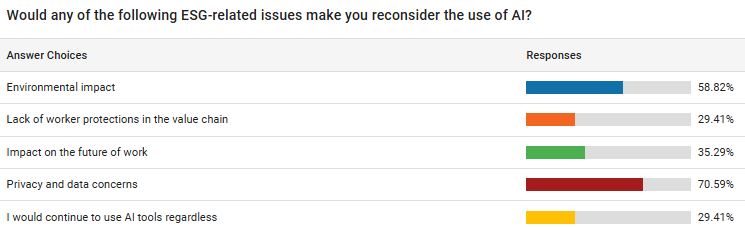
Last week’s poll results
Greenhushing: The quiet evolution of the US green bond market
The ESG investing landscape in the United States is evolving in response to regulatory developments and shifting market trends. According to the Financial Times, the US green bond market has experienced a decline in total issuances, falling by $18.9bn since the same period last year, reaching the lowest number since 2021. In response to both increased federal scrutiny and investor caution, investors have adopted a quieter strategy: greenhushing. This practice refers to the funding of ESG-related projects using traditional debt instruments, without publicizing a “green” use of proceeds. The strategy aims to avoid political backlash while still supporting critical infrastructure, especially in sectors like clean energy, where private investment is needed to meet spiking power demands induced by the data centre load in the AI era. In these cases, a “green” or “ESG” label has become optional or even risky, despite the clear need for investment, a snapshot of the ESG zeitgeist, where a shift from a labels-focused approach to an outcome-driven strategy may be developing. The challenge for companies is to continue to raise capital for critical, value generating investments, perhaps under different terms and disclosures; for investors, identifying opportunities that align with financial or sustainability objectives may become more difficult as terminology changes.
FTI Note: California shows that sustainability rules will keep coming
In September 2024, under its Climate Accountability Package, California established new greenhouse gas (“GHG”) emissions reporting requirements to provide transparency into the environmental and financial risks of climate change. Despite the SEC voting to stop defending federal climate-related disclosure rules in February (more on that below), the California law demonstrates how individual US states continue to plough ahead on sustainability rules, mirroring regulation in other global jurisdictions. While debate around how far sustainability and disclosure requirements should go continue, California’s efforts align with a broader movement toward transparency that include New York and Illinois. Although this is a state rule, due to the broad applicability criteria (i.e., doing business in California), thousands of companies will be impacted and will need to adhere to the legislation. FTI’s US ESG & Sustainability Advisory team has set out an overview of the rules and what companies can do to get ahead of reporting deadlines. Ultimately, by doing this work early and thoroughly, companies can identify and address gaps, positioning themselves for compliance with not only California’s requirements, but those around the country and the world, all while playing a key role in driving performance and enhancing risk management within their business.
IFRS details jurisdictional progress
In keeping with the theme of sustainability disclosure rules, ESG News reports on IFRS’ release of an initial set of 17 jurisdictional profiles this week, confirming that 36 jurisdictions globally are progressing toward aligning with the reporting requirements of the International Sustainability Standards Board (ISSB). The profiles provide an insight into each jurisdiction’s adoption pathway, including whether sustainability reporting requirements are finalised or under development. IFRS confirmed its plans to update the profiles as jurisdictions progress on adoption, providing companies with an understanding of how and when sustainability rules will impact them in jurisdictions where they operate.
SEC actions mark latest rollback on ESG at federal level
ESG Dive reports that the SEC has officially withdrawn two proposed rules aimed at expanding ESG-related disclosures and modifying the shareholder proposal process. These proposals, part of a broader slate of Biden-era regulatory initiatives, were listed among 14 rules rescinded by the agency in its latest agenda update. The first rule would have required investment advisers and funds labelled as ESG to provide more detailed information about their strategies in prospectuses, annual reports, and brochures, while also aiming to standardise ESG disclosures for comparisons across funds. The rule would also have required environmentally focused funds to disclose portfolio greenhouse gas emissions. The second proposal, introduced in July 2022, sought to reverse parts of a Trump-era rule that raised thresholds for shareholder proposal submissions and resubmissions. The SEC had previously looked at narrowing the grounds on which companies could exclude proposals, including clarifying standards related to duplication, substantial implementation, and resubmission. In parallel, the SEC also ceased defending its climate risk disclosure rule in court earlier this year, leaving state attorneys general to carry on the legal defence, while the Department of Labor announced plans to revise its rule permitting retirement plan fiduciaries to consider ESG factors – another rollback of climate-focused policy under the previous administration. These moves mark a collective retreat from the recent efforts to formalise ESG considerations in financial regulation, signalling a more cautious or even adversarial stance toward such policies under shifting political leadership; marking a clear dichotomy between the federal view and the efforts of certain individual states to spur greater transparency on sustainability.
Basel Committee waters down climate risk disclosure
Following a lengthy consultation process, the world’s forum for banking regulators, the Basel Committee on Banking Supervision, published updated requirements on the disclosure of climate risk, with the implementation now voluntary as opposed to requiring mandatory adoption by regulators. The Basel Committee’s framework has delegated the responsibility to national regulators to decide whether banks are required to report and respond to the impact of both physical (e.g., flooding and heat stress) and transitional (i.e. changes to climate policy) climate risk on financial returns and risk profiles. The Committee emphasised the voluntary nature of the proposal while also removing the requirement for banks to report on carbon emissions associated with their capital markets activities and trading. Reuters notes that the Basel Committee’s decision has come as global climate disclosure consensus is beginning to fracture, with Europe continuing to seek ways of addressing climate-related risks and the US – at least at a federal level – scaling back efforts to mandate climate action and disclosures.
Australia launches sustainable finance taxonomy
Australia has officially launched its first Sustainable Finance Taxonomy, which aims to mobilise private capital to achieve Australia’s net zero targets and broader climate goals. The voluntary framework is designed to classify and guide investments into green and transition-focused economic activities and forms a key part of the treasury department’s Sustainable Finance Roadmap launched in 2023. The taxonomy provides clear criteria to help investors and market participants determine how economic activities align with climate and sustainability objectives. ESG Today reports that it distinguishes between “green” activities, i.e., those that meet Paris Agreement-aligned decarbonisation scenarios or directly enable decarbonisation, and “transition” activities, which help emissions-intensive sectors move closer to a 1.5°C pathway where no immediate low-emission substitutes exist.
In its initial phase, the taxonomy covers six major emissions-intensive sectors: Agriculture and Land, Minerals, Mining and Metals, Manufacturing and Industry, Electricity Generation and Supply, Construction and Buildings, and Transport. Notably, Australia’s taxonomy is the first globally to include sectors such as minerals, mining, and metals, and it sets expectations for engagement with First Nations peoples and cultural heritage management. ASFI will pilot the taxonomy among leading financial institutions, which aims to evaluate the taxonomy across a range of use cases and inform future refinements for broader market adoption.
The launch mirrors similar taxonomy systems aimed at defining sustainable economic activities in the EU, UK, Singapore, Hong Kong, Canada, and India, indicating a level of consensus that, despite nuances in the definition of “green”, classifications systems are needed to aid companies in detailing truly sustainable activities and, simultaneously, supporting investors in providing capital to same.
TNFD new phase of work on high quality nature data
This week, the Taskforce on Nature-related Financial Disclosures (TNFD) announced the launch of a new phase of work aimed at enhancing global access to decision-useful nature data. This phase is intended to inform a set of recommendations to be presented at COP30, the UN Climate Change Conference, taking place in Belém, Brazil, in November 2025.
The new phase includes a pilot programme involving implementation partners, data providers, data users and market intermediaries. The programme will evaluate key nature-data principles and evaluate data quality across three market use cases: corporate reporting, target setting and transition planning. It will also seek to identify gaps in existing data ecosystems that require long-term investment to improve coverage, quality, and accessibility.
In parallel, TNFD – alongside the United Nations Development Programme (UNDP) with support from the German Government – is launching a global ‘Grand Challenge’ to develop technology solutions that help small and medium-sized enterprises (SMEs) assess their nature-related risks and opportunities. A shortlist of the best solutions will be unveiled at COP30. As nature-related risks gain prominence and calls for transparency increase, TNFD’s efforts should be welcomed by both corporates and investors, contributing to greater efficiency in capital markets.
ICYMI
- The Science Based Targets initiative announced the release of the Automotive Sector Net-Zero Standard, aimed at guiding automakers and auto parts manufacturers to enable science-based net zero target setting for their businesses, ESG Today reports.
- Handelsbanken’s 2025 Property Investor Report reveals 92% of large portfolio landlords think tenants are willing to pay more for greener homes, according to Sustainable Views.
- Texas lawmakers have advanced a bill requiring proxy advisers to provide detailed disclosures when their voting recommendations incorporate ESG factors, sparking warnings from investor groups and governance experts.
| The views expressed in this article are those of the author(s) and not necessarily the views of FTI Consulting, its management, its subsidiaries, its affiliates, or its other professionals.
©2025 FTI Consulting, Inc. All rights reserved. www.fticonsulting.com |