2025 End-of-Year Payer-Provider Dispute Data Update
2025 was a dynamic year for the health care industry, marked by a sharp increase in the number of payer-provider disputes. In the fourth quarter of 2025, the number of disputes exceeded that of any quarter FTI Consulting has tracked since 2022. Against the backdrop of significant federal regulatory and legislative policy changes, both payers and providers continued to adjust their operational, policy, and regulatory strategies. Notably, the final quarter of 2025 saw disputes between large national providers and payers, threatening access to care for millions of Americans nationwide.
Looking Back at 2025
The July 2025 enactment of the One Big Beautiful Bill Act (“OBBBA”), combined with the December 31, 2025, expiration of the enhanced premium tax credits under the Affordable Care Act, is estimated to result in more than 14 million people losing access to health insurance coverage by the year 2034.1 Eligibility changes and coverage losses are intensifying fiscal, operational, and administrative pressures on both payers and providers, with potentially significant implications for financial forecasts and margins.
Rising uncompensated care burdens are becoming increasingly concerning for providers, which are projected to increase by $204 billion over the next decade.2 At the same time, payers may experience coverage losses and heightened insurance churn, leading to greater instability, deteriorating risk pools as healthier members exit coverage, and increased administrative complexity.3 Compounding these challenges, states will be prohibited from establishing new provider taxes beginning in 2026, a change that is likely to create additional funding shortfalls for hospitals.4
Moreover, since President Trump took office in 2025, the health care landscape has undergone notable shifts, as his administration, the U.S. Department of Health and Human Services (“HHS”), the Centers for Medicare and Medicaid Services (“CMS”), and the Make America Healthy Again (“MAHA”) movement took shape and advanced a number of policy changes. In particular, HHS, CMS, and the MAHA movement increased scrutiny of large industry actors, including health insurers – especially those providing government-sponsored coverage (Medicare Advantage and Medicaid managed care plans) – and pharmaceutical manufacturers, heightening regulatory scrutiny, oversight, and enforcement pressure across the sector. 5
Our Research & Q4 2025 in Review
For four years, FTI Consulting’s Healthcare Strategic Communications team has tracked and reported on payer-provider disputes through publicly reported news coverage, as well as paid and earned media. Reaching agreement on key contract terms – such as reimbursement, utilization management, care coordination, disease management, quality improvement, and performance metrics – has become increasingly challenging, affecting coverage for tens of millions of individuals and families across the United States.6 Contract negotiations that result in disputes continue to draw attention from state and federal policymakers, regulators, and local government officials, with growing visibility and coverage across traditional media outlets, social media, and the public.7,8
What we found:Among all quarterly updates since FTI Consulting began tracking in 2022, Q4 2025 saw the highest number of reported disputes.
Q4 2025 Healthcare & Life Sciences Quarter in Review
- The last quarter of 2025 included the highest number of publicly reported disputes compared to the previous quarters of 2025. 76 disputes were reported in traditional media outlets, of which 23 remain unresolved.
- 55% (44 out of 76) of total disputes involved Medicare Advantage (MA) plans, 10 of which went unresolved by the end of the fourth quarter of 2025.
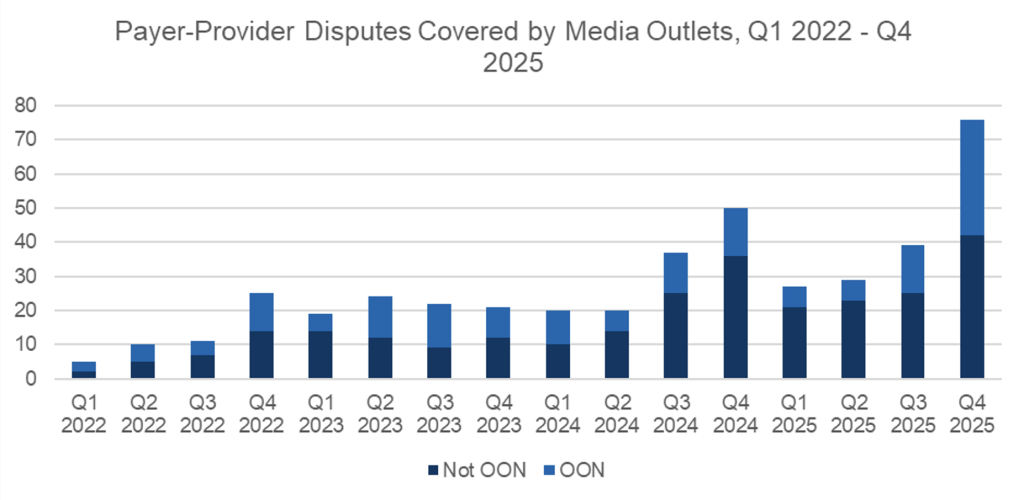
As contract negotiations and disputes continue to attract scrutiny from policymakers, the public, and the media, a growing number of national healthcare trade publications and top-tier outlets are covering payer-provider conflicts and the underlying factors driving them. For Q4, FTI Consulting’s data was featured in CBS News, US News & World Report, KFF, and Healthcare Dive. As these disputes gain visibility, individuals and families nationwide are increasingly aware of their direct impact on their healthcare access. This has prompted a rise in patient-centered media coverage, highlighting the consequences and stressors of these disputes for patients – the stakeholders most affected when payer and provider contract negotiations stall or result in a network termination.9
On the Horizon: Growing Discontent with MA
Consistent with trends observed in prior quarters, disputes between providers and MA plans continued to increase, especially within the fourth quarter of 2025. Providers have cited growing administrative and financial challenges associated with MA participation, including reimbursement rates, utilization management practices, and the operational burden created as a rising share of seniors enroll in MA plans.10,11 In response, providers are making strategic decisions that are reshaping the healthcare landscape for seniors and Medicare‑eligible individuals. An increasing number of providers have elected to exit MA entirely, selectively discontinue participation in certain MA plans, or contract with only one or two MA insurers while declining others. Becker’s Hospital Review reported that in 2025, 14 large provider networks adopted one of these approaches.12
At the same time, MA plans are facing mounting fiscal and administrative constraints of their own. CMS payment updates have, on average, lagged underlying medical cost growth, placing sustained pressure on MA plan margins.13 In response, payers are being forced to make difficult trade-offs that further strain provider relationships and member offerings. These pressures have translated into tighter provider contract terms, narrower networks, reduced supplemental benefits, and higher cost-sharing for beneficiaries.14 In a growing number of markets, these dynamics have also contributed to MA plan retrenchment, including insurers scaling back plan offerings or exiting certain geographies altogether, further reshaping coverage options available to Medicare-eligible individuals.15
Looking Ahead to 2026
Pressures are expected to persist through 2026. As legislative and regulatory scrutiny intensifies, the number of uninsured individuals rises, and cost containment becomes a higher priority for both payers and providers, we anticipate the trend of increasing payer-provider disputes will continue. FTI Consulting will continue to monitor key developments related to OBBBA implementation, ongoing debates over the enhanced premium tax credits, and the Trump administration’s broader healthcare reform agenda.
Research Methodology:
FTI Consulting searched multiple news databases for articles regarding negotiations over reimbursement rates between provider organizations and insurance companies. Those negotiations, that were publicly reported by a news outlet on or after October 1 were counted for the quarter in which they were reported. Negotiations that were resolved or failed to reach an agreement in one quarter but were first reported in another quarter were counted for the quarter in which they became public. When a provider decided to no longer accept any MA plans, FTI Consulting counted that decision as a single dispute upon notification of the decision to remove all MA plans from the respective provider network.
References
[1] Burns, Alice, et al., “How Will the 2025 Reconciliation Law Affect the Uninsured Rate in Each State?” KFF (Aug. 20, 2025). https://www.kff.org/uninsured/how-will-the-2025-reconciliation-law-affect-the-uninsured-rate-in-each-state/
[2] “One Big Beautiful Bill Act: What it means for healthcare providers,” Fierce Healthcare (Sept. 22, 2025). https://www.fiercehealthcare.com/sponsored/one-big-beautiful-bill-act-what-it-means-healthcare-providers
[3] Kim, Sally, et al., “What health plan leaders need to know about OBBBA,” (Aug. 8, 2025). https://www.advisory.com/topics/health-plan/obbba-implications-on-health-plans
[4] Supra, note 2.
[5] Hooper, Kelly, et al., “MAHA convenes in Washington,” Politico (Nov. 12, 2025). https://www.politico.com/newsletters/politico-pulse/2025/11/12/maha-convenes-in-washington-00647367
[6] Hudson, Caroline, “Provider, payer contract disputes are heating up,” Modern Healthcare (May 29, 2024). https://www.modernhealthcare.com/providers/health-plan-negotiations-inflation-claims-denials/#:~:text=Contract%20negotiations%20are%20growing%20more,from%20the%20COVID%2D19%20pandemic.&text=Providers%20are%20facing%20higher%20costs,agreeing%20on%20how%20much%20higher.%E2%80%9D
[7] Emerson, Jakob, “Payers, providers diverge on why no surprises costs are climbing,” Becker’s Payer Issues (Oct.13, 2025). https://www.beckerspayer.com/payer/payers-providers-diverge-on-why-no-surprises-costs-are-climbing/
[8] Hooper, Kelly, “’Out of network’: Disputes between insurers and hospitals leave patients uncovered,” Politico, (Oct. 15, 2025). https://subscriber.politicopro.com/article/2025/10/out-of-network-disputes-between-insurers-and-hospitals-leave-patients-uncovered-00608163
[9] Sable-Smith, Bram, “When hospitals and insurers fight, patients get caught in the middle,” NPR (Aug. 26, 2025). https://www.npr.org/sections/shots-health-news/2025/08/26/nx-s1-5515408/health-insurance-network-contract-price-legal-patients
[10] Hut, Nick, “Providers, payers both struggle with Medicare Advantage challenges,” HFMA, (May 9, 2025). https://www.hfma.org/payment-reimbursement-and-managed-care/providers-payers-both-struggle-with-medicare-advantage-challenges/
[11] Condon, Alan, “The Medicare Advantage question hospitals want answered,” Becker’s Hospital Review (Dec.4, 2025). https://www.beckershospitalreview.com/finance/the-medicare-advantage-question-hospitals-want-answered/
[12] Emerson, Jakob, “14 health systems dropping Medicare Advantage plans | 2026,” Becker’s Hospital Review (Dec. 30, 2025), 026 – Becker’s Hospital Review | Healthcare News & Analysis.
[13] Fuglesten Biniek, Jeannie, “How Medicare Pays Medicare Advantage Plans: Issues and Policy Options,” KFF (Nov. 20, 2025). https://www.kff.org/medicare/how-medicare-pays-medicare-advantage-plans-issues-and-policy-options/
[14] Brady, Michael, “Why Medicare Advantage contract negotiations are getting heated,” Healthcare Dive, (Nov. 26, 2025). https://www.healthcaredive.com/news/medicare-advantage-contract-negotiations-heated-disputes-rise/806096/
[15] Eastabrook, Diane, “Post-acute providers brace for Medicare Advantage plan exits,” Modern Healthcare, (Oct. 23, 2025). https://www.modernhealthcare.com/post-acute-care/mh-medicare-advantage-market-exits-new-hampshire-vermont/