
Just over ten years ago, we asked a deceptively simple question: how effectively were FTSE 100 companies using social media to support their financial communications.
The answer in 2014 wasn’t that no one was trying – around half the FTSE 100 posted about their results on Twitter (now X). But efforts were patchy, inconsistent and largely ineffective. Few used social media strategically to communicate performance. We called it the “Social Divide in the City” – a gap between digital potential and real business impact.
A decade on, the stakes are higher. Social media now plays a central role in a fast-moving, high-pressure environment shaped by geopolitical tensions, AI disruption, and rising expectations for transparency and leadership. What was once a nice-to-have is now business critical.
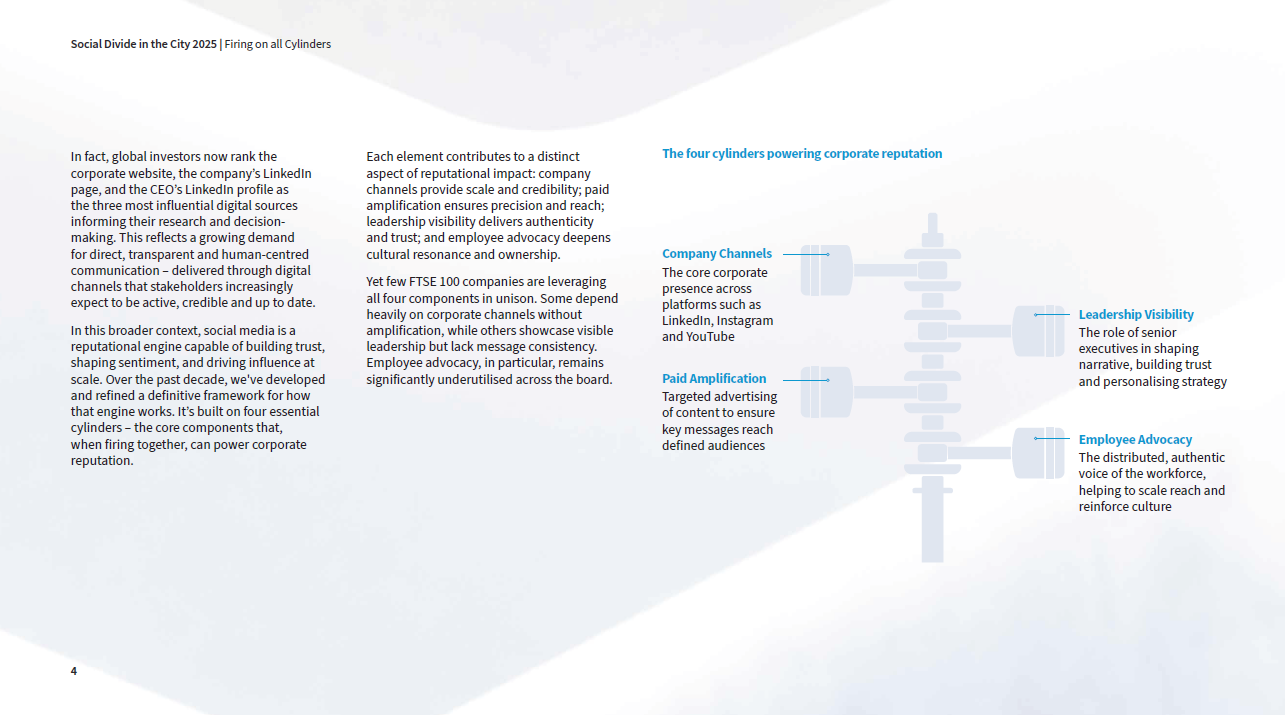
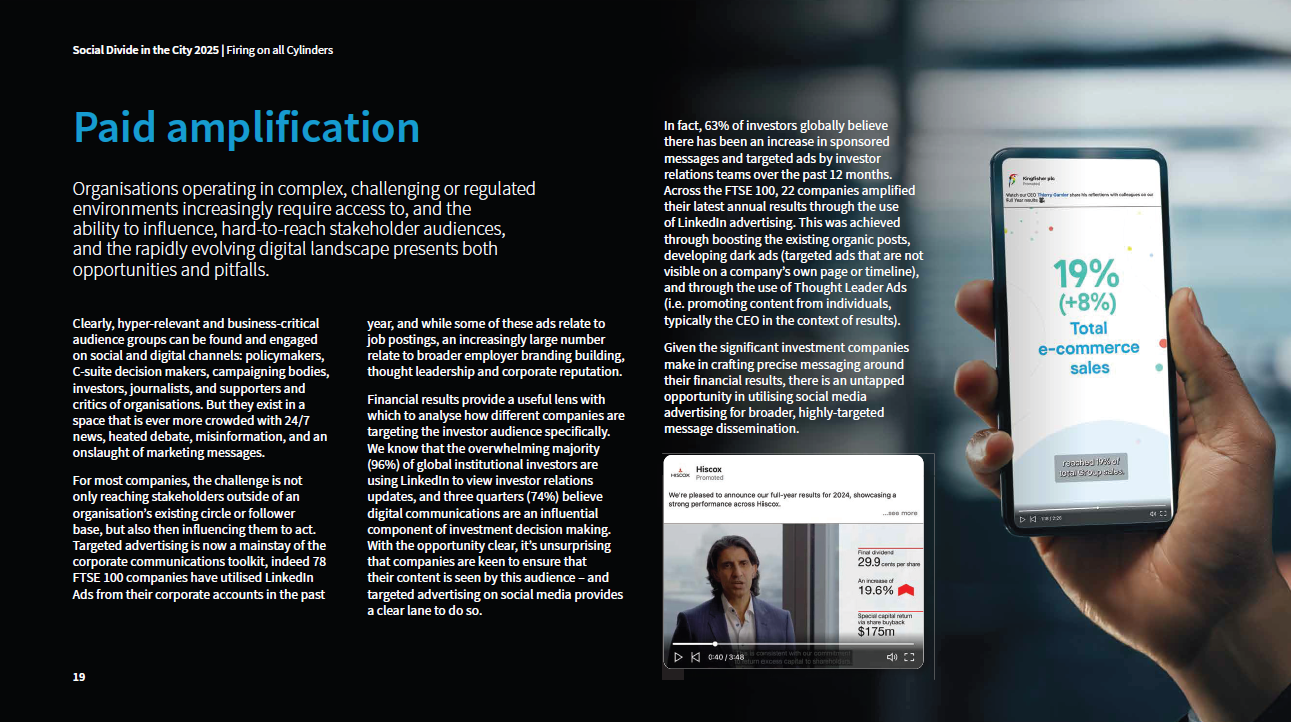
This report captures how far the FTSE 100 have come – and how far many still have to go. Using annual results season as our lens, we go beyond posts to analyse the full reputation engine: corporate accounts, executive voices, paid media, and employee advocacy.
The social divide hasn’t disappeared – it’s evolved. While some companies lead with clarity and impact, many still fall back on habit over strategy.
Here’s what good looks like – and how to get there.
Why the Reputation Engine matters

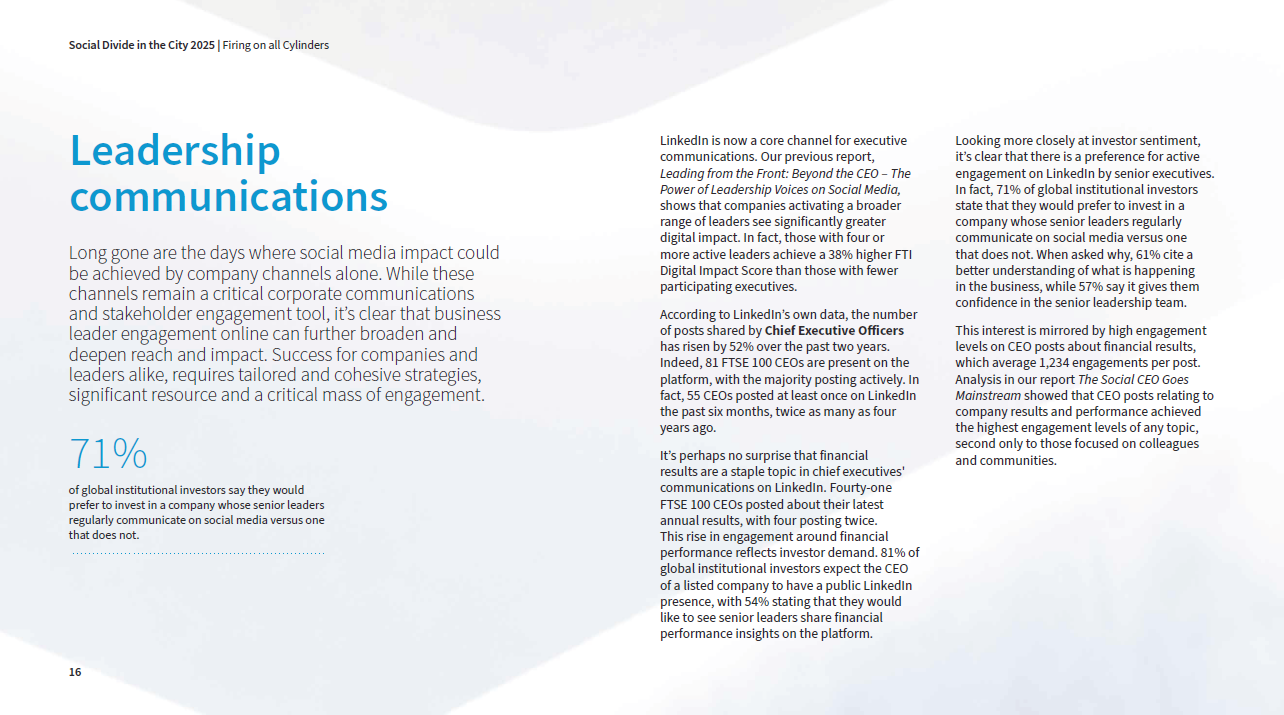


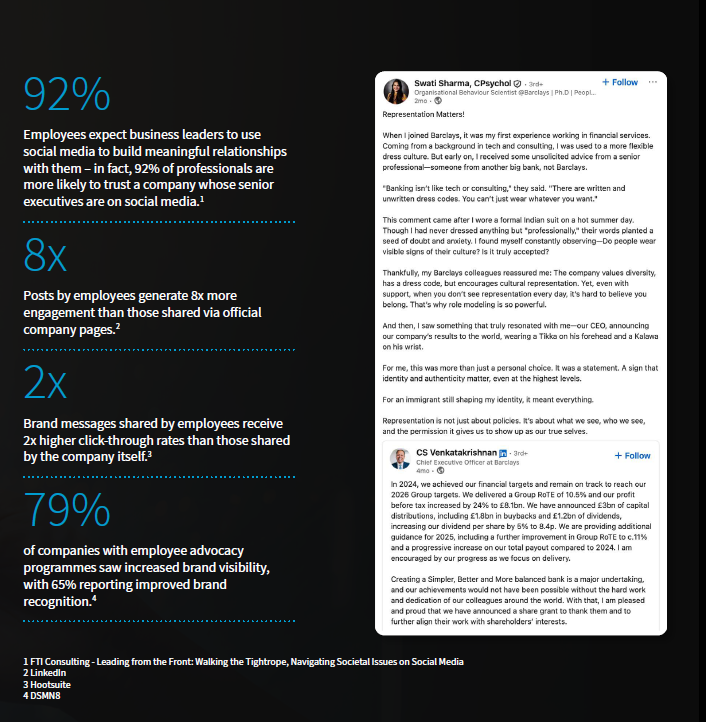
Employees sit at the heart of today’s most pressing corporate challenges, including everything from navigating polarised political discourse to managing
the fallout of layoffs, ‘woke’ backlash, and return-to-office tensions.
These issues aren’t confined to internal channels. Increasingly, employees are taking to social media to share their experiences, frustrations and pride, shaping in real-time how external stakeholders perceive a company’s culture, leadership and brand.
In this context, employee advocacy is no longer a ‘nice to have’; it is a reputational imperative.
Methodology
Analysis period
This report covers activity between 1 May 2024 and 30 April 2025, using the FTSE 100 companies as of 1 March 2025 as the target group.
Data collection
We conducted in-depth online analysis to evaluate the digital presence, engagement and impact of FTSE 100 companies and their senior executives across key social media platforms.
Investor survey
Between 21 November and 12 December 2024, FTI Consulting ran an online survey of 551 global institutional investors across the US, Europe and the Middle East. Respondents included portfolio and fund managers representing institutions with an average of $110.6 billion in assets under management, spanning private equity, mutual funds, pension and hedge funds, insurance firms, sovereign wealth funds, and endowments.
Reputation Engine Index
Our Reputation Engine Index evaluates both corporate channels and executive activity, with a weighted scoring system based on platform relevance in corporate communications.
Full methodology included in the report.
Connect with FTI
Past Leading from the Front reports
Privacy Overview
| Cookie | Duration | Description |
|---|---|---|
| cookielawinfo-checkbox-analytics | 11 months | This cookie is set by GDPR Cookie Consent plugin. The cookie is used to store the user consent for the cookies in the category "Analytics". |
| cookielawinfo-checkbox-functional | 11 months | The cookie is set by GDPR cookie consent to record the user consent for the cookies in the category "Functional". |
| cookielawinfo-checkbox-necessary | 11 months | This cookie is set by GDPR Cookie Consent plugin. The cookies is used to store the user consent for the cookies in the category "Necessary". |
| cookielawinfo-checkbox-others | 11 months | This cookie is set by GDPR Cookie Consent plugin. The cookie is used to store the user consent for the cookies in the category "Other. |
| cookielawinfo-checkbox-performance | 11 months | This cookie is set by GDPR Cookie Consent plugin. The cookie is used to store the user consent for the cookies in the category "Performance". |
| viewed_cookie_policy | 11 months | The cookie is set by the GDPR Cookie Consent plugin and is used to store whether or not user has consented to the use of cookies. It does not store any personal data. |